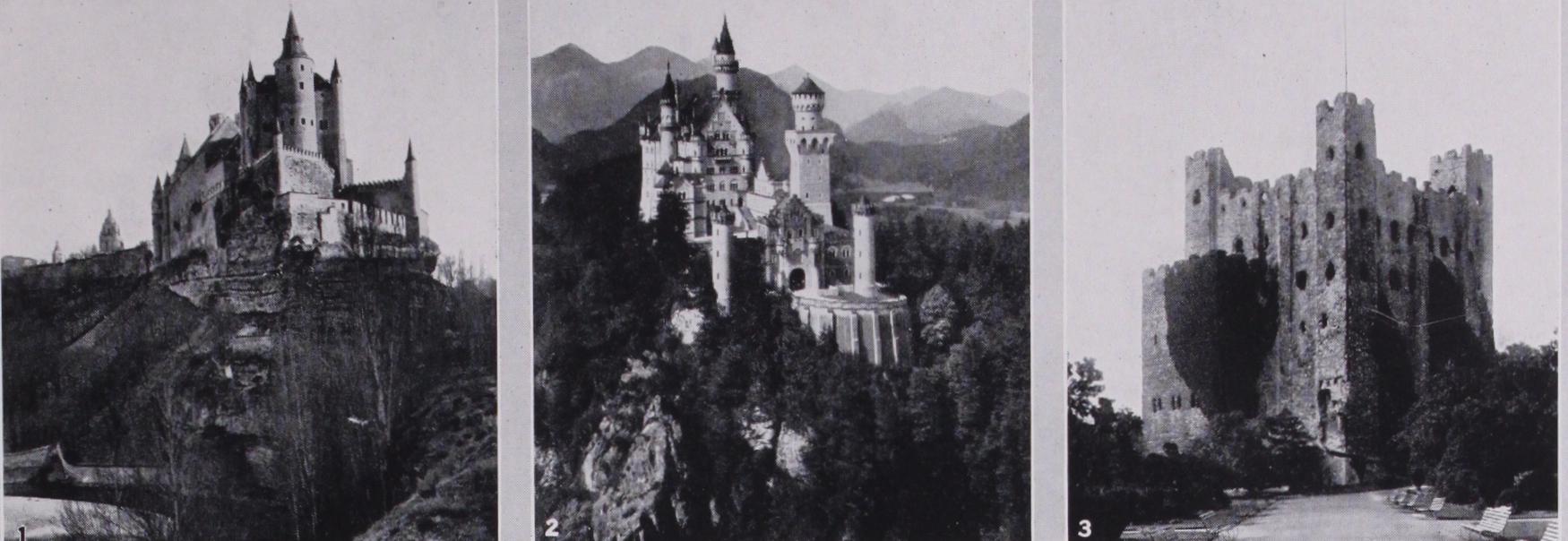
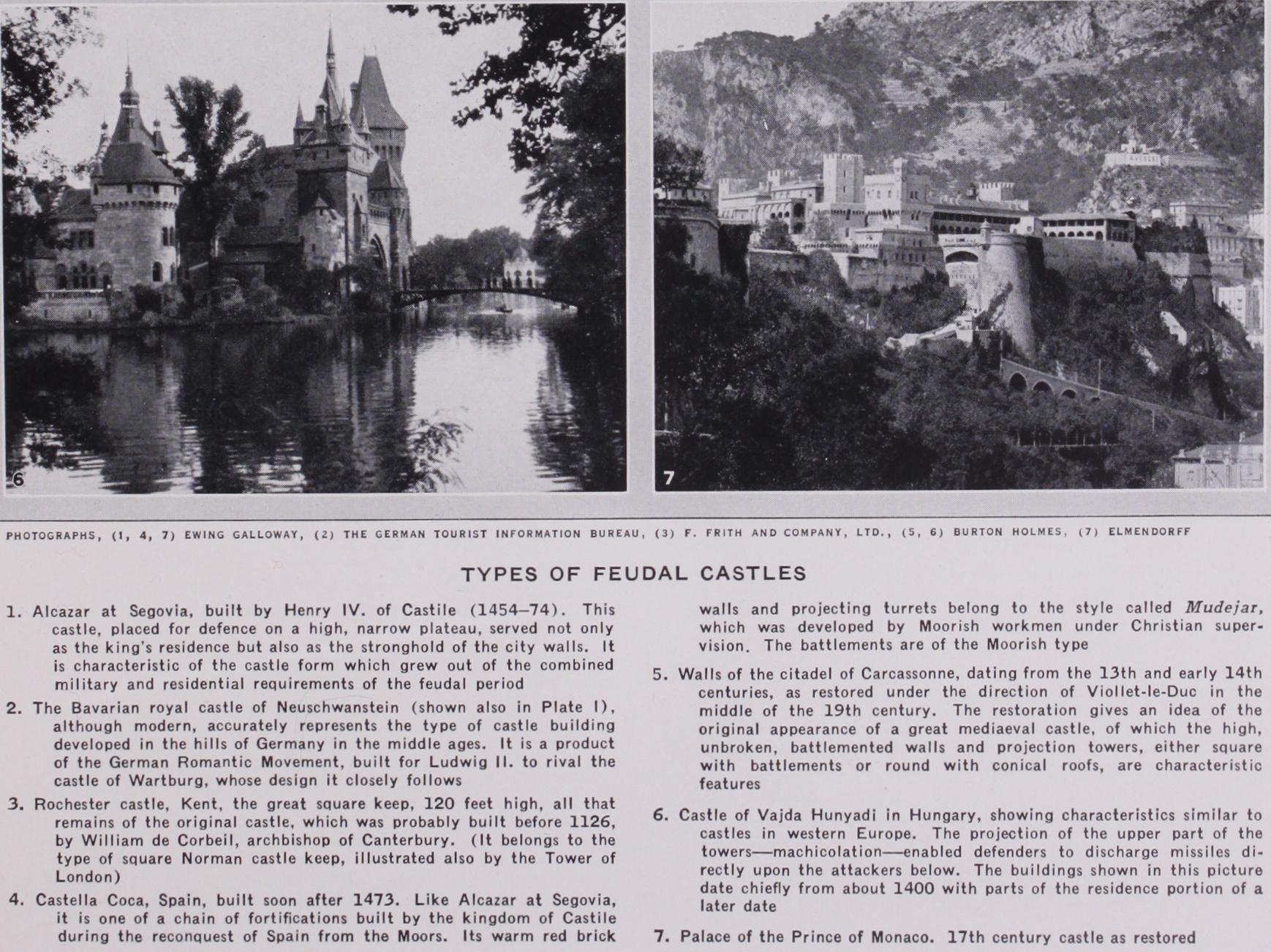
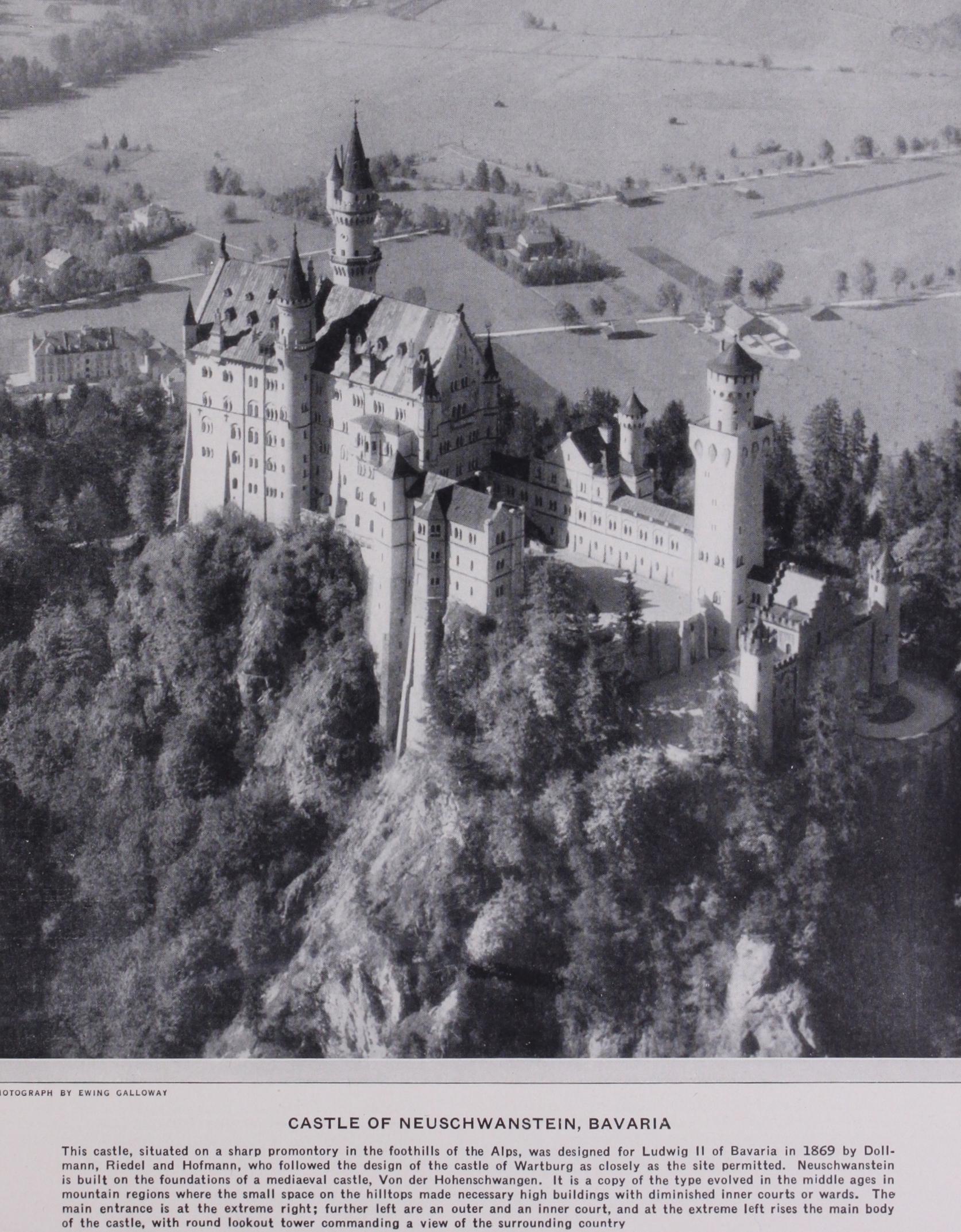
CASTLE, a small self-contained fortress, usually of the middle ages, though the term is sometimes used of prehistoric earth works (e.g., Hollingbury castle, Maiden castle), and sometimes of citadels (e.g., the castles of Badajoz and Burgos) and small de tached forts d'arret in modern times. It is also often applied to the principal mansion of a prince or nobleman, and in France (as château) to any country seat. Under its twofold aspect of a fortress and a residence, the mediaeval castle is inseparably con nected with the subjects of fortification (see FORTIFICATION AND SIEGECRAFT) and architecture. For an account of Roman and pre-Roman castella in Britain see BRITAIN.
The Normans introduced also two other types of castle, the one where they found a natural rock stronghold which only needed adaptation, as at Clifford, Ludlow, the Peak and Exeter, to produce a citadel; the other a wholly distinct type, the high rectangular tower of masonry, of which the Tower of London is the best known example. This type belongs rather to the more settled con ditions of the I 2th century when speed was not a necessity, and in the first half of which the fine extant keeps of Hedingham and Rochester were erected. These towers were originally surrounded by palisades, usually on earthen ramparts, which were replaced later by stone walls. The whole fortress thus formed was styled a castle, but sometimes more precisely "tower and castle," the for mer being the citadel, and the latter the walled enclosure, thus preserving the meaning of the Roman castellum. Reliance was placed by the engineers of that time simply on the inherent strength of the structure, the walls of which defied the battering ram, and could only be undermined at the cost of much time and labour, while the narrow apertures were constructed to exclude arrows or flaming brands.
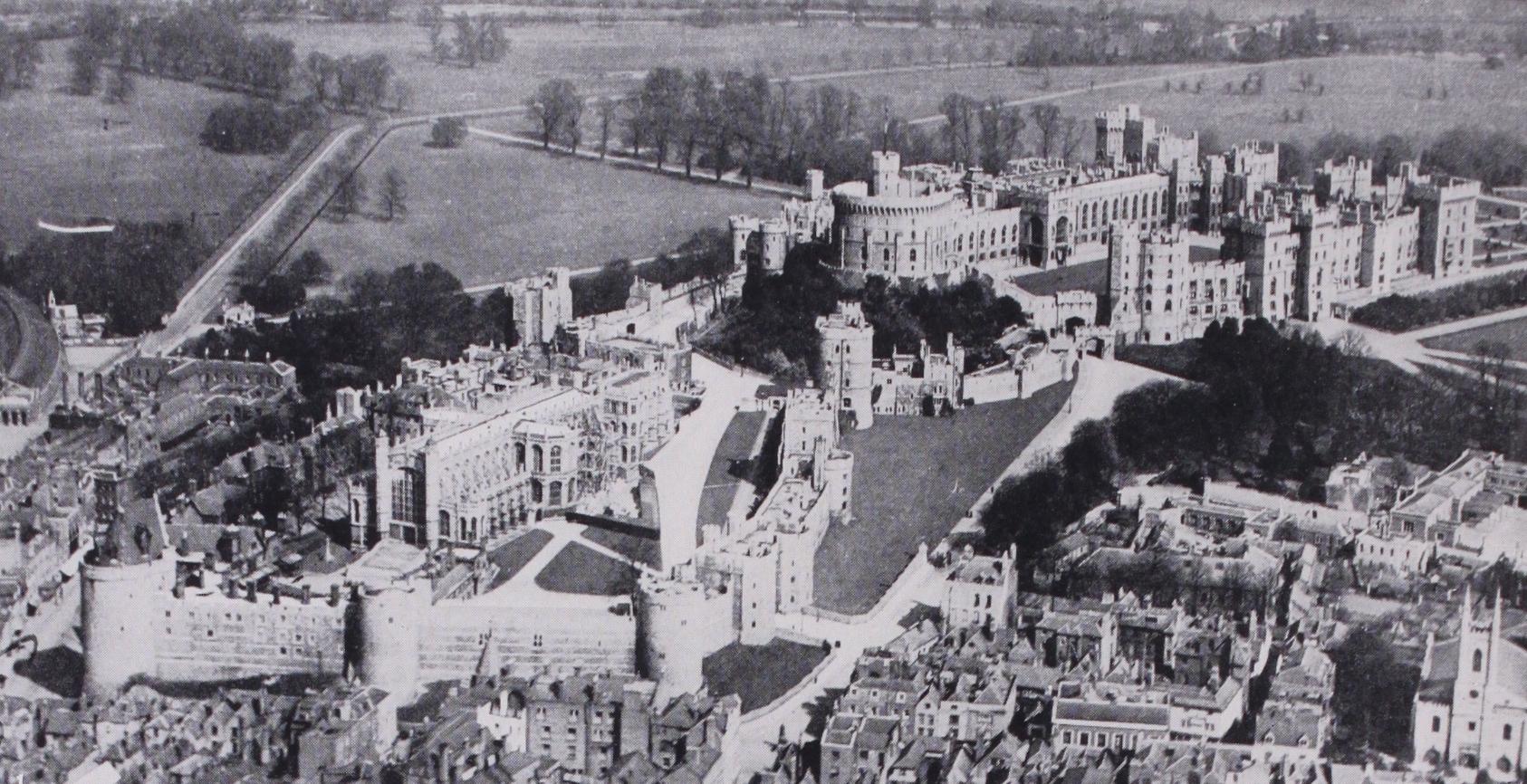
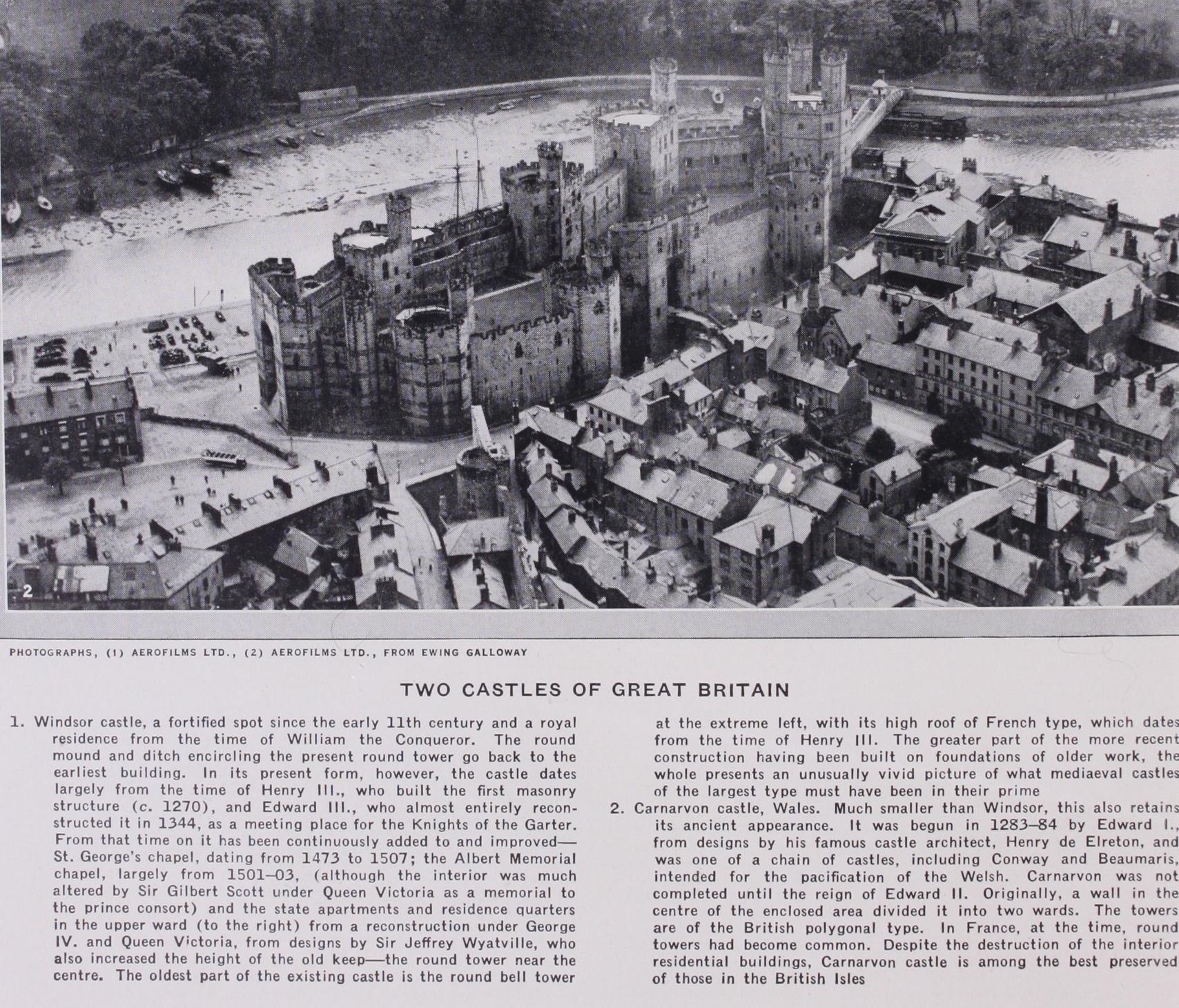
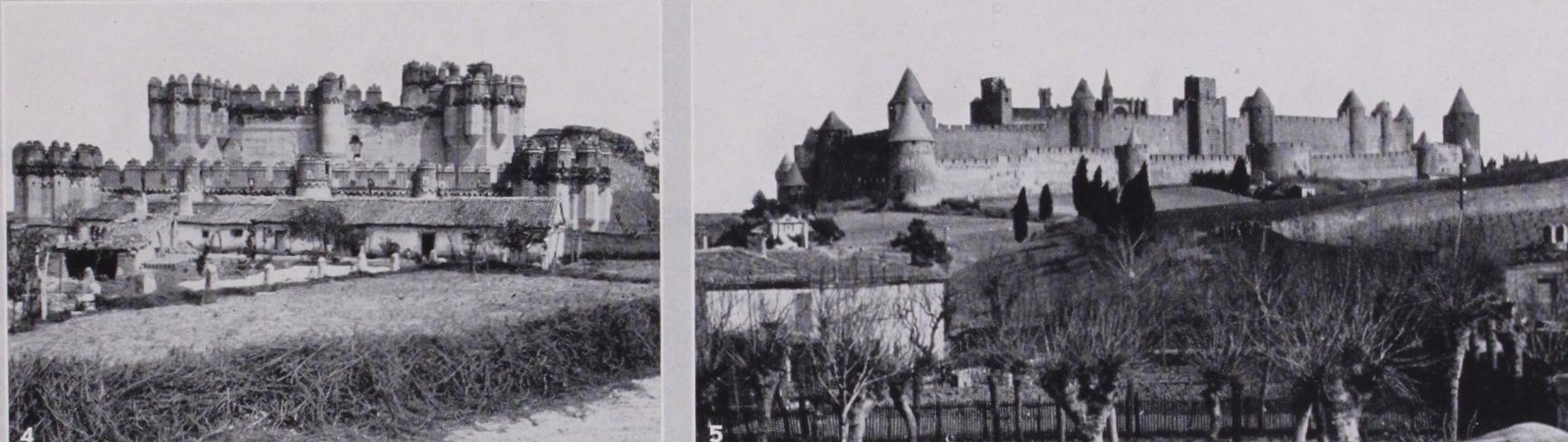
The Concentric Plan.—The next development was the exten sion of the principle of successive lines of defence to form what is called the "concentric" castle, in which each ward was placed wholly within another which enveloped it ; places thus built on a flat site (e.g., Caerphilly castle) became for the first time more formidable than strongholds perched upon hills such as Château Gaillard, where, although the more exposed parts possessed many successive lines of defence, at other points, for want of room, it was impossible to build more than one or, at most, two walls. In these cases, the fall of the inner ward by surprise, escalade or regular siege (as was sometimes feasible), entailed the fall of the whole castle. The adoption of the concentric system precluded any such mischance, and thus, even though siege-engines improved during the 13th and 14th centuries, the defence maintained itself superior to attack during the latter middle ages. Its final fall was due to the introduction of gunpowder. "In the 14th century the change begins, in the 15th it is fully developed, in the 16th the feudal fastness has become an anachronism." Decline of Baronial Fortifications.—The general adoption of cannon placed in the hands of the central power, a force which ruined the baronial fortifications. The possessors of cannon were usually private individuals of the middle classes, from whom the prince hired the materiel and the workmen. A typical case will be found in the history of Brandenburg and Prussia (Carlyle, Frederick the Great, bk. iii.; ch. i.), the castle of Friesack, held by an intractable feudal noble, Dietrich von Quitzow, being re duced in two days by the elector Frederick I. with "Heavy Peg" (Faule Grete) and other guns (Feb. 1414). In England, the earl of Warwick in 1464 reduced the strong fortress of Bamborough in a week, and in Germany, Franz von Sickingen's stronghold of Landstuhl, formerly impregnable on its heights, was ruined in one day by the artillery of Philip of Hesse (1523). Heavy artillery was used for such work, of course, and against lighter natures, some castles and even fortified country-houses managed to make a stout stand as late as the Great Rebellion in England.
The castle thus ceases to be the fortress of small and ill-govern ing local magnates, and its later history is merged in that of modern fortification. But an interesting transitional type between the mediaeval stronghold and the modern fortress is found in the coast castles erected by Henry VIII., especially those at Deal, Sandown and Walmer (c. 1540). Walmer castle is still the official residence of the lord warden of the Cinque Ports. Viollet-le-Duc, in his Annals of a Fortress (English trans.) , gives a full and inter esting account of the repeated renovations of the fortress on his imaginary site in the valley of the Doubs, the construction by Charles the Bold of artillery towers at the angles of the castle, the protection of the masonry by earthen outworks and boulevards and, in the 1 7th century, the final service of the mediaeval walls and towers as a pure enceinte de surete. Here and there we find old castles serving as forts d'arret or block-houses in mountain passes and in some few cases, as at Dover, they formed the nucleus of purely military places of arms, but normally the castle falls into ruins, becomes a peaceful mansion, or is merged in the forti fications of the town which has grown up around it. In the Annals of a Fortress the site of the feudal castle is occupied by the citadel of the walled town. The baronial "castle" assumes pari passu the form of a mansion, retaining indeed some capacity for defence, but in the end losing all military characteristics save a few which survived as ornaments. Examples of such castellated mansions are seen in Wingfield Manor, Derbyshire, and Hurstmonceaux, Sussex, created in the 15th century. Many older castles which sur vived were altered to serve as residences. (C. F. A.) Castles in English History.—Such strongholds as existed in England at the time of the Norman Conquest seem to have offered but little resistance to William the Conqueror, who, in order effec tually to guard against invasions from without as well as to awe his newly-acquired subjects, immediately began to erect castles all over the kingdom, and likewise to repair and augment the old ones. Besides, as he had parcelled out the lands of the English amongst his followers, they, to protect themselves from the resent ment of the despoiled natives, built strongholds and castles on their estates, and these were multiplied so rapidly during the troubled reign of King Stephen that the "adulterine" (i.e., un authorized) castles are said by one writer to have amounted to I,I15.
In the first instance, when the interest of the king and of his barons was identical, the former had only retained in his hands the castles in the chief towns of the shires, which were entrusted to his sheriffs or constables. But the great feudal revolts under the Conqueror and his sons showed how formidable an obstacle to the rule• of the king was the existence of such fortresses in private hands, while the people hated them from the first for the oppres sions connected with their erection and maintenance. It was, therefore, the settled policy of the Crown to strengthen the royal castles and increase their number, while jealously keeping in check those of the barons. But in the struggle between Stephen and the empress Maud for the crown, which became largely a war of sieges, the royal power was relaxed and there was an outburst of castle-building by the barons. These in many cases acted as petty sovereigns, and such was their tyranny that the native chronicler describes the castles as "filled with devils and evil men." These excesses paved the way for the pacification at the close of the reign, when it was provided that all unauthorized castles con structed during its course should be destroyed. Henry II., in spite of his power, was warned by the great revolt against him that he must still rely on castles, and the massive keeps of Newcastle and of Dover date from this period.
Under his sons the importance of the chief castles was recog nized as so great that the struggle for their control was in the forefront of every contest. When Richard made vast grants at his accession to his brother John, he was careful to reserve the pos session of certain castles, and when John rose against the king's minister, Longchamp, in 1191, the custody of castles was the chief point of dispute throughout their negotiations, and Lincoln was besieged on the king's behalf, as were Tickhill, Windsor and Marl borough subsequently, while the siege of Nottingham had to be completed by Richard himself on his arrival. To John, in turn, as king, the fall of Chateau Gaillard meant the loss of Rouen and of Normandy with it, and when he endeavoured to repudiate the newly-granted Great Charter, his first step was to prepare the royal castles against attack and make them his centres of resist ance. The barons, who had begun their revolt by besieging the castle of Northampton, now assailed that of Oxford and seized Rochester castle. The king recovered Rochester after a severe struggle and captured Tonbridge, but thenceforth there was a war of sieges between John with his mercenaries and Louis of France with his Frenchmen and the barons, which was especially notable for the great defence of Dover castle by Hubert de Burgh against Louis. On the final triumph of the royal cause, after John's death, at the battle of Lincoln, the general pacification was accompanied by a fresh issue of the Great Charter in the autumn of 1217, in which the precedent of Stephen's reign was followed and a special clause inserted that all "adulterine" castles, namely those which had been constructed or rebuilt since the breaking out of war between John and the barons, should be immediately destroyed. And special stress was laid on this in the writs addressed to the sheriffs.
Thus for two centuries after the Norman Conquest castles had proved of primary consequence in English political struggles, revolts and warfare. And, although, when the country was again torn by civil strife, their military importance was of small account, the crown's historic jealousy of private fortification was still seen in the need to obtain the king's licence to "crenellate" (i.e., em battle) the country mansion.