
CATACOMBS. Tombs hewn in solid rock were used by the Etruscans as independent family burial places, grouped together. They often rise in the hillside by tiers or are on the same level branching off into streets and alleys. Their plan is for the most part that of a house and the walls are often covered with paint ings in an archaic style in red and black. At Poggio Gaiella, near Chiusi, the ancient Clusium, is a cemetery with a sepulchral chamber containing a large hall about 2 5f t. in diameter supported by a cylindrical rock pillar. Opening out of this and other cham bers are low winding passages, just large enough for a man to creep through, and this tomb has been surmised to be that of Lars Porsena, king in his day of Etruria (see fig. 2) .
In the days of the Republic inhumation was general and the bodies of the Scipios and the Nasos were buried in still existing catacombs, the term applied by transference to subterranean ex cavations for the interment of the dead. Originally it designated the natural configuration—in hollows—of a district close to the Appian way (see ROME). In the vaults below the church of St. Sebastiano lay, according to tradition, the bodies of the Apostles St. Peter and St. Paul for seven months until removed to the basilicas which bear their names. The place became an object of pilgrimage and its name KaraKvj43as, "by the hollow," developed as a generic name for all burial places of the same kind.
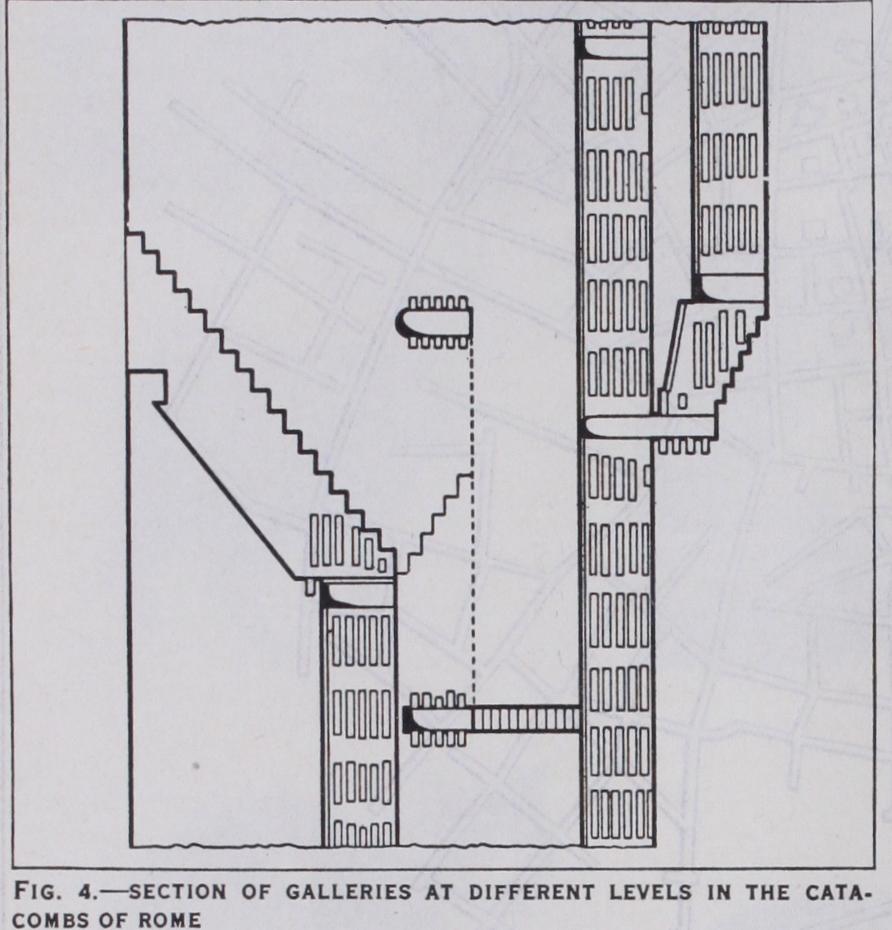
Rome is built upon a rock and the three strata named by gists tufa litoide, tufa granolare and pozzolana have all been ploited. The tufa litoide is ried as building stone. The combs of Rome—the most sive known—are constructed in this stratum alone as it enabled the engineers to form vertical walls for the galleries in which the dead were placed and to work with comparative ease. The pozzolana used as an ingredient for mortar was worked from the lowest stratum so that in spite of old erroneous persistent beliefs the burial places are distinct from the pozzolana, excavated in different strata, though here and there starting from the same level. The catacombs form a vast rinth of narrow galleries usually from 3 to Oft. wide with small chambers at intervals, excavated at successive levels (fig. I). The dead are buried in the galleries in long horizontal recesses in the walls, tier upon tier, even to 12 ranges. The galleries generally run in straight tiers, at the same level, in storeys (seven in one part of the cemetery of S. Calixtus), and intersect at various angles (see fig. 3). The graves (loculi) were usually parallel to the gallery in Christian cemeteries, but in pagan areas the recess was usually at right angles. Some loculi held four or more bodies, most held one (fig. 5). They were carefully closed by slabs of marble or huge tiles cemented together. When an epitaph was set up, it was painted or engraved on these tiles. Table tombs and arched tombs are also found.
Sarcophagi are rare. The fam ily vaults—cubicula—were small apartments, usually rectangular, sometimes circular or polygonal, opening from the main corridors and frequently ranged regularly along the sides of the galleries.
Loculi were cut for later burials in the same family area and the inscriptions and mural decora tions were frequently damaged or destroyed. The funeral feast was celebrated by the family in its vault, both on the day of burial and on the anniversary. The Eucharist, the invariable accompaniment of funerals in the early Christian Church, was celebrated here, and in some of the cata combs are larger halls and connected suites of chapels which may have been constructed for congregational worship in the days of persecution (fig. 4). Baptisteries have been discovered. The catacombs were also used as places of refuge, for which they were admirably adapted, both by the intricacy of their design and by access through secret passages to sand quarries and the open country.
Almost without exception they had their origin in small burial areas, the property of private persons, and their great develop ment was due to the spread of Christianity and the burial of the dead in this manner conformed to Roman usage. There was no reason for secrecy and since interment in rock-hewn tombs had been practised in Rome by Jewish settlers before the rise of the Christian Church, the practice may well have been popularly, per haps correctly, associated with the Jewish population which con tributed elements to the new religious order. At a later period the grave diggers seem to have acquired or to have established a kind of property in the catacombs and to make new graves reck lessly destroyed the religious paintings on the walls. The major part of the catacombs belong to the 3rd and early part of the 4th centuries. By A.D. 3S4 when St. Jerome visited them, interment in them had become rare. By the time of Pope Damasus (A.D. 366-384) they had become the resort of pilgrims. They were adapted to this by the orders of the pope. The works of art were restored. The epitaphs were renewed. In this latter work he employed an engraver named Furius Philocalus whose work can be recognized at once.
As a result the improvements described have lessened the value of the catacombs as memorials of the religious art of the 2nd and 3rd centuries. Subterranean interment ceased with the sack of Rome by Alaric in A.D. 450. The catacombs shared in the de struction of Rome by the Goths in the 6th century and by the Lombards at a later date. Pope Paul I. and Pope Pascha I. found them in such decay and pollution that the holy relics they con tained were translated elsewhere and the catacombs soon ceased to attract pilgrims. By degrees their existence was forgotten and they were discovered by chance in 1578 and have been studied, explored, investigated and described by scholars such as Baronius, Antonio Bosio (d. 1629), Marc Antonio Boldetti (c. 1720), Se roux d'Agincourt (1825) Raoul Rochette and most notably in recent times by Father Marchi of the Society of Jesus. Additions to our knowledge have been made by de Rossi and include the re discovery near the catacomb of Priscilla, on the Via Salaria Nuova, of the Cosmeterium Jordanorum, first found in 1578 but soon afterwards choked up and lost. It is possible now to identify the tombs of martyrs like Nereus and Achilleus, said to have been baptized by St. Peter, who with their mistress Petronilla, of the Aurelian family and the spiritual daughter of St. Peter, suffered death for their faith under Domitian. Many of the names of persons mentioned in the Epistles of St. Paul are found here and every fresh excavation yields similar evidence.
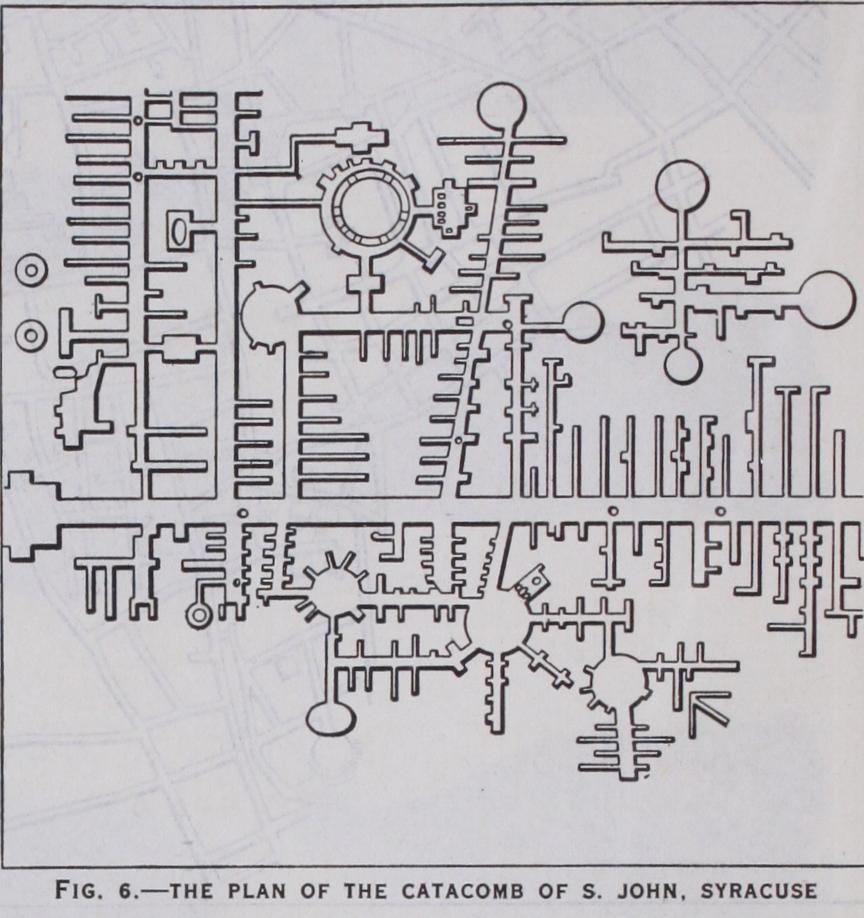
At Syracuse there are very extensive catacombs known as "the Grottos of St. John." There is an entire underground city with several storeys of larger and smaller streets, squares and cross ways cut out of the rock; at the intersection of the cross ways are great circular halls of a bottle shape, like a glass-house furnace, lighted by air shafts. The galleries are generally very narrow, furnished on each side with arched tombs, and communicating with family sepulchral-chambers closed originally by doors, the marks of the hinges and staples being still visible. The walls are in many places coated with stucco adorned with frescoes including palms, doves, labara and other Christian symbols. This cemetery differs widely in arrangement from the Roman catacombs.
The catacombs at Malta are near the ancient capital of the island. The passages were all cut in a close-grained stone, and are very narrow, with arched ceilings, running very irregularly, and ramifying in all directions. The greater part of the tombs stand on either side of the galleries in square recesses (like the table tombs of the Roman catacombs) and are rudely fashioned to imi tate sarcophagi. The interments are not nearly so numerous as in other catacombs, nor are there any vestiges of painting, sculpture or inscriptions. At Taormina in Sicily is a Saracenic catacomb, also figured by Agincourt. The main corridor is 12 ft. wide, having three or more ranges of loculi on either side, running longitudinally into the rock, each originally closed by a stone bearing an inscription.
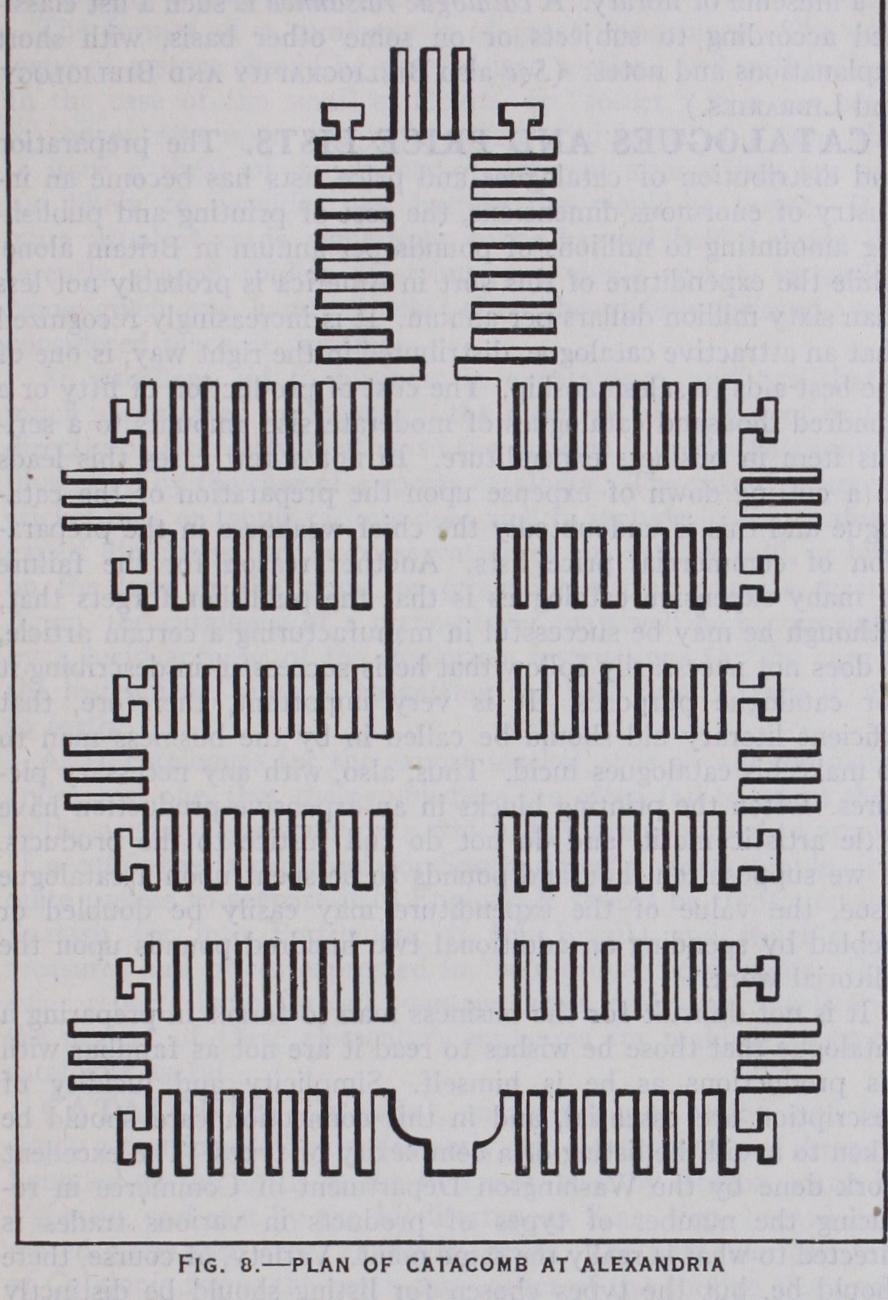
In Egypt we find a small Christian catacomb at Alexandria. The loculi here also are set endways to the passage. The walls are abundantly decorated with paintings, one of a liturgical character. But the most extensive catacombs at Alexandria are those of Egypto-Greek origin, from the largest of which, according to Strabo (lib. xvii. p. 795), the quarter where it is placed had the name of the Necropolis. The plan is remarkable for its regularity (fig. 8). Here, too, the graves run endways into the rock. There are other catacombs in the vicinity of the same city.
Subterranean cemeteries of the general character of those de scribed are very frequent in all southern and eastern countries. A vast necropolis in the environs of Saida, the ancient Sidon, con sists of a series of apartments approached by staircases.
In 1903 a new cemetery with frescoes came to light on the Via Latina, considered by Marucchi to have belonged to a heretical sect. In the same year the Jewish cemetery on the Via Portuense, was rediscovered. The subterranean basilica of SS. Felix and Adauctus, discovered by Boldetti and afterwards choked up with ruins, was cleared again : the crypt, begun by Damasus and enlarged by Siricius, contains frescoes of the 6th-7th centuries. In the same year extensive catacombs were revealed on the site of Hadrumetum near Sousse in Tunisia.
In 1907-08 interesting discoveries were made in the South East of Sicily (P. Orsi, Notizie degli Scavi, 1908). The year 1911 witnessed the discovery of the remarkable hypogeum of Trebius Justus on the Via Latina, with frescoes showing gnostic influence (Nuovo Bull. 1911 and 1912). In 1912 a catacomb was found at Grottaferrata which has since been excavated by the Basilian monks. In 1915-1916 a memoria of SS. Peter and Paul was explored beneath the basilica of S. Sebastiano, Ad catacumbas, on the Appian way. Graffiti with invocations to these apostles, dating from the fourth century were discovered (Marucchi, Nuovo Bul lettino, for 1916, 1917, 1919, 192o). In 1917 was found subter ranean basilica of the first century, perhaps the work of a pagan sodalitas (g. Bagnani, Journ. of Roman Studies, 1919, p. 78). In 1919, not far from the Porta Maggiore and the ancient Via Labicana, a Hypogeum with two frescoed chambers was dis covered. The subjects were unusual; one, Christ instructing his sheep from a book recalled a passage in the inscriptions of Abercius in the Lateran ; others were scenes from the story of Job diverging from those usual in the Catacombs ; a group of 12 figures, perhaps apostles, including two recalling the traditional types of SS. Peter and Paul (Marucchi, Nuovo Bull. 1921). The year 1921 witnessed the rediscovery near the catacomb of Priscilla on the Via Salatia Nuova, of the Coemeterium Jordanorum, first found in 1578 but soon afterwards choked up and lost (Marucchi and Josi, Nuovo Bull. 1922).