
CELLULOSE. The main ingredient of the membranous cell walls of plants, which in the more advanced stages of develop ment assume elongated shapes and become tubular and fibrous. In the plant structure cellulose is always accompanied by other substances in intimate association, as incrustants, from which it can be freed by various methods. Cellulose of high purity is easily prepared from cotton, the seed hair of gossypium, by pro longed boiling of the raw material with 1% solution of sodium hydroxide, subsequent treatment with dilute acetic acid and re peated washing with distilled water : its analysis will then be about of cellulose and 0.05% of ash. Cellulose obtained in this sort of way is regarded as standard cellulose. Chemical filter pa per is practically pure cellulose, especially when it has received an exhaustive treatment with hydrochloric and hydrofluoric acids for removal of ash, which is partly siliceous. Standard cotton cellu lose is white, fibrous and of characteristic form and appearance: other pure fibrous celluloses, e.g., bleached flax, hemp, ramie, wood-cellulose, are equally characterized in form and appearance. Commonly it absorbs 6-8% of moisture in contact with the air, which is given off again by drying at i oo-105 ° C.: it appears that it gives up water more slowly than it absorbs it. When dry, cellu lose is a good electrical insulator with specific inductive capacity about 7. The specific gravity of cellulose is about 1.58 and de pends on its source and on its state or condition (woods, contain ing 4o-8o% of air, have an apparent specific gravity about 0.3 1.3) . W. N. Hartley (1893) and S. Judd Lewis (1918-24) have shown that cellulose is strongly fluorescent to much of the ultra violet spectrum; it appears that constituent groups within the cellulose molecule affect the fluorescent properties, as indicated by distortion of the characteristic frequency curve, so that it may be possible, eventually, to use this method in the determination of questions of constitution.
The properties of cellulose depend to a considerable extent on its state or condition. Thus, whereas cotton cellulose will absorb about 7% of moisture from the air, regenerated cellulose, such as artificial silk, will absorb similarly about io% and so on ; the gen eral experience being that almost any sort of pre-treatment tends to make some portion at least of the cellulose more reactive, and this effect is not reversible.
The chemistry of cellulose has been derived, of necessity, very largely from the study of its reactions to reagents which, of course, affect the state or condition of aggregation and it is prob able that it has never been possible to reverse chemical treatment to the full extent of restoring the cellulose to the state or condi tion of aggregation in which the plant formed it originally, and upon which its qualities and properties as cellulose material de pend. When, therefore, celluloses derived from different sources by different methods behave differently, e.g., towards acids or al kalis as already recorded, it may be either that they are not one and the same sort of cellulose or that if they are the same then their state of aggregation may be not the same. X-ray analysis has given some information on this problem though much remains to be done before its conclusions can be accepted with finality. The method depends upon the diffraction of X-rays by the planes of the atoms. By ingenious arrangements the diffracted rays are registered photographically on a film as a series of parallel lines of varying intensity and characteristic pattern. The method shows that the cellulose aggregates consist of crystallites : their arrangement in crystalline form is the same for cotton, ramie and wood. The artificial silks, excepting cellulose acetate, which is amorphous—show the same sort of crystallite units. But there are differences, however, which appear to arise in respect of the ar rangement of crystallites about the fibre axis : irregular arrange ments produce photographic ring diagrams and regular arrange ments produce point diagrams. Artificial silks (excepting acetate silk) have an intermediate arrangement : cotton treated with strong solution of sodium hydroxide (mercerized cotton) and washed without tension gives a ring diagram, but if it is washed under tension, a point diagram is obtained. Thus there is some direct evidence that the crystallites are probably identical in all these different materials and that differences of property may be related to differences of crystallite arrangement, more particu larly with respect to fibre axis.
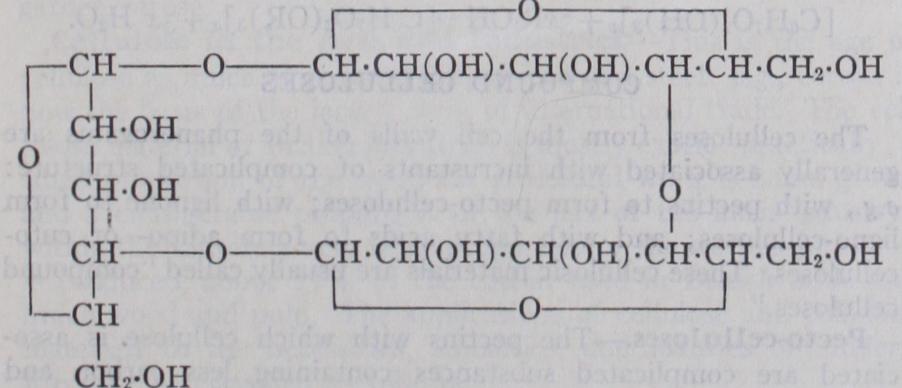
Empirical Composition.—The elementary composition of cel lulose indicates that it is a carbohydrate containing carbon 44.4%, hydrogen 6.2%, oxygen 49.4% whence the empirical formula C6H1005 is derived which is identical with that of starch: it is thus non-nitrogenous, though originating in the cell protoplasm. The cellulose from the cell walls of the lower cryptogams, when puri fied, does, however, retain 2-4% of nitrogen and, when hydro lysed, it gives glucosamine in addition to monoses and acetic acid. The cellulose of phanerogams is generally associated in the plant with other complicated substances with which it forms the so called "compound celluloses." Chemical Constitution.—Cellulose is a complex polysac charose or polyose of monosaccharoses or monoses : it may, in fact, be regarded as derived from monoses by the elimination of x molecules of water from x molecules of monose to form one molecule of polyose: thus This reaction is evidently of fundamental importance in plant physiology. Conversely, cellulose is hydrolysed by acids to give dextrose : G. W. Monier Williams (J. Chem. Soc. 119 [1921], 803-805) obtained 90-67% of the theoretical amount of crystalline dextrose. J. C. Irvine and E. L. Hirst (J. Chem. Soc. 123 518-532) showed also that cotton when methylated and hydrolysed gives a quantitative yield of 2 :3 : 6-trimethyl dextrose : they have consolidated these facts, taken together, into a formula which expresses the constitution of cellulose in terms of three dextrose residues, linked together in a ring : thus Various other formulae have been also suggested from time to time and it is still possible that no single formula will adequately represent the constitution of cellulose; but the evidence thus available appears to indicate that in the equation given above x=3.
Cellulose and Water: Hydrated Cellulose.—The interac tions of cellulose and water involve questions of great interest and these questions are still open. So-called "hydrated cellulose," in which water is intimately associated with cellulose, may be produced in a number of ways ; e.g., (a) by mechanical comminu tion and pressure of cellulose with water, and this is essentially the method used industrially in the papermaker's "beater"; (b) by the action of strong solutions of certain salts such as zinc chlo ride, calcium sulphocyanide, cuprammonium solution (Schweizer's reagent), etc., and this is essentially the method used for making vulcanized fibre, cuprammonium silk and willesden goods; (c) by the action of strong solutions of alkalies, and this is essentially the mercerizing process used in the cotton textile industries and also the first step in the making of viscose; (d) by strong solu tions of acids, and this is essentially the acid process of parch mentizing paper ; (e) by regenerating cellulose from its esters, and this is essentially the process of making artificial silks- excepting acetate silk. Hydrated cellulose is cellulose associa ted with more or less water (even up to 90% water to to% cellulose) to form a more or less swollen or gelatinous mass. The swelling of solids by imbibition of liquids and their dispersion in the liquids is quite a well known and common phenomenon : thus gelatine and starch will swell and, on warming, disperse in water : gelatine swells greatly, starch hardly at all, both disperse readily. On the other hand, cellulose neither swells nor disperses in pure water though it "hydrates" when it is subjected to continuous mechanical comminution and pressure, as it is in the "beater"; but in the various other circumstances detailed above it does show effects very similar to ordinary swelling and dispersion. The ques tions then arise, What is this "hydration" and is it analogous to swelling (imbibition) and dispersion as known in other substances such as those named? J. R. Katz (Physik. Zeit [1924] 25, 321) has examined the phenomena concerned by X-ray analysis and the diagrams he obtained, being in general the same for hydrated cellulose as for cellulose itself, appear to indicate that the water taken up is inter-crystallite rather than intra-molecular; the process would then be imbibition. It was also found, however, that when strong sodium hydrate solution is the hydrating agent a different X-ray diagram is obtained for the hydrated, alkali-cellu lose produced and when the sodium hydrate is removed, by wash ing, the diagram for cellulose is obtained anew : this appears to indicate that the action in this instance is rather different, and re versible. The balance of evidence favours the interpretation that the hydration of cellulose is, for the present, to be regarded as a physical association of water with the crystallites of cellulose and not as an entry of water into the molecules. In cellulose hydrate, therefore, the water is not to be considered as held like the water in salt hydrates, called water of crystallization, though the nomen clature is the same. A definite salt hydrate such as Barium Chlorate, when dehydrated at constant tempera ture, will give up all its water at a definite and constant pressure equal to its vapour pressure at that temperature. Hydrated cellu lose, on the other hand, when dehydrated, gives up its water at pressures falling gradually and continuously and without sign of constancy at any stage : this is characteristic of all systems in which water is held physically, i.e., under inter-molecular rather than intra-molecular forces. At the same time it is also true that a certain relatively small proportion of the water might also be present bound within the molecules without its presence being discoverable in the presence of so large an excess of the physically held water, which would probably mask its presence. It cannot be said with absolute certainty, therefore, that the possibility of a definite hydrate of cellulose is altogether excluded. The hydration of cellulose is a factor of great importance in the economy of the plant, in determining the conditions of equilibrium between the water content of the cell wall and the sap. It is also no doubt a factor of great importance in the seasoning of timber.