
CEREALS IN DIET Wheat is the most important cereal and supplies the best flour for bread and pastry-making; it also furnishes semolina (see FLOUR; BREAD; PASTRY; SEMOLINA). Rye though widely used in Russia, Germany and France for bread-making (pumpernickel) is less suitable for flour (see RYE). It is, however, widely used in this form in Germany, Russia and the United States.
Oats, barley, rice and maize are prepared as meal (see POR RIDGE) ; or, the grain is hulled (pearl barley) and sometimes polished (rice) ; or, it may be "rolled," i.e., flattened by applied heat in order to facilitate the cooking process. Corn-flour or corn starch and blancmange powders are specially manufactured from very finely ground maize. Buckwheat furnishes a flour which is much used for making griddle cakes. Some other farinaceous foods are sago, tapioca and arrowroot used as thickening for soups and for puddings, etc., although they are prepared from the roots of tropical plants and are from a very different family. Potatoes, chestnuts and bananas are also prepared in meal form.
Baked puddings composed of cereals or other farinaceous foods and milk require slow cooking because milk evaporates. Where skim milk is used, fat should be added, also in the case of foods deficient in fat, e.g., sago, tapioca, rice. Allow 2 oz. of starchy food or grain to each pint of milk. Do not break the skin which forms on milk puddings as this retains the steam and prevents loss by evaporation. For plain blancmanges allow r i oz. of starchy food to a pint of milk; where water is used, as in cereal jellies, more starchy food is needed. Stir until the mixture thickens. For thickening sauces use I teaspoonful of starch to z pint of liquid.
Cereal foods may be combined with eggs, cheese, preserves, vegetables, meat and fish. Various dishes are made with "mushes" i.e., meals previously cooked and flavoured, bound with eggs or other liaison and fried in the form of cutlets or cakes.
Sago Mould.—Boil i z pints of water with 2 teaspoonfuls of damson cheese and i 2 oz. of castor sugar. When boiling sprinkle in 3 oz. of seed sago. Stir until the sago is clear. Set in a wet mould. Turn out when cold and serve with whipped cream.
Bake on a floured griddle until stiff and slightly coloured. Dry off before the fire. Store in a tin and when required toast gently. Eat with butter. (J. A. Si.) In the United States.—The general composition of the cereal grains is much the same. If the whole grains are used there need be little concern as to which are chosen from the nutritive angle, as most of the mineral and vitamin content of the cereal grains is found in the outer coating. When cereals are refined this content is largely lost unless it is salvaged through the consumption of bran. While this mineral content should not be underestimated the most important function of cereals is to furnish the body at a low cost with heat and energy. They form an inexpensive, easily digested foundation upon which to build health with other more expensive foods to supply flavour and other nutritive essen tials beside calories. When a diet must be limited in cost the whole grain should be particularly sought. In a varied diet which contains plenty of milk, fruits, vegetables and eggs it probably makes little difference whether one eats white bread, whole wheat or whole or refined breakfast cereals. The general composition of cereal grains is: water, io to 12%; proteins, io to 12%; carbohydrates, 65 to 75%; mineral matter, 2%; fat, 0.5% to 8%. Cereals contain a valuable amount of protein although they are not usually classed among the protein foods.
Rice has the greatest consumption of any of the cereals although it has its largest use in the Orient. Wheat has the widest use of any cereal in the Western world. Barley, rye, oats and buckwheat are used in quantity. All of these cereals are made into some sort of flour and all of them except buckwheat are made into porridge, or into the modern "toasted," ready-to-eat breakfast foods. Of the cereal grains corn is the only one that is used in its fresh form as a vegetable. All cereals need to be cooked thor oughly to soften the fibre and to make them palatable. Many of the porridge cereals such as oatmeal are now steam-cooked in the factories and therefore need but a short cooking in the kitchen.
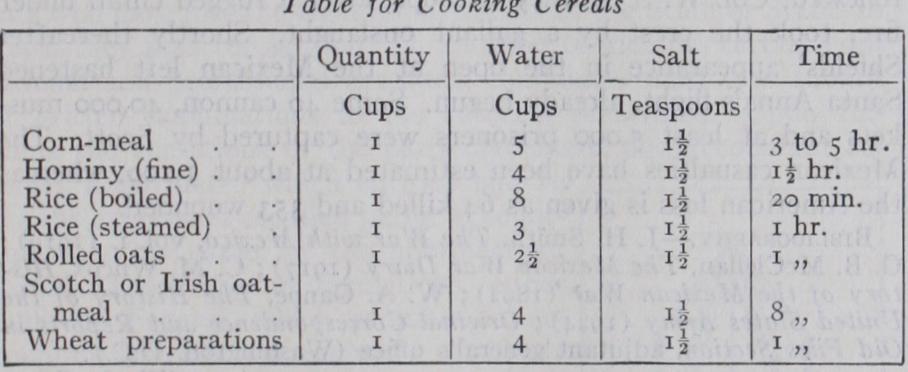
When starches such as flour, corn-starch or arrowroot are used for thickening purposes the starch grains must be thoroughly mixed with a small amount of cold liquid or hot fat before being mixed with the other ingredients for sauces or puddings. White sauce (q.v.) is one example of the hot fat method, corn-starch pudding is an example of the cold liquid method.
Mix the cornstarch, salt and sugar with enough cold milk to make a smooth paste. Scald the rest of the milk in a double boiler, and when it is hot stir in the corn-starch mixture. Stir until smooth and thick. Cover and cook 3o min. in double boiler. Remove from the fire, add the beaten eggs, and the vanilla. Pour into a mold and chill. When set turn out on a large plate, garnish with cherries and candied orange or grapefruit peel and serve with a chocolate sauce or whipped cream.
A chocolate pudding may be prepared by adding before the eggs, two squares of chocolate cooked until smooth with a cup of cold water. The eggs may be omitted. A fruit pudding may be prepared by using I cup of cut dates, raisins, prunes or mixed fruit. A caramel pudding may be prepared by using a cup of brown sugar, instead of granulated sugar. One cup of dried fruit may be added.
Wash the rice, mix it with the other ingredients and pour the mixture into a buttered pudding dish. Bake for two hours in a slow oven F) stirring it three times during the first hour to prevent sticking. Raisins or cut dates may be added or a cup of strong coffee diminishing amount of milk. Serve either very hot or very cold with whipped cream, hard sauce, fruits with syrup or caramel sauce.
Pour milk slowly on meal, cook in double boiler twenty minutes, add molasses, salt, nutmeg and ginger. Pour into buttered pudding dish and bake two hours in slow oven F). Serve with cream or with a fruit sauce. (E. M. B.)