
CHAIN STORE. A chain store (known in Great Britain as "multiple shop") is a retail store that is one unit of an organized group of retail stores handling essentially the same type of mer chandise, operating under a common ownership or ultimate capi tal control and under a central management that generally deter mines uniform methods of operation. Broadly speaking, any such ownership or operation of more than one retail store constitutes a chain store system. However, the Bureau of the Census classi fies as chain store systems only those retail organizations that consist of four or more retail units. The Federal Trade Commis sion, in its Chain Store Inquiry, 1932, defined a chain store sys tem as "an organization owning a controlling interest in two or more establishments which sell substantially similar merchandise at retail." The latter definition is followed by those States that have enacted chain store tax laws in that two units rather than four is the point of departure for such taxes. To date, no legal question with respect to the authority of the States on this point has been seriously raised.
The original purpose of chain store organization was to combine to a large extent the advantages of large and small scale retailing. A chain store system consolidates the ownership and management of many retail units within the same general line of merchandise but with decentralized locations. On the one hand, the chain store enjoys the economies of quantity purchasing, of advan tageous discounts and allowances, of departmentalization, of skil ful management, and of standard operating methods. On the other hand, it usually reaches out to the very door of the ultimate consumer and provides convenient availability of purchase in neighbourhood locations.
The first of the important existing chain store systems appears to have been The Great American Tea Company (now the Great Atlantic and Pacific Tea Company), founded by Gilman and Hartford in 1858 on a one-store basis, and which included three stores by the end of 1859 and 25 by 1865. The Jones Brothers Tea Company (now the Grand Union Company) was established in 1872; the F. W. Woolworth Company in 1879; the James Butler grocery chain in 1882; the J. G. McCrory chain in 1882, and S. S. Kresge chain in 1885. The United Cigar Stores Company came into existence in 1901; the J. C. Penney Company in 19o2; the W. T. Grant Company in 1906, and the Louis K. Liggett chain in 1907.
Since 1919, the chain store idea in the United States has ex panded with amazing rapidity and into many different fields.
The position of the chains in the United States can be seen from the following figures which are taken from census reports on retail distribution but which represent the Census Bureau's definition of a chain as consisting of four or more retail units.
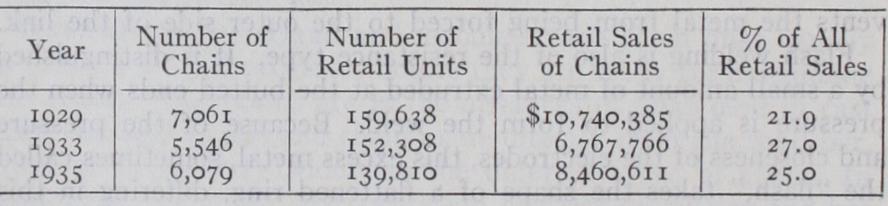
The increase in the chain store's share of the nation's total re tail trade from 1929 to 1933 and the decrease in the chain store's share of the total from 1933 to 1935 is explained by the fact that the chains are most important and prefer to operate in staple fields. Five chain store fields, grocery chains, department store chains, variety store chains, filling station chains, and drug store chains, account for about 6o% of all the chain business. In a sharp depression, the dollar volume in such necessities as gro ceries (36% of all chain sales in 1933 were in the grocery trade) and other staple lines does not decline so rapidly as does the total retail business. In a recovery period the increase in chain store dollar volume (about 33% of all chain store sales in were in groceries) is likely to be smaller than the increase in total retail business.
The fundamental merchandising policies of the typical chain store are : (i ) a limitation of stocks handled to rapidly moving articles for which there is an established demand, (2) the pur chase of merchandise on a quantity basis, (3) buying merchandise in the main direct from producers or manufacturers, (4) the elimination or limitation of such services as credit and delivery, (5) the use of frequently changed sales leaders, (6) price-tagging all merchandise plainly, and (7) featuring the price appeal in advertising.
The corporate chain store in the United States now faces a num ber of restrictive influences to which it must adjust its operating policies. Among these is the growing competition of : ( ) the "voluntary chains" (groups of individual retailers—each of whom owns his own store—either associated with wholesalers or acting co-operatively, and organized to carry on joint merchandising ac tivities), and (2) the severe price competition, particularly in the food field, of independent "super-markets." There is, in addition, a growing amount of restrictive State and Federal legislation that results in higher tax and wage costs and in fewer special discounts for the chain. Many State legislatures and municipal governments have imposed special and graduated taxes upon the chain. A Federal "death sentence" chain store tax measure has been proposed and vigorously espoused by Repre sentative Wright Patman and his supporters. The enforcement of the Robinson-Patman Act and its prohibitions on the division of "brokerage" and on "unfair" discounts and allowances has op erated to spread out large-scale buying advantages more evenly among corporate chains and independents. The enactment of the Miller-Tydings resale price maintenance enabling amendment to the Sherman Anti-Trust Act has influenced many manufacturers to take advantage of the several State permissive fair trade acts to establish minimum resale prices.
Especially in the food field, the corporate chain store is at tempting to meet these restrictive influences, in part, by limiting the number of new store locations established in neighbourhood locations, by weeding out unprofitable neighbourhood units, and by setting up self-service or semi-self-service "super-markets." In spite of the rapid push of the chain into the "super-market" field, the consumer's demand for "convenient availability" still exists. The independent neighbourhood store, in many instances, has sharply increased its volume when chain neighbourhood stores have been closed. (G. R. C.) Great Britain.—The multiple shop system came into existence at the end of the i9th century, probably influenced by the "tied house" system of the brewers, and has had wide developments. Among the retail trades now organized in this way are chemists and druggists, oil and colour men, drapers, boot and shoe shops, clothiers, tea shops and cafés, milk retailers, grocers and furni ture dealers, while in recent years there has been a large increase among the "variety" chain stores—typified by Messrs. Woolworth's —which sell a wide range of goods either at a single price or at a price not above a definite, and low, limit.
Population movements and the creation of new housing estates have contributed to the expansion of the multiple shop system of trading, which also owes something to the incursion into this field of certain Football Pool organizations. Its growth has meant the elimination or suppression of a proportion of small trading units. A shop-keeper stands for independency ; he is his own master and a definite social unit in civic life, and his replacement by a com pany-appointed manager amounts to a change of some importance from a social point of view. The manager may or may not be a local man; he may or may not be identified with the life of the town in which he draws his salary, and the profit made by the shop he manages leaves the society in which it is made and is dis tributed to absentee shareholders. The aggregate effect of these social and economic changes it is impossible to determine with accuracy, but it must be considerable.
Chain stores in Great Britain are covered by the Shops Acts, and in 1938 agreements were concluded between the proprietors' associations regulating the grocery and footwear multiple firms and the Shop Assistants' Union with reference to minimum wages and conditions of labour.
In 1937 an unsuccessful attempt had been made to introduce a Bill limiting all such organizations to six branches, with other restrictions.