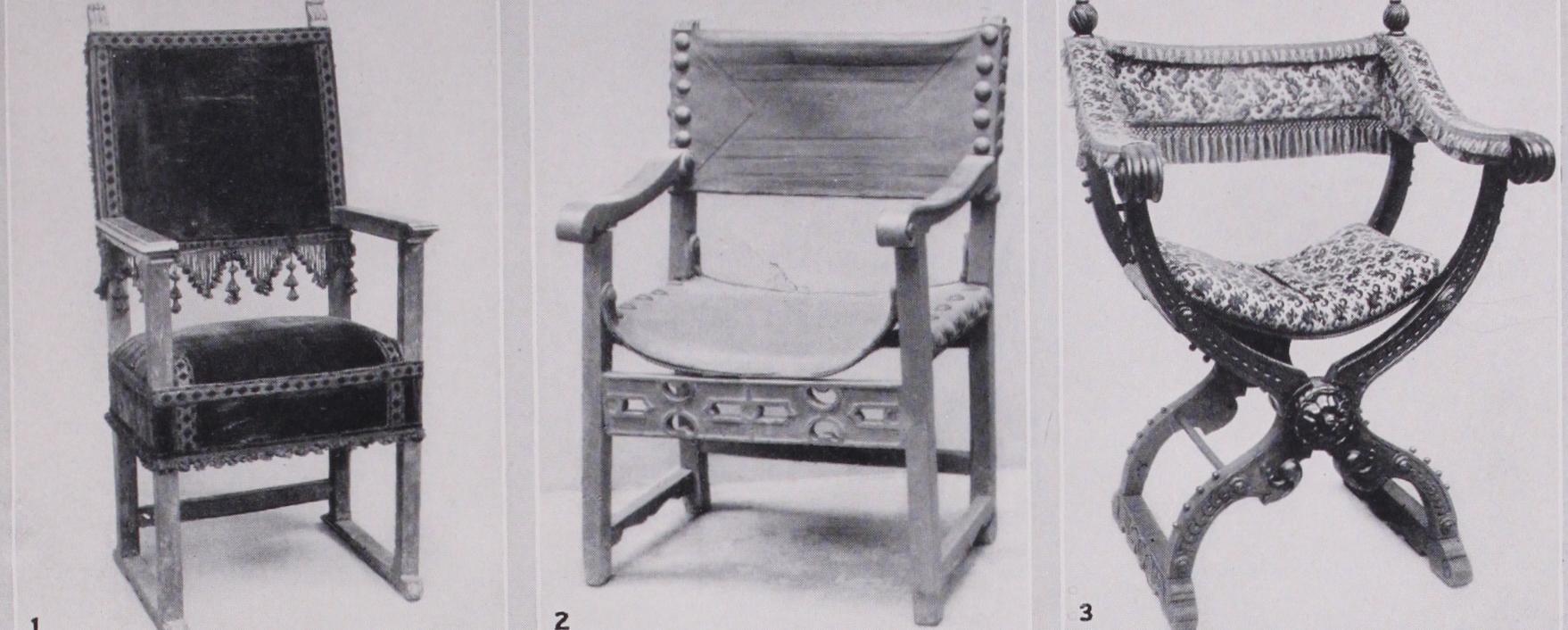
CHAIR, a movable seat, usually with four legs and for a single person, the most varied and familiar article of domestic furniture. (In Mid. Eng. cliaere, through O.Fr. chaere or cliaiere, from Lat. cathedra, later caledra, Gr. rca9S3pa seat, cf. "cathe dral" ; the modern Fr. form chaise, a chair, has been adopted in English with a particular meaning as a form of carriage ; chaise in French is still used of a professorial or ecclesiastical "chair," or cathedra.) The chair is of extreme antiquity, although for many centuries and indeed for thousands of years it was an ap panage of state and dignity rather than an article of ordinary use. "The chair" is still extensively used as an emblem of author ity. It was not until the i6th century that it became common anywhere. The chest, the bench and the stool were until then the ordinary seats of everyday life, and the number of chairs which have survived from an earlier date is exceedingly limited; most of such examples are of ecclesiastical or seigneurial origin.
The most famous of the very few chairs which have come down from a remote antiquity is the reputed chair of St. Peter in St. Peter's at Rome. The wooden portions are much decayed, but it would appear to be Byzantine work of the 6th century, and to be really an ancient sedia gesta toria. It has ivory carvings rep resenting the labours of Hercules. A few pieces of an earlier oaken chair have been let in ; the exist ing one, Gregorovius says, is of acacia wood. The legend that this was the curule chair of the sena tor Pudens is necessarily apoc ryphal. It is not, as is popularly supposed, enclosed in Bernini's bronze chair, but is kept under triple lock and exhibited only once in a century.
Byzantium, like Greece and Rome, affected the curule form of chair, and in addition to lions' heads and winged figures of Victory and dolphin-shaped arms used also the lyre-back which has been made familiar by the pseudo-classical revival of the end of the 18th tury. The chair of Maximian in the cathedral of Ravenna is believed to date from the middle of the 6th century. It is of marble, round, with a high back, and is carved in high relief with figures of saints and scenes from the Gospels—the Annunciation, the Adoration of the Magi, the flight into Egypt, and the baptism of Christ. The smaller spaces are filled with carvings of animals, birds, flowers and foliated ornament. Another very ancient seat is the so-called "Chair of Dagobert" in the Louvre. It is of cast bronze, sharpened with the chisel and partially gilt ; it is of the curule or faldstool type and supported upon legs terminating in the heads and feet of animals. The seat, which was probably of leather, has disappeared. Its attribution depends entirely upon the statement of Suger, abbot of St. Denis in the 12th century, who added a back and arms. Its age has been much discussed, but Viollet-le-Duc dated it to early Merovingian times.
To the same generic type be longs the famous abbots' chair of Glastonbury ; such chairs might readily be taken to pieces when their owners travelled. The f ald isterniuna in time acquired arms and a back, while retaining its folding shape. The most famous, as well as the most ancient, Eng lish chair is that made at the end of the 13th century for Edward I., in which most subsequent monarchs have been crowned. It is of an architectural type and of oak, and was covered with gilded gesso which long since disappeared.
This was especially the case down to the end of the Tudor period, after which France began to set her mark upon the British chair. The squat variety, with heavy and sombre back, carved like a piece of panelling, gave place to a taller, more slender, and more elegant form, in which the framework only was carved, and attempts were made at ornament in new directions. The stretcher especially offered opportunities which were not lost upon the cabinet-makers of the Restoration. From a mere uncompromising cross-bar intended to strengthen the construction, it blossomed into an elaborate scroll-work or an exceedingly graceful semi circular ornament connecting all four legs, with a vase-shaped knob in the centre. The arms and legs of chairs of this period were scrolled, the splats of the back often showing a rich arrange ment of spirals and scrolls. This most decorative of all types appears to have been popularized in England by the cavaliers who had been in exile with Charles II. and had become familiar with it in the north-western parts of the European Continent.
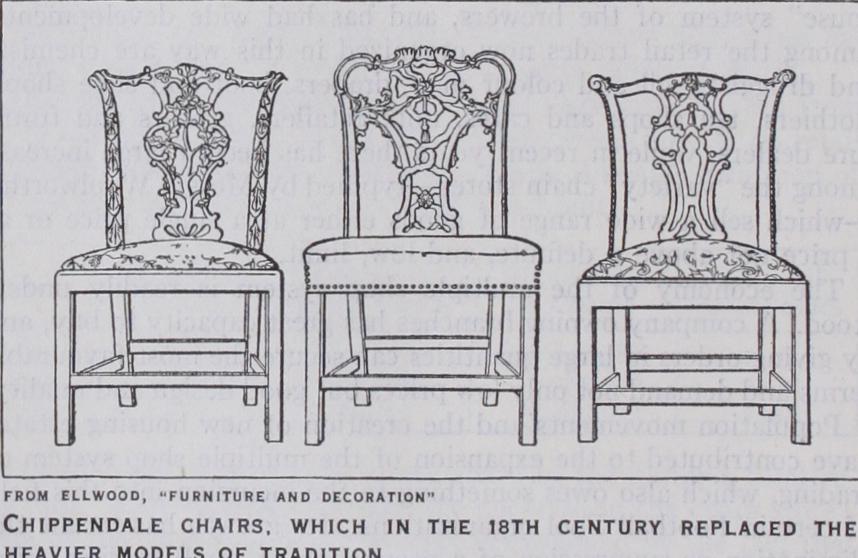
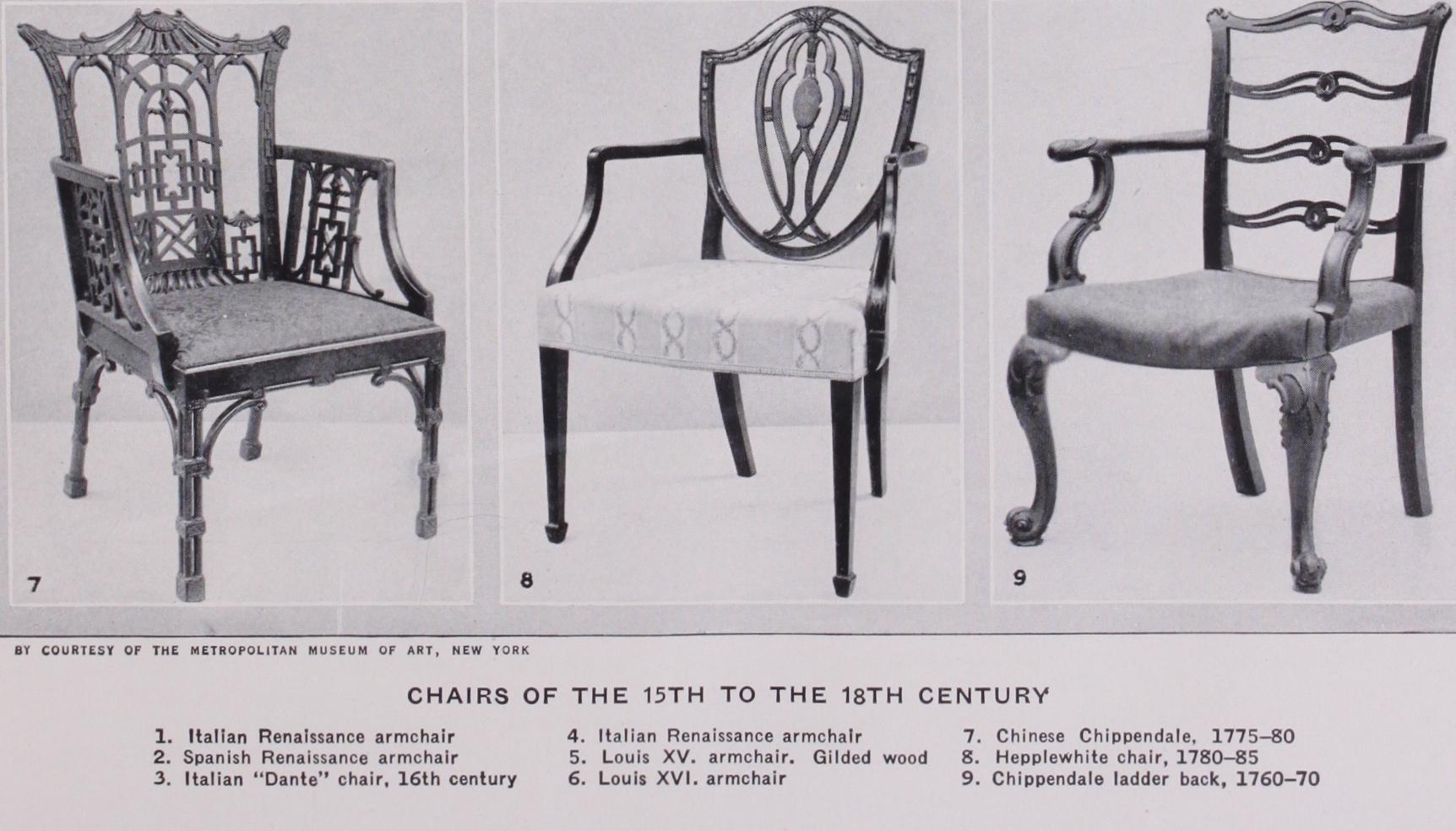
During the reign of William and Mary these charming forms degenerated into something much stiffer and more rectangular, with a solid, more or less fiddle-shaped splat and a cabriole leg with pad feet. The more ornamental examples had cane seats and ill-proportioned cane backs. From these forms was gradually de veloped the Chippendale chair, with its elaborately interlaced back, its graceful arms and square or cabriole legs, the latter terminating in the claw and ball or the pad foot. Hepplewhite, Sheraton and Adam all aimed at lightening the chair, which, even in the master hands of Chippendale, remained comparatively heavy. The endeavour succeeded, and the modern chair is every where comparatively slight. Chippendale and Hepplewhite be tween them determined what appears to be the final form of the chair, for since their time practically no new type has lasted, and in its main characteristics the chair of the loth century is the direct derivative of that of the later i8th.
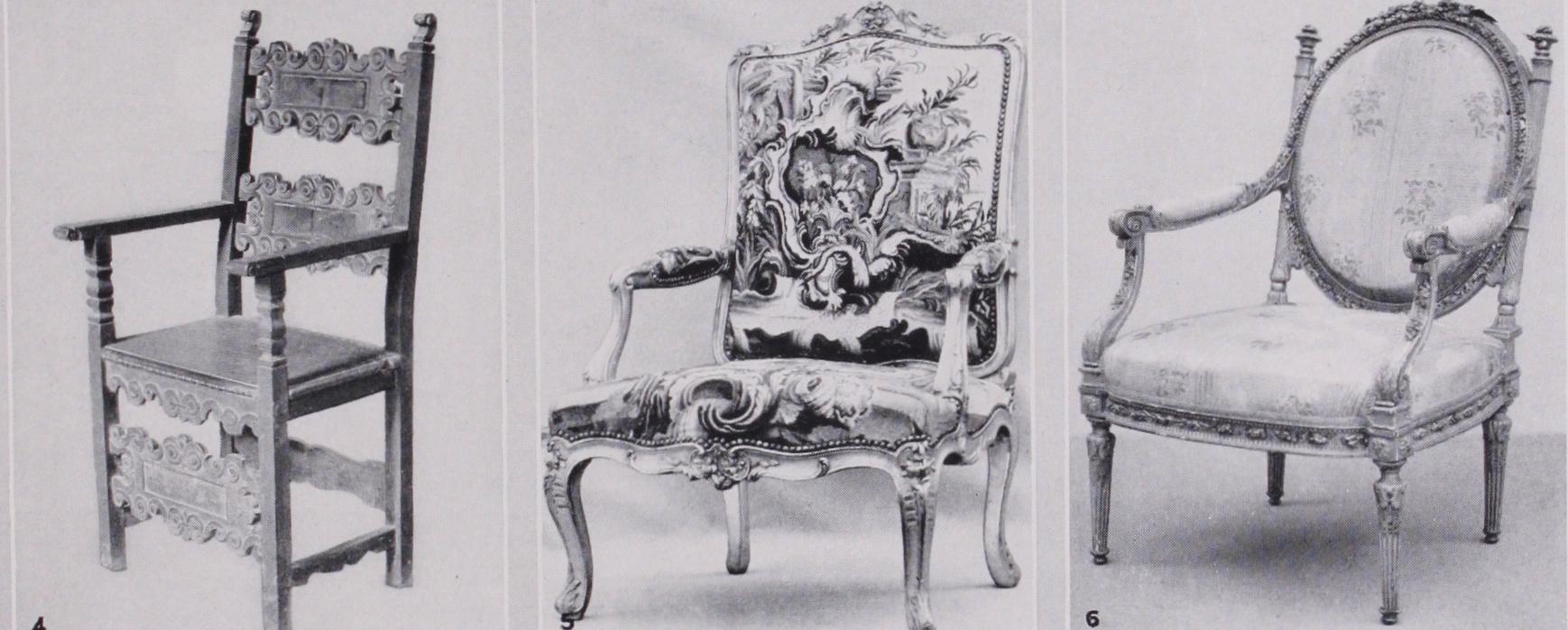
The i8th century was, indeed, the golden age of the chair, es pecially in France and England, between which there was con siderable give and take of ideas. Diderot could not refrain from writing of them in his Encyclopedie. The typical Louis Seize chair, oval-backed and ample of seat, with descending arms and round-reeded legs, covered in Beauvais or some such gay tapestry woven with Boucher or Watteau-like scenes, is a very gracious object, in which the period reached its high-water mark. The Empire brought in squat and squabby shapes, comfortable enough no doubt, but entirely destitute of inspiration. English Empire chairs were often heavier and more sombre than those of French design. Thenceforward the chair in all countries ceased to at tract the artist. The art nouveau school has occasionally produced something of not unpleasing simplicity; but more often its efforts have been frankly ugly or even grotesque. There have been prac tically no novelties. So much, indeed, is the present indebted to the past in this matter that even the revolving chair, now so familiar in offices, has a pedigree of something like four centuries (see also INTERIOR DECORATION; FURNITURE). (J. P.-B.)