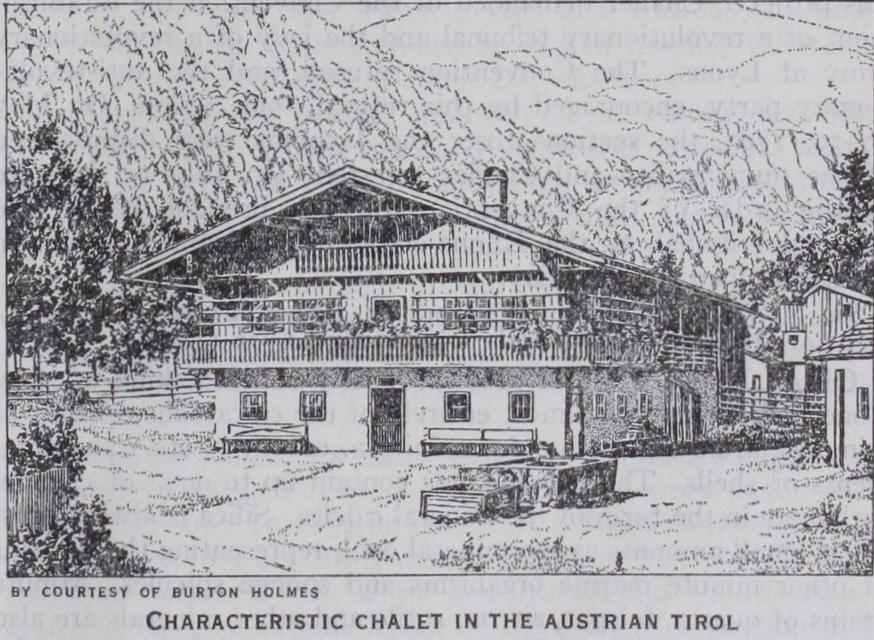
CHALET, a term applied to the timber houses of Switzerland. the Bavarian Alps, Tirol and the French Alps. The chalet is distinguished above all by the frank and interesting manner in which it makes use of its material, wood. The timber used is generally in heavy planks, from 3 to bin. thick, and carefully framed together somewhat in the manner of a log-house. Side walls, generally low, often project beyond the ends, forming porches or loggias, closed at the ends. Upper floors, almost uni versally, project over the storeys below, with all sorts of fantastic and interesting bracket treatments. Balconies across the front are common and are frequently enriched with carved railings. Win dows are small and hung as casements. In general, roofs are of low pitch and project enormously, both at the eaves and at the gable ends, which are occasionally snubbed with a small triangle of sloping roof at the top. The roof surfaces are covered with large wood shingles, slabs of slate or stone; in the wilder districts planks are often laid over the roof covering and weighted with boulders to prevent damage from heavy gales. In plan, the chalet tends towards the square ; frequently, not only the house proper, but stables and storage barns are included under one enormous roof. Many local peculiarities of detail exist. (See HOUSE.) CHALIAPIN, FYODOR IVANOVICH (shahl-yah'pen) Russian bass singer, born at Kazan, on Feb. 1, 1873. His early career was a varied and adventurous one; he was by turns porter, shoemaker, hunter and street sweeper. He received his first musical training as a choirboy at Kazan, but his serious studies as a singer were made under Oussatov at Tiflis, where he made his first appearance in opera in 1892 in A Life for the Tsar. He then sang in 1894 at the Summer theatre, St. Petersburg (Leningrad), and later at the Imperial opera house. After visit ing Milan he took important parts in the Mamantoff opera com pany, and ,At a private opera house in Moscow in 1896. In 1913, during the Russian opera season organized by Sir Thomas Beecham at Drury Lane, London, he appeared in Boris Godunov, Ivan the Terrible, and La Khovantchina. His superb bass voice and re markable dramatic powers took his audience by storm, and he had a similar success in Prince Igor. During the World War and afterwards, until 1921, he remained in Russia. His first appear ance outside Russia after the war was at the Albert Hall, London, in 1921. He visited America in 1908; his second tour there was in 1922-23. Among his most famous parts may be named those of Ivan the Terrible in Rimsky-Korsakov's Maid of Psko f ; Salieri in Mozart and Salieri; Leporello in Don Giovanni; Don Basilio in the Barber of Seville; and Mephisto in Me firto f ele. See his Pages from my Life (1927).