
CHANCEL, strictly, that part of a church close to the altar and separated from the nave (q.v.) by cancelli or screens. This space, originally known as the space inter cancellos, or locus altaris cancellis septus, came itself to be called the chancel. Later the word came to include the whole of that part of the church occupied by altars, communion tables and all the officiating clergy and singers, i.e., the presbytery (q.v.), the chancel proper and the choir (q.v.). In some cases the word is used synonymously with choir.
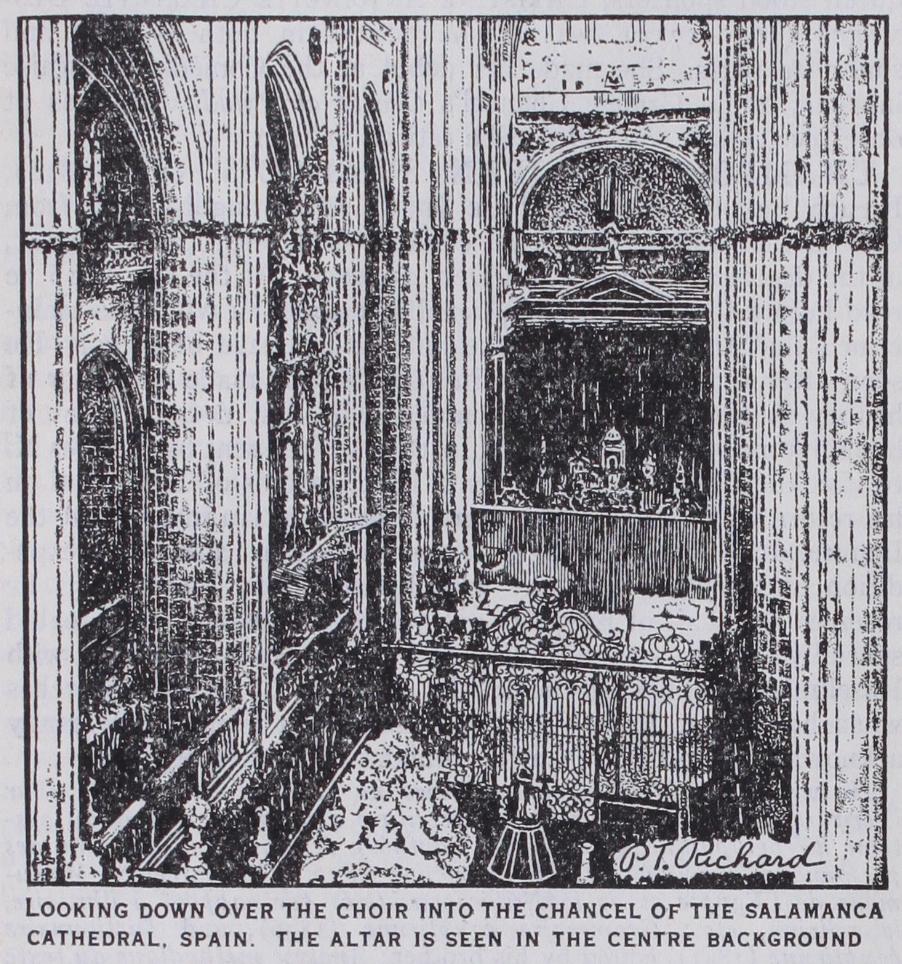
In basilican churches, the chancel is set apart only by a low railing; e.g., S. Clemente, Rome. Such divisions correspond more to the altar, communion or sanctuary rail of a modern church than to the developed mediaeval chancel screen. In the highly organized mediaeval church, the chancel is clearly differentiated from the nave by the raising of the floor level, and by the chancel or rood screen (see RooD) . This screen is frequently continued on each side, behind the choir stalls, and around the east end of the cathedrals of sanctuary, as in Paris, Bourges and Amiens. At the side, such screens form the back of the choir stalls. The chancel screen in front of the altar is sometimes only a low parapet, sometimes a light, openwork structure of wood or metal, but often, especially in the large cathedrals and abbeys of England, a massive and solid stone structure, frequently carrying the organ. In collegiate and monastic churches, these screens thus completely separated the spaces reserved for services for the members of the clerical community from the spaces for popular services, for which a second altar was usually set up to the west of the screen, as formerly in Westminster Abbey.
Chancel sizes vary enormously. On the European continent they usually extend from the east end to the crossing, as in many modern churches, but in abbey churches, and generally in English mediaeval churches, they comprise also several bays of the nave. In the churches of Paris the chancel is relatively small. The chan cel screen becomes more open and its main function is to support a crucifixion group ; it is, therefore, primarily a rood screen. In small churches the chancel is sometimes lower and narrower than the nave.