
CHANNEL FERRY. In the World War the necessity of utilizing the canals and waterways of France and Belgium for transport in order to relieve the pressure on the railways was early recognized, and to take over and develop this work behind the British lines the Inland Water Transport Section of the Royal Engineers was formed in 1914.
The activities of this new organization became so great that a similar organization (later the Directorate of Inland Waterways and Docks, Royal Engineers) was set up in England. The func tions of this directorate expanded until it took in other branches of transport besides canal traffic, and included the supply and equipment for docks and harbours, and constructional work at various ports which formed bases for transport of munitions and materials for the British armies in all theatres of war.
To meet the growing demands from France for suitable craft, personnel, plant and stores in an efficient and economical manner, it was decided to establish a cross-channel barge port and stores depot, from which barges capable of navigating the French canals could be sent across loaded. Richborough in Kent was chosen.
The site had many advantages. It was :—(a) directly oppo site the ports and canals of northern France (see Map) ; (b) within easy access of a main railway system; (c) a flat, low-lying, un occupied ground of over 2,000 acres, capable of being developed without interfering with any vested interests, or existing traffic or other port facilities; (d) situated on a tidal river with a shel tered entrance; (e) comparatively inaccessible to enemy naval raids.
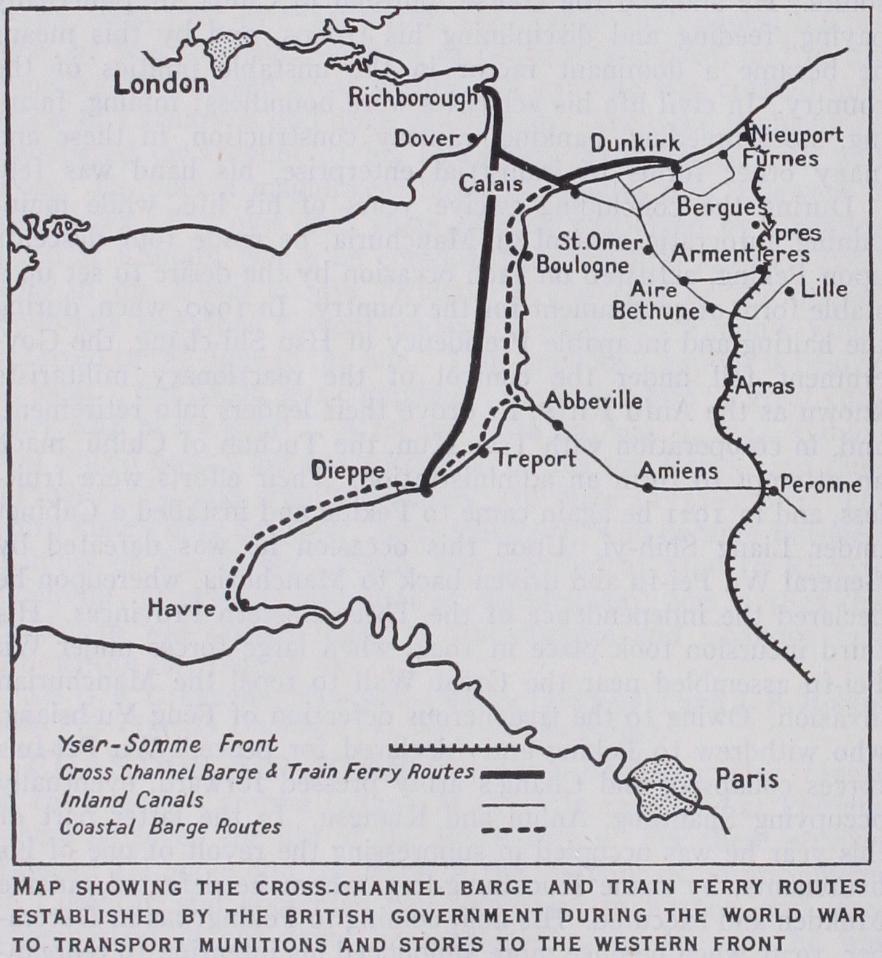
The development of Richborough was remarkably rapid and by 1917—although the primary object of its existence was the cross channel barge traffic—it had grown into a large and well equipped seaport and workshop base with three-quarters of a mile of wharves and Tom. of railway sidings capable of dealing with 30,00o tons of traffic per week; with extensive engineering work shops and foundries where urgent repair work which could not be carried out in the war areas was done; a spacious salvage transit yard where the sorting, storage and dispatch of salvage was carried on by female labour ; large store warehouses from which con sumable stores, plant, and other material were dispatched over seas at a moment's notice ; camp accommodation for 15,000 troops and a regimental depot for the reception, equipment, training and disposal of all personnel recruited for the Inland Waterways and Docks for service at home and in the various theatres of war.
These works were constructed by military labour, especially re cruited from skilled trades and working under the supervision of technical officers. The recruits, large numbers of whom were of low medical category, after being given a short military training at the regimental depot were passed on for duty and intensive training to one or other of the formations, e.g., construction, work shops, railway traffic, marine or stores, from which they were drafted overseas for similar service as and when required, 1,200 officers and 51,000 other ranks passing through in this way.
Cross-Channel Barge Service.—The expansion of Richborough into a transportation base and the establishment of the channel barge service—carried on without a break day or night until the Armistice with barges specially designed for the crossing and for navigating the French waterways—was an enormous relief to ordinary shipping and the following advantages were also ob tained :—(a) Relief of congestion at French ports as barges passed straight through to inland depots with consequent avoid ance of double handling; (b) return of barges from war zone loaded with salvage; (c) saving of railway carriage in France; (d) relief to English ports; (e) disposal of both marine and war risks into smaller units; (f) no naval patrol necessary.
The total exports by barge up to the armistice exceeded 31 million tons and the total imports of salvage half a million.
A fleet of 386 craft was controlled from Richborough includ ing 67 sea-going tugs and 255 200-ton barges. Over 20,000 cross channel trips were made and it is interesting to note that no craft was lost as the result of enemy action, though some sus tained casualties when in canals close up behind the British lines.
Train Ferry Service.—Late in 1916, the serious shipping po sition, the increasing demand from France for supplies, and the delays in the channel ports owing to inadequate appliances for handling heavy cargo, led to the decision to establish a train ferry service on the Richborough cross-channel route to enable heavy war material to be run direct on rail from factories to war areas. In Jan. 1917 orders were placed for three train ferry vessels capable of carrying 54 fully loaded ten-ton trucks or as many guns, tanks, locomotives, or other vehicles as could be arranged on the four deck-tracks, or a total load of 960 tons.
Terminals and berths for these vessels were built at Richbor ough, Southampton, Dunkirk, Calais and Dieppe; the method of communication between ship and shore being a double track self adjusting bridge hinged at the shore end.
The service from Richborough to Calais began in February 1918 and was carried on without mishap and without convoy. The vessels were good seaboats and crossed in all but the most severe Weather. As a transport unit they were of immense value. Their first cargoes were heavy wagons, 34o of which were taken across in seven trips (averaging 12 hours each). Previously it had taken a 3,600-ton steamer one month to convey 30o wagons. It is estimated that the three ferry boats released six 8,000 ton ocean-going steamers, whilst an enormous economy was effected in the avoidance of double transhipment. One of the outstanding features of the service was the ease and rapidity with which the vessels were loaded and unloaded—the time averaging less than 25 minutes per trip. After the disaster of March 21, 1918, when some 60o British guns were lost, over 700 guns were shipped by train ferry within 48 hours to replace them. In May 1918 two 14-inch guns on railway mountings, each weighing 302 tons and measuring 8 7f t. overall, were taken over safely and run up to the front without the necessity of dismantling in England and re-erecting in France. In his dispatch of Jan. 7, 1919, F.M. Sir Douglas Haig said, "During the period following the great defensive battles, up to the final triumph of the Allied cause the channel ferry has proved of inestimable value." After the war the port at Richborough was acquired by an industrial group with interests in the Kent coalfields.
(A. J. A. W.) In Oct. 1936 a passenger train ferry service was opened between Dover and Dunkirk.