
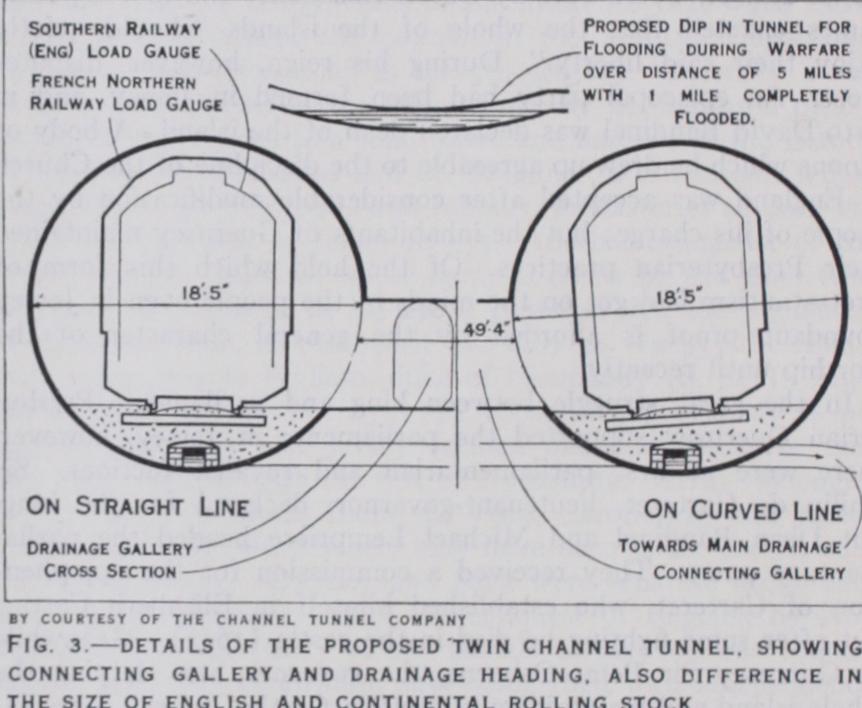
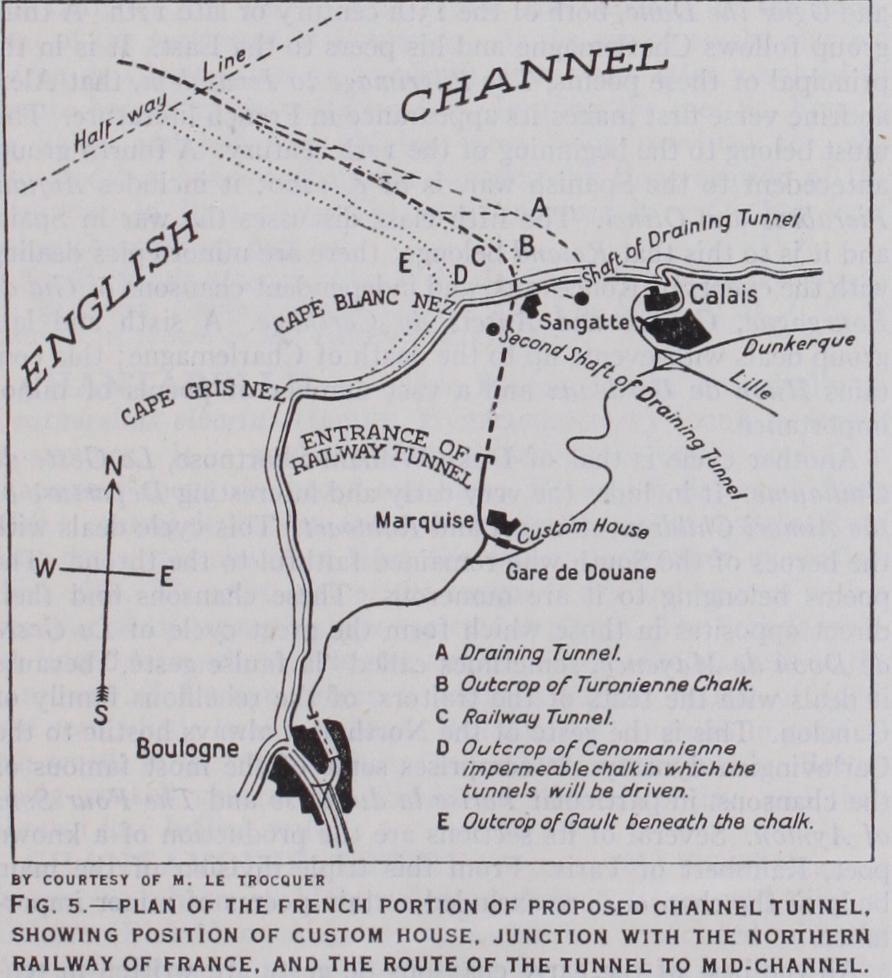
CHANNEL TUNNEL. A tunnel under the English channel would be one of the engineering wonders of the world, and the longest ever made. The Simplon tunnel through the Alps is 12 miles long; the channel tunnel would be over 3o miles long, of which more than 20 would be under the open sea. The authors of the channel tunnel scheme are confident that it could be made successfully, and their proposals may be thus summarized: Construction.—The tunnel would consist of two tubes or tun nels of about loft. diameter, driven about soft. apart and con nected by frequent cross galleries. The tunnel would start in France near Wissant, between Boulogne and Calais, and in Eng land behind the Shakespeare cliffs between Dover and Folkestone. The total length would be 31 miles.
The trains would be worked by electricity, and the power station would be situated in Kent at Some miles distance from the sea.
The train time in such a tunnel would be about three quarters of an hour and if luggage were examined on trains the 3o or 4o minutes wasted in embarking and disembarking would be saved and the journey to Paris shortened by an hour and a half.
A tube of about 'oft. diameter would be first driven from shore to shore to serve as a drainage tunnel and to take a light railway. Chambers would be excavated near the middle, and by this means additional facings would be provided for driving the two railway tunnels and the time of construction would thus be greatly shortened.
The estimated time for the whole work is five to six years.
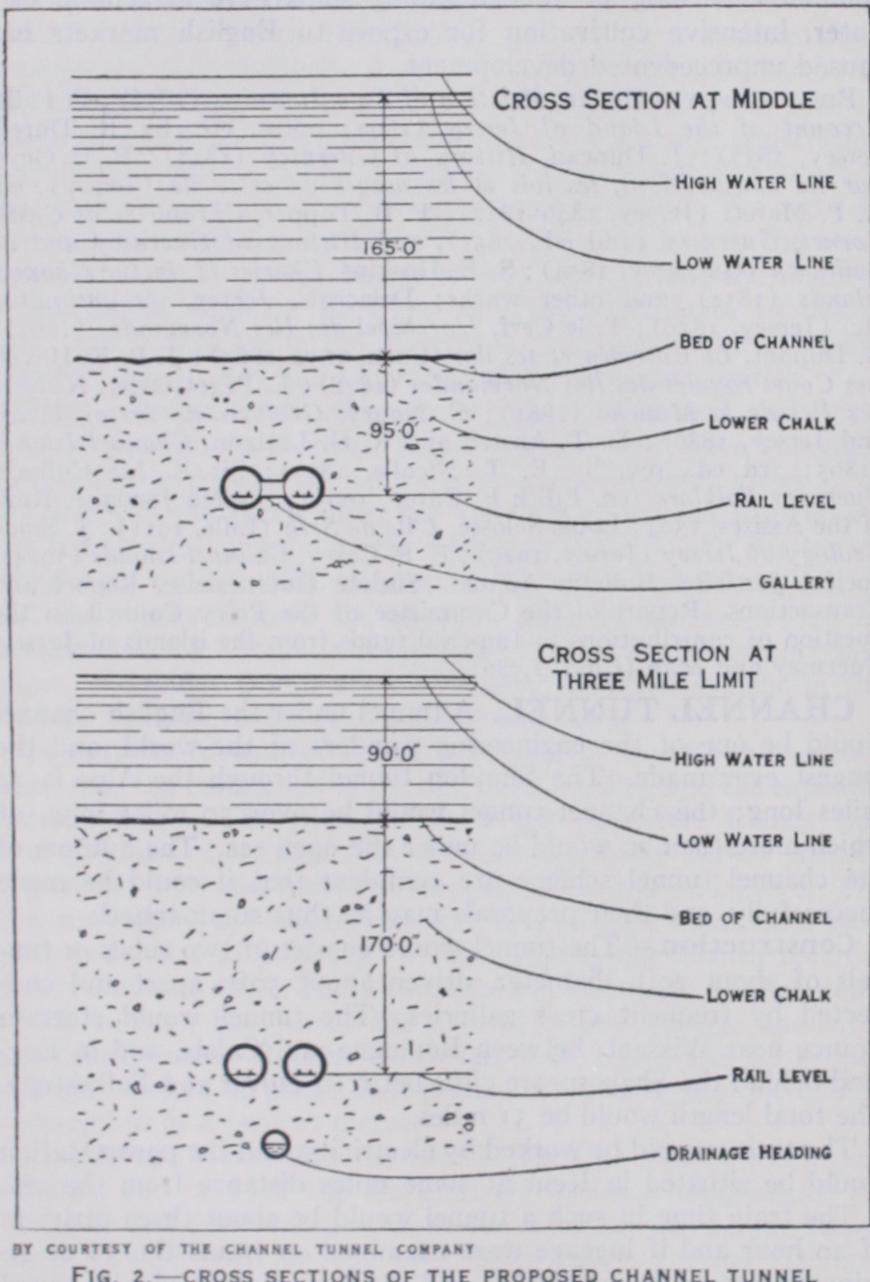
The tunnel would be bored in the bed of grey chalk which out crops on the cliffs on both sides. and which. the geologists say, continues right across the straits. Two preliminary tubes, each z; miles long, have been driven from Sangatte near Calais and from the shore under Shakespeare cliff, where the old works can be seen from the railway between Folkestone and Dover. Although these tubes were not lined, the percolation of water into them has been almost nil. The railway tunnels would be lined with steel throughout like the London tubes.
The size of the tunnels would permit the passage of the largest continental express carriages with sleeping and restaurant cars. That English rolling stock can run on the continent was proved during the World War, hut the broader and loftier French cars are too big for the English platforms and tunnels and bridges.
The Southern railway, to meet this difficulty, propose to build a new electric railway direct from London to Dover to carry the continental traffic only. It would avoid the towns and be without stations. The present railway lines would be quite unequal to the work of carrying the traffic expected, and the new line should save another half hour on the journey. Victoria station is too small for the present traffic and cannot well be enlarged. A new continental terminus would therefore have to be built, probably at the junc tion of Waterloo bridge road and Stamford street.
From this station would run the half hourly service to Paris, the great international expresses to Berlin and Russia, to Brussels, Vienna, and Constantinople, to Rome and Naples, to Madrid and Lisbon, to Biarritz and to the Riviera and Switzerland.
It is a great project, comparable only to the Suez and Panama canals, and one which would do much to ensure the prosperous future of London and England.
B1eriot landed in his aeroplane at Dover in 1909, and a spon taneous movement in the House of Commons resulted in the f orma tion of a channel tunnel committee which ultimately numbered over 400 members of parliament, under the chairmanship of Sir Arthur Fell. The Labour Party joined en bloc, and Mr. Asquith promised to have enquiries made. The World War broke out and nothing could be done. Mr. Lloyd George promised to make more enquiries. Mr. Bonar Law and Mr. Baldwin made no move. Mr. MacDonald in July 1924 offered to consult all the living ex Prime Ministers. The five met, and, after a 4o minutes meeting, rejected the project, although a majority amongst M.P.s of two to one supported it. Mr. Winston S. Churchill in an article in the Weekly Dispatch (July 27, 1924), wrote: "There is no doubt about their promptitude. The question is : Was their decision right or wrong? I do not hesitate to say it was wrong." So the channel tunnel scheme was again shelved, but it cannot be killed. It is unquestionably the greatest engineering proposal before the world and in the words of Marshal Foch spoken at a gathering at the Cercle Interallie, Paris, in 1922 : "If the channel tunnel had been built it might have prevented the war, and in any event it would have shortened its duration by one half." The French Channel Tunnel Company has a concession from their Government and can resume work at any moment, but the English Channel Tunnel Company can do nothing without an act of parliament to which no British Government has yet consented. BIBLIoGRAPHy.--Blue Book, Joint Select Committee, Report and Evidence, 1883 (47) ; "Le Tunnel sous-marin," Albert Sartiaux, gen. man. Nord railway of France, Revue des Deux Mondes, Oct. 1913; "Channel Tunnel," paper read to Royal Society of Arts, Dec. 17, 1913, Arthur Fell, M.P.; Military Aspect of the Tunnel, Lord Sydenham of Combe, June 29, 1914; Article Weekly Dispatch, July 27, 1924, Winston S. Churchill ; "Engineering Features of Channel Tunnel," Paper, Institute of Structural Engineers, May 6, 1927, Yves le Trocquer. (A. F.)