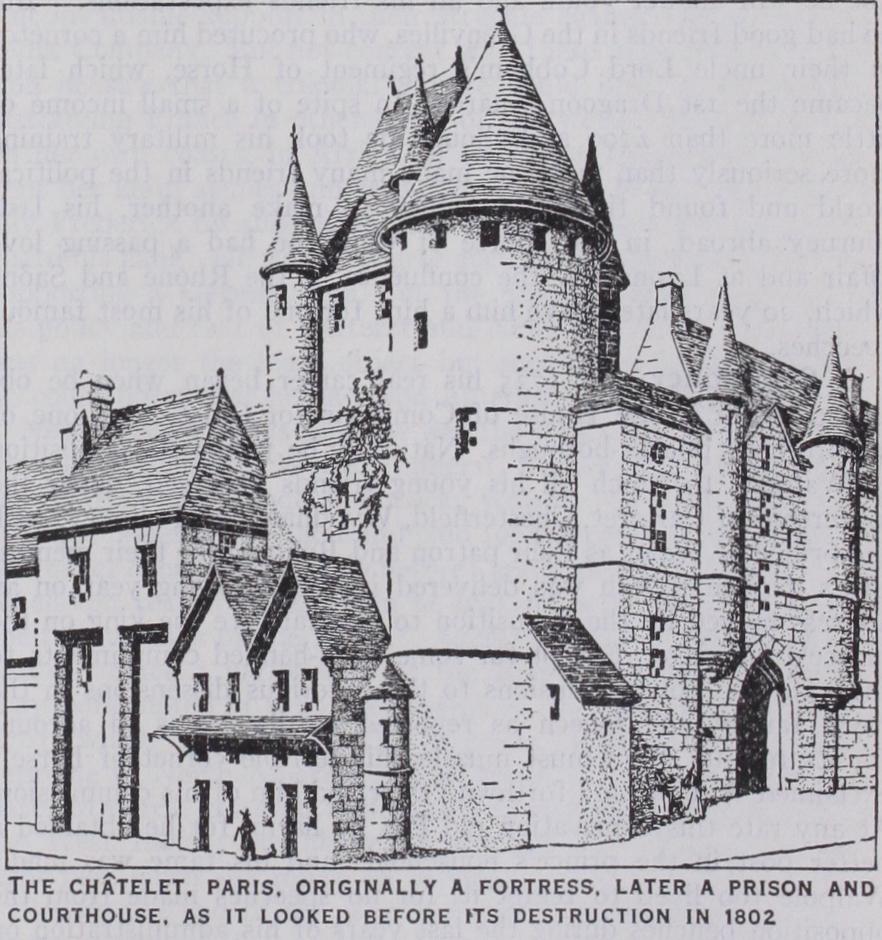
CHATELET, the word, sometimes also written castillet, used in France for a building designed for the defence of an outwork or gate, sometimes of great strength or size, but distinguished from the château, or castle proper, in being purely defensive and not residential (from Med. Lat. castella) . In Paris, before the Revolution, this word was applied both to a particular building and to the jurisdiction of which it was the seat. This building, the original Chatelet, had been first a castle defending the ap proach to the Cite. Tradition traced its existence back to Roman times, and in the 18th century one of the rooms in the great tower was still called the chambre de Cesar. The jurisdiction was that of the provostship (prevote) and viscountship of Paris, which was certainly of feudal origin, probably going back to the counts of Paris.
It was not till the time of St. Louis that, with the appointment of Ltienne Boileau, the provostship of Paris became a prevote en garde, i.e., a public office no longer put up to sale. When the baillis (see BAILIFF AND BAILIE) were created, the provost of Paris naturally discharged the duties and functions of a bailli, in which capacity he heard appeals from the seigniorial and inferior judges of the city and its neighbourhood, keeping, however, his title of provost. When under Henry II. certain bailliages became presidial jurisdictions (presidiaux) i.e. received to a certain ex tent the right of judging without appeal, the Chatelet, the court of the provost of Paris, was made a presidial court, but without losing its former name. Finally, various tribunals peculiar to the city of Paris, i.e., courts exercising jurisdictions outside the com mon law or corresponding to certain tours d'exception which existed in the provinces, were united with the Chatelet, of which they became divisions (chambres). Thus the lieutenant-general of the police made it the seat of his jurisdiction, and the provost of the Ile de France, who had the same criminal jurisdiction as the provosts of the marshals of France in other provinces, sat there also. As to the personnel of the Chatelet, it was originally the same as in the bailliages, except that after the 14th century it had some special officials, the auditors and the examiners of inquests. Like the baillis, the provost had lieutenants who were deputies for him, and in addition gradually acquired a consider able body of ex officio councillors. This last staff, however, was not yet in existence at the end of the 14th century, for it is not mentioned in the Registre criminal du Chatelet 0389-92), pub lished by the Societe des Bibliophiles Francais. In 1674 the whole personnel was doubled at the time when the new Chatelet was established side by side with the old, the two being soon after amalgamated. On the eve of the Revolution it comprised, beside the provost whose office had become practically honorary, the lieutenant civil who presided over the chambre de prevote an pare civil or court of first instance ; the lieutenant crirninel, who presided over the criminal court; two lieutenants particuliers, who presided in turn over the chambre du presidial or court of appeal from the inferior jurisdictions; a juge auditeur; 64 coun cillors (conseillers) ; the procureur du roi, four avocats du roi, and eight substituts, i.e. deputies of the procureur (see PROCU