
CHATTANOOGA, a city of Tennessee, U.S.A., on the Tennessee river, at the southern boundary of the State; a port of entry and the county seat of Hamilton county. It is at the inter section of Federal highways II, 41 and 72; has a municipal air port, Marr Field ; and is served by the Central of Georgia, the Nashville, Chattanooga and St. Louis, the Tennessee, Alabama and Georgia and the Southern railways, by river steamers and barges and by bus lines operating over a territory with a radius of ioo miles. The area is i6sq.m. The population in 1920 was negroes), and was 119,798 in 1930 Federal census. Within the metropolitan area of 25sq.m. a local census in 1927 counted 148,000. The city is picturesquely situated on Moccasin Bend, a sharp turn of the Tennessee, with Signal mountain to the north-west, Missionary ridge on the east, and to the south Lookout mountain (2,126ft.), which commands magnificent views in five States. Hydro-electric development on the Tennessee has provided practically unlimited power since 1913, and Chattanooga has become one of the most important manufacturing centres of the South, with 400 factories in or just outside the city, making over 1,300 articles. The annual output is valued at about $160, 000,000. Among the leading products are malleable iron and steel castings, clay and cast-iron pipes, fire hydrants, boilers, shovels, electrical insulator machinery, refrigerators, tapestry brick, paper, hosiery, oil-well and saw-mill and logging machinery, cedar chests, patent medicines, cement, gas ranges, smoothing irons, hay presses, pea-hulling machinery and portable asphalt paving plants. In 1926 the city used 211,000,000 kw. hours of electric current. It consumes 1,200 tons of pig-iron per day. There is a large wholesale and retail business, and three insurance companies have their home offices here. Bank debits to individual accounts in 1926 amounted to $581,737,000 and the assessed valuation of property was $106,804,540. The educational insti tutions include the University of Chattanooga (Methodist Epis copal, established in 1866) and the Chattanooga college of Law. In the fine auditorium built as a memorial to the men who served in the World War, a season of grand opera is held every February, and weekly organ recitals are given on Sunday afternoons.
In 1817 missionaries came to the Cherokee Indians on the Chickamauga, 6m. E. of Chattanooga. In 1834 a Cherokee chief, John Ross, built a house (still standing) within the present limits of the city, and the place was long called Ross's Landing. It was incorporated as Chattanooga in 1851, and received a city charter in 1866. Since 1911 it has had a commission form of government. In 186o the population was 2,545; in 1880, 12,892; in 1900, 30,154. The iron industry was well established even be fore the development of hydro-electric power, because of the proximity of coal-fields and iron mines. The city and its en virons were the scene of important engagements in the Civil War, notably the battles of Chickamauga, on Sept. 18-20, 1863; and of Missionary Ridge and Lookout mountain ("the battle above the clouds"), on Nov. 24-25, 1863. The national cemetery in the city contains 14,248 graves (5,059 marked "unknown"), and there is also a Confederate cemetery. Chickamauga battle field, ten miles S. of Chattanooga, in Georgia, has been a national military park since 1895. In both the Spanish-American and the World War it was used for the mobilization and training of troops. Its 5,563 acres are dotted with over 2,000 monuments, and many others are scattered over Missionary Ridge, Lookout mountain and other historic spots. Ft. Oglethorpe, just north of the battlefield, is a regimental cavalry post.
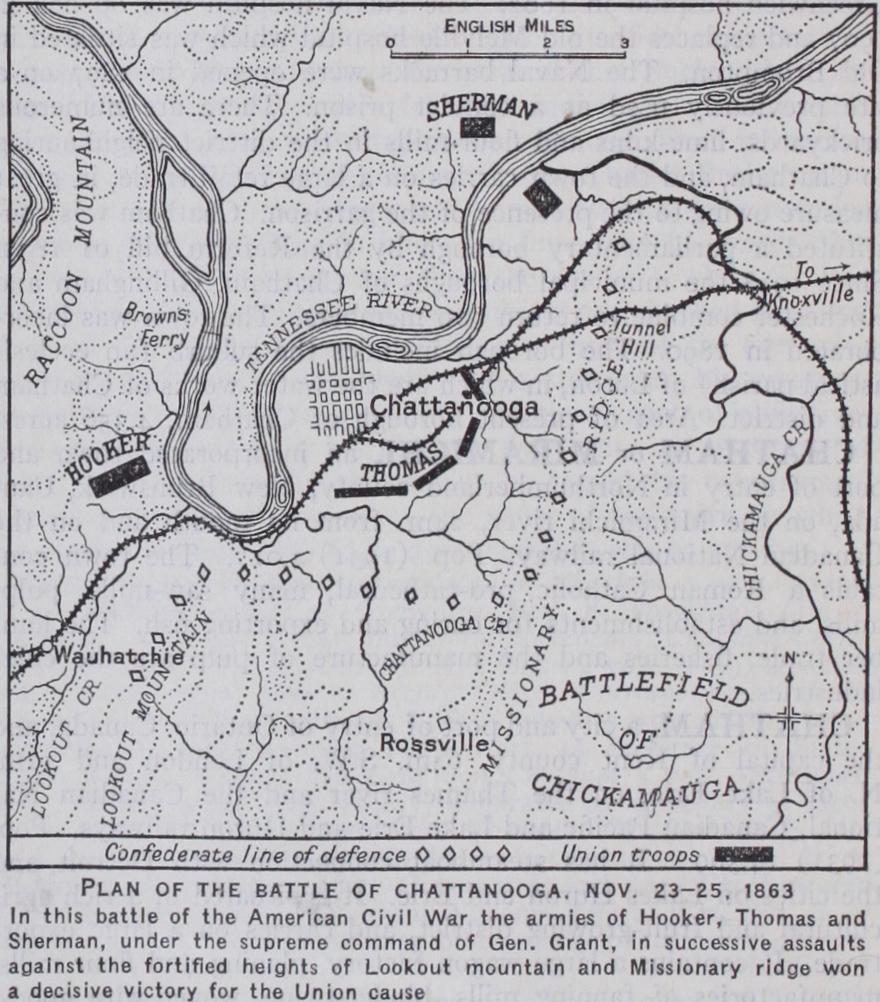
The attack began at t P.M. and was locally a complete success. The heights attacked were in Sherman's hands, and fortified against counter-attack, before nightfall. Hooker in the meanwhile had fought the "Battle above the Clouds" on the steep face of Lookout Mountain, and though opposed by an equal force of Con federates, had completely driven the enemy from the mountain. The 24th then had been a day of success for the Federals, and the decisive attack of the three armies in concert was to take place on the 25th. But the maps deceived Grant and Sherman as they had previously deceived Rosecrans. Sherman had captured, not the north point of Missionary Ridge, but a detached hill, and a new and more serious action had to be fought for the possession of Tunnel Hill, where Bragg's right now lay strongly entrenched. The Confederates used every effort to hold the position and all Sherman's efforts were made in vain. Hooker, who was moving on Rossville, had not progressed far, and Bragg was still free to reinforce his right. Grant therefore directed Thomas to move forward on the centre to relieve the pressure on Sherman. The Army of the Cumberland was, after all, to strike the decisive blow. About 3.30 P.M. the centre advanced on the Confederate's trenches at the foot of Missionary Ridge. These were carried at the first rush, and the troops were ordered to lie down and await orders. Then occurred one of the most dramatic episodes of the war. Suddenly, and without orders either from Grant or the officers at the front, the whole line of the Army of the Cumberland rose and rushed up the ridge. Two successive lines of entrenchments were carried at once. In a short time the crest was stormed, and after a last attempt at resistance the enemy's centre fled in the wildest confusion. The pursuit was pressed home by the divisional gen erals, notably by Sheridan. Hooker now advanced in earnest on Rossville, and by nightfall the whole Confederate army, except the troops on Tunnel Hill, was retreating in disorder. These too were withdrawn in the night, and the victory of the Federals was complete. Bragg lost 8,684 men killed, wounded and prisoners out of perhaps 34,00o men engaged ; Grant, with 6o,000 men, lost about 6,000.