
CHERRY. As a cultivated fruit-tree the cherry is generally supposed to be of Asiatic origin, whence, according to Pliny, it was brought to Italy by Lucullus after his defeat of Mithridates, king of Pontus, 68 B.C. As with most plants which have been long and extensively cultivated, it is a matter of difficulty, if not an impossibility, to identify the parent stock of the numerous cultivated varieties of cherry; but they are generally referred to two species : Prunus Cerasus, the wild or dwarf cherry, the origin of morello, duke and Kentish cherries, and P. Avium, the gean, the origin of the geans, hearts, mazzards and bigarreaus. Both species grow wild through Europe and western Asia to the Hima layas, but the dwarf cherry has the more restricted range of the two in Britain, as it does not occur in Scotland and is rare in Ireland. The cherries form a section Cerasus of the genus Prunus; and they have sometimes been separated as a distinct genus from the plums proper ; both have a stone-fruit or drupe, but the drupe of the cherry differs from that of the plum in not having a waxy bloom; further, the leaves of the plum are rolled (convolute) in the bud, while those of the cherry are folded (conduplicate).
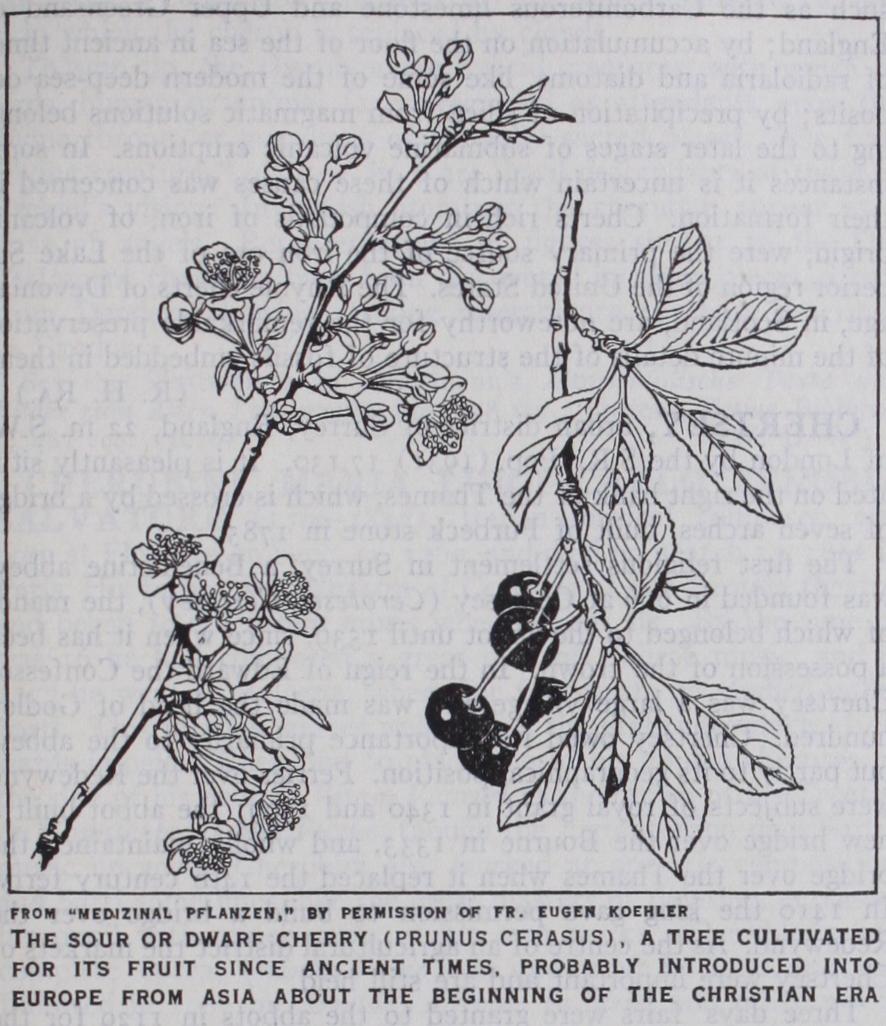
The cherries are trees of moderate size and shrubs, having smooth, serrate leaves and white flowers. They are natives of the temperate regions of both hemispheres; and the cultivated vari eties ripen their fruit in Norway as far as 63° N. The geans are generally distinguished from the common cherry by the greater size of the trees, and the deeper colour and comparative insipidity of the flesh in the ripe fruit, which adheres firmly to the "nut" or stone; but among the very numerous cultivated varieties specific distinctions shade away so that the fruit cannot be ranged under these two heads. The leading varieties are recognized as bigar reaus, dukes, morellos and geans. Several varieties are cultivated as ornamental trees and on account of their flowers.
In North America both species of cultivated cherries are widely grown. The varieties of Prunus cerasus are grouped as sour cherries ; those of P. avium as sweet cherries. The sour cherry in North America is very cosmopolitan and is grown from New foundland to Vancouver island, on the north and to Texas and Florida on the south, yielding fruit in a score or more varieties in a greater diversity of soils and climates than any other tree fruit. On the other hand, the sweet cherry in the New World is fastidious as to soils, lacking in hardiness to both heat and cold, and is prey to many insects and fungous diseases; therefore it is grown at its best in comparatively few and limited areas. Taken together, varieties of sweet and sour cherries are the most com monly cultivated of all tree fruits in North America.
The cherry is a well-flavoured sub-acid fruit, and is much es teemed for dessert. Some of the varieties are particularly selected for pies, tarts, etc., and others for the preparation of preserves, and for making cherry brandy. The fruit is also very extensively employed in the preparation of the liqueurs known as kirsch wasser, ratafia and maraschino. Kirschwasser is made chiefly on the upper Rhine from the wild black gean, and in the manu facture the entire fruit-flesh and kernels are pulped up and allowed to ferment. By distillation of the fermented pulp the liqueur is obtained in a pure, colourless condition. Ratafia is similarly manu factured, also by preference from a gean. Maraschino, a highly valued liqueur, the best of which is produced at Zara in Dalmatia, differs from these in being distilled from a cherry called marasca, the pulp of which is mixed with honey, honey or sugar being added to the distillate for sweetening. It is also said that the flavour is heightened by the use of the leaves of the perfumed cherry, Prunus Mahaleb, a native of central and southern Europe.
The wood of the cherry tree is valued by cabinetmakers, and that of the gean tree is largely used in the manufacture of tobacco pipes. The American wild cherry, Prunus serotina, is much sought after, its wood being compact, fine-grained, not liable to warp, and capable of receiving a brilliant polish. The kernels of the per fumed cherry, P. Mahaleb, are used in confectionery and for scent. A gum exudes from the stem of cherry trees similar in its proper ties to gum arabic.