CHESS, once known as "checkers," a game played with certain "pieces" on a special "board" described below. It takes its name from the Persian word shah, a king, the name of one of the pieces or men used in the game. Chess is the most cosmopolitan of all games, invented in the East (see History, below), intro duced into the West and now domiciled in every part of the world. As a mere pastime chess is easily learnt, and a very moderate amount of study enables a man to become a fair player, but the higher ranges of chess-skill are attained only by persistent labour. The real proficient or "master" not merely must know the subtle variations in which the game abounds, but must be able to apply his knowledge in the face of the enemy and to call to his aid, as occasion demands, all that he has of foresight, brilliancy and resource, both in attack and in defence. Two chess players fighting over the board may fitly be compared to two famous generals encountering each other on the battlefield, the strategy and the tactics being not dissimilar in spirit.
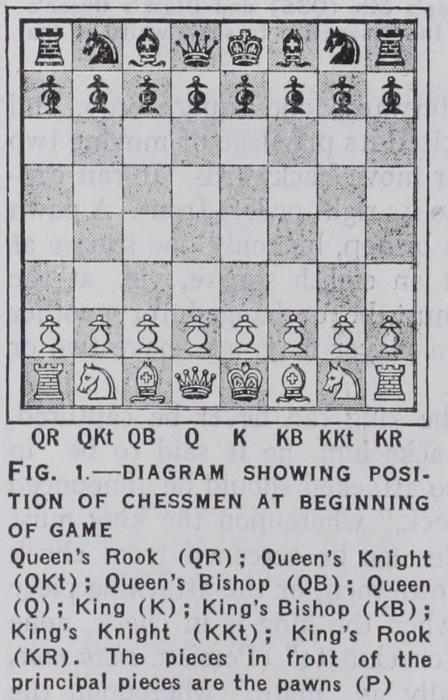
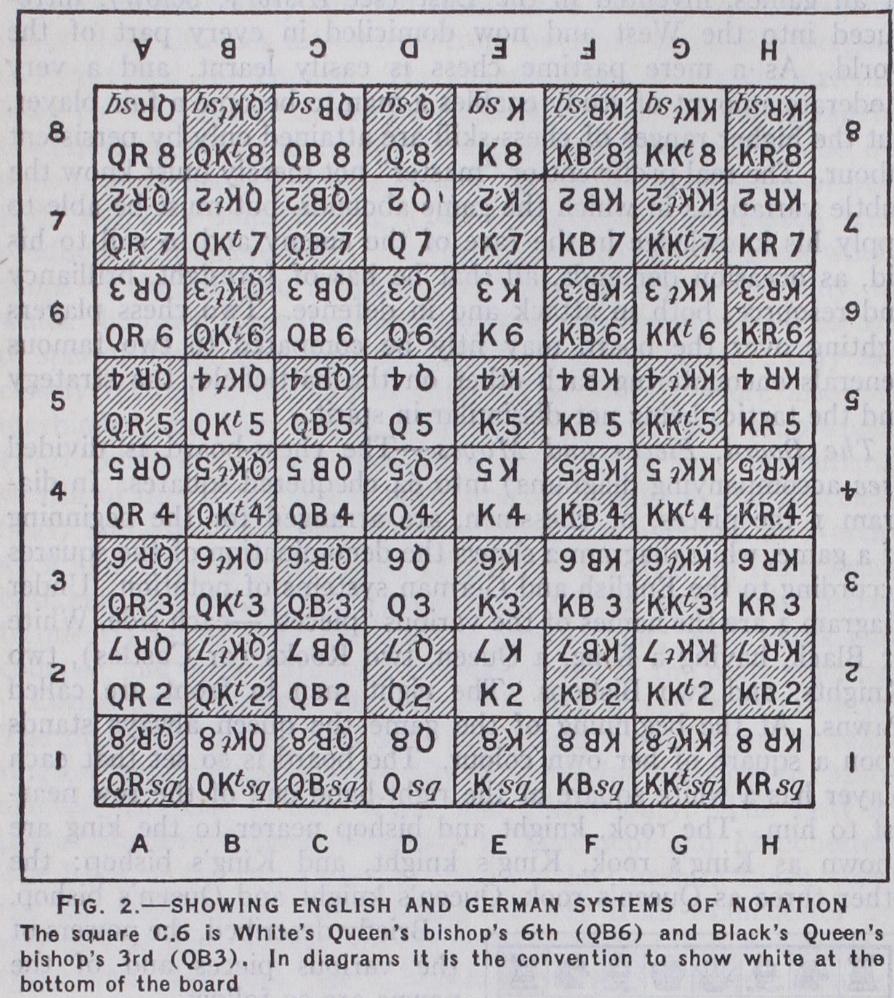
The Board, Pieces and Moves.—The chess-board is divided (see accompanying diagrams) into 64 chequered squares. In dia gram I the pieces, or chessmen, are arranged for the beginning of a game, while diagram 2 shows the denomination of the squares according to the English and German systems of notation. Under diagram 1 are the names of the various "pieces"—each side, White or Black, having a King, a Queen, two Rooks (or Castles), two Knights, and two Bishops. The eight men in front are called Pawns. At the beginning of the game the queen always stands upon a square of her own colour. The board is so set that each player has a white square at the right-hand end of the row near est to him. The rook, knight and bishop nearer to the king are known as King's rook, King's knight, and King's bishop; the other three as Queen's rook, Queen's knight and Queen's bishop.
Briefly described, the powers of the various pieces and of the pawns are as follow : The king may move in any di rection, only one square at a time, except in castling. Two kings can never be on adjacent squares. The queen moves in any direc tion either diagonally or parallel to the sides of the board, whether forward or backward. There is no limit to her range over vacant squares; an opponent she may take ; a piece of her own colour stops her. She is the most power ful piece on the board, for she can move either as a rook or a bishop.
The rooks (from the Indian rukh and Persian rokh, meaning a soldier or warrior) move paral lel to the sides of the board—forward or backward—but they cannot move diagonally. Their range is like the queen's, unlimited, with the same exceptions.
The bishops move diagonally in any direction whether back ward or forward. They have an unlimited range, with the same exceptions.
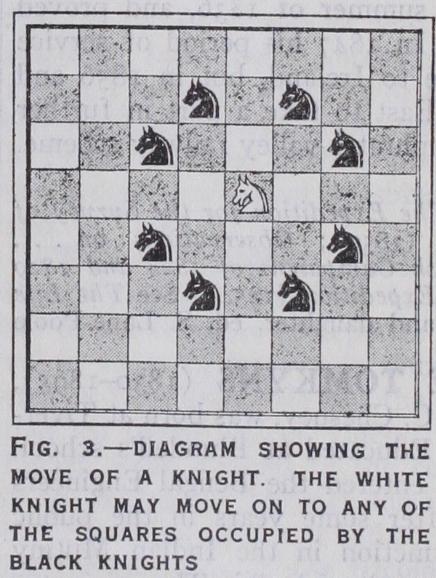
The knights' moves are of an absolutely different kind. They move from one corner of any rectangle of three squares by two to the opposite corner; thus, in diagram 3, the white knight can move to any square occupied by a black one, and vice versa. The move may be made in any direction, e.g., a knight at the square e4 in diagram 2 can move to any one of the eight squares f6, d6, c5, c3, d2, f2, g3, g5. It is no obstacle to the knight's move if intervening squares are occupied. It will be perceived that the knight always moves to a square of a different colour.
The king, queen, rooks and bishops may capture any foeman which stands anywhere within their respective ranges; and the knights can capture the adverse men which stand upon the squares to which they can leap. The piece which takes occupies the square of the piece which is taken, the latter being removed from the board. The king cannot capture any man which is protected by another man.
The moves and capturing powers of the pawns are as follow: Each pawn for its first move may advance either one or two squares straight forward, but afterwards one square only, and this whether upon starting it exercised its privilege of moving two squares or not. A pawn can never move backwards. It can cap ture only diagonally—one square to its right or left front. A pawn moves like a rook, captures like a bishop, but only one square at a time. When a pawn arrives at an eighth square, viz., at the extreme limit of the board, it must be exchanged for another piece of the same colour, so that a player may, e.g., have two or more queens on the board at once.
"Check" and "Checkmate." The king can never be captured, but when any piece or pawn attacks him, he is said to be "in check," and the fact of his being so attacked should be announced by the adverse player saying "check," whereupon the king must move from the square he occupies, or be screened from check by the interposition of one of his own men, or the attacking piece must be captured. If, however, when the king is in check, none of these things can be done, it is "checkmate" (Persian, shah mat, the king is dead), known generally as "mate," whereupon the game terminates, the player whose king has been thus checkmated being the loser. When the adversary has only his king left it is very easy to checkmate him with only a queen and king, or only a rook and king. The problem is less easy with king and two bishops, and still less easy with king, knight and bishop, in which case the opposing king has to be driven into a corner square whose colour corresponds with the bishop's, mate 1 eing given with the bishop. A king and two knights cannot mate, if the op ponent play correctly. To mate with king and rook the opposing king must be driven on to one of the four side lines and kept there with the rook on the next line, till it is held by the other king, when the rook mates.
The pawn gives check in the same way as it captures, viz., di agonally. One king cannot give check to another, nor may a king be moved into check.
"Check by discovery" is given when a player, by moving one of his pieces, checks with another of them. "Double check" means attacking the king at once with two pieces—one of the pieces in this case giving check by discovery.
"Perpetual check" occurs when one player, seeing that he can not win the game, finds the men so placed that he can give check ad infinitum, while his adversary cannot possibly avoid it. The game is then drawn. A game is also drawn "if, before touching a man, the player whose turn it is to play, claim that the game be treated as drawn, and prove that the existing position existed, in the game and at the commencement of his turn of play, twice at least before the present turn." "Stalemate." When a king is not in check, but his owner has no move left save such as would place the king in check, it is "stalemate," and the game is drawn.
"Castling." This is a special move permitted to the king once only in the game. It is performed in combination with either rook, the king being moved two squares laterally, while the rook towards which he is moved (which must not have previously moved from its square) is placed next him on the other side; the king must be touched first. The king cannot castle after hav ing been once moved, nor when any piece stands between him and the rook, nor if he is in check, nor when he has to cross a square commanded by an adverse piece or pawn, nor into check. It will be perceived that after castling with the king's rook the latter will occupy the KB square, while the king stands on the KKt square, and if with the queen's rook, the latter will occupy the queen's square while the king stands on the QB square.
"Taking en passant." This is a privilege possessed by any of the pawns under the following circumstances : If a pawn, say of the white colour, stands upon a fifth square, say upon K5 counting from the white side, and a black pawn moves from Q2 or KB2 to Q4 or KB4 counting from the black side, the white pawn can take the black pawn en passant. For the purposes of such capture the latter is dealt with as though it had only moved to Q3 or KB3, and the white pawn taking it diagonally then oc cupies the square the captured pawn would have reached had it moved but one square. The capture can be made only on the move immediately succeeding that of the pawn to be captured.
"Drawn Game." This arises from a stalemate (noticed above), or from either player not having sufficient force wherewith to fect checkmate, as when there are only two kings left on the board, or king and bishop against king, or king with one knight, or two knights against king, or from perpetual check. One of the players can call upon the other to give checkmate in 5o moves, the result of failure being that the game is drawn. But, if a pawn is moved, or a piece is captured, the counting must begin again.
A "minor piece" means either a knight or a bishop. "Winning the exchange" signifies capturing a rook in exchange for a minor piece. A "passed pawn" is one that has no adverse pawn either in front or on either of the ad joining files. A "file" is simply a line of squares extending verti cally from one end of the board to the other. An "open file" is one on which no piece or pawn of either colour is standing. A pawn or piece is en prise when one of the enemy's men can capture it. "Gambit" is a word derived from the Ital. garnbetto, a tripping up of the heels; it is a term used to signify an opening in which a pawn or piece is sacrificed at the opening of a game to obtain an attack. An "opening," or debut, is a certain set method of commencing the game. When a player can only make one legal move, that move is called a "forced move." Value of the Pieces.—The relative worth of the chessmen cannot be definitely stated on account of the increase or decrease of their powers according to the position of the game and the pieces, but taking the pawn as the unit the following will be an estimate near enough for practical purposes: pawn i, bishop 3.2 5, knight 3.25, rook 5, queen 9.5o. Three minor pieces may more often than not be advantageously exchanged for the queen. Two bishops are usually stronger than two knights, more especially in open positions.
Laws.—The laws of chess differ, although not very materially, in different countries. In competitions among English players the laws adopted are those laid down by the British Chess Federa tion in First Move and Odds.—To decide who moves first, one player conceals a white pawn in one hand and a black pawn in the other, his adversary not seeing in which hand the different pawns are put. The other holds out his hands with the pawns concealed, and his adversary touches one. If that contains the white pawn, he takes the white men and moves first. If he draws the black pawn his adversary has the first move, since white, by convention, always plays first. Subsequently the moves are taken alter nately. If one player, by way of odds, "gives" his adversary a pawn or piece, that piece is removed before play begins. If the odds are "pawn and move," or "pawn and two," a black pawn, usually the king's bishop's pawn, is removed and white plays one move, or any two moves in succession but must not pass beyond his fourth rank till his opponent has moved. "Pawn and two" is generally considered to be slightly less in point of odds than to give a knight or a bishop; to give a knight and a bishop is to give rather more than a rook; a rook and bishop less than a queen ; two rooks rather more than a queen. The odds of "the marked pawn" can only be given to a much weaker player. A pawn, generally KKt's pawn, is marked with a cap of paper. If the pawn is captured its owner loses the game; he can also lose by being checkmated in the usual way, but he cannot give mate to his adversary with any man except the marked pawn, which may not be moved to an eighth square and exchanged for a piece.
Rules.—If a player touch one of his men he must move it, un less he says j'adoube (I adjust), or words of a similar meaning, to the effect that he was only setting it straight on its square. If he cannot legally move a touched piece there is no penalty. He must say j'adoube before touching his piece. If a player touch an opponent's piece, he must take it, if he can; if not, make a legal move with the piece by which he made the illegal capture. If he can do neither, no penalty. A move is completed and cannot be taken back as soon as a player, having moved a piece, has taken his hand off it. If a player is called upon to mate under the 50 move rule, "5o moves" means so moves and the 49 replies to them. A pawn that reaches an eighth square must be exchanged for some other piece of the same colour, the move not being complete until this is done; a second king cannot be selected.
Modes of Notation.—The English and German methods of de scribing the moves made in a game are different. According to the English method each player counts from his own side of the board, and the moves are denoted by the names of the files and the numbers of the squares. Thus when a player for his first move advances the king's pawn two squares, it is described as follows: "I. P–K4." The following moves, with the aid of dia gram 2, will enable the reader to understand the principles of the British notation. The symbol X is used to express "takes"; a dash – to express "to." It is now usual to express the notation as concisely as possible; thus, the third moves of White and Black would be given as 3 B–B4, because only the king's bishop and only the queen's bishop's fourth square can be intended.
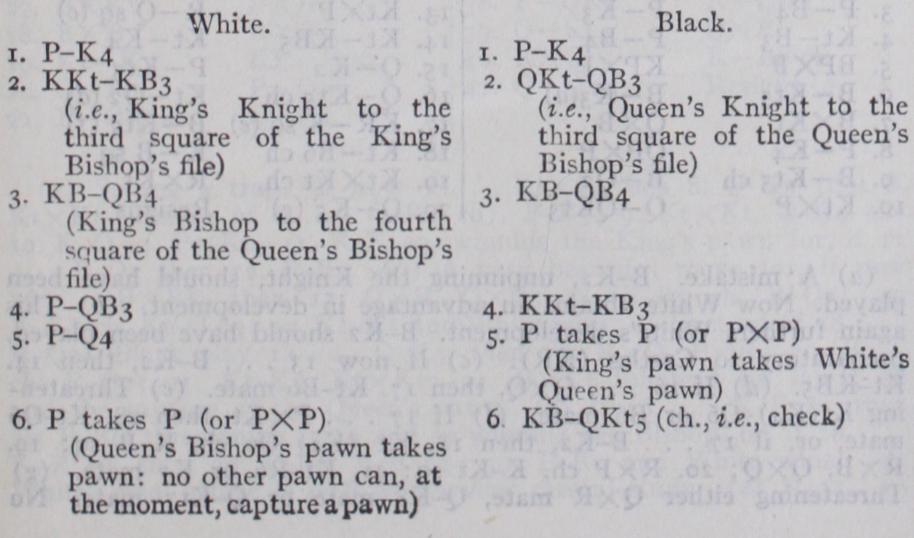
The French names for the pieces are King, Roi; Queen, Dame; Rook, Tour; Knight, Cavalier; Pawn, Pion; for Bishop the French substitute Fou, a jester. Chess is Les Echecs.
The German notation employs the alphabetical characters a, b, c, d, e, f, g and proceeding from left to right, and the nu merals I, 2, 3, 4, 5, 6, 7 and 8, running upwards, these being always calculated from the white side of the board (see diagram 2). Thus the White Queen's Rook's square is ai, the White Queen's square is di ; the Black Queen's square, d8 ; the White King's square, er ; the Black King's square, e8, and so with the other pieces and squares. The German names of the pieces are as fol low: King, Konig; Queen, Dame; Rook, Turin; Bishop, Laufer; Knight, Springer; Pawn, Bauer. Chess is Schack.
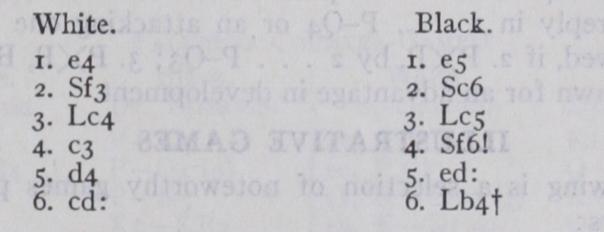
The initials only of the pieces are given, the pawns (Bauern) being understood. The Germans use the following signs in their notation, viz.: for "check" (j) ; "checkmate" () ; "takes" ( :) ; "castles on king's side" (o–o) ; "castles on queen's side" (o–o–o) ; for "best move" a note of admiration ( !) ; for "weak move" a note of interrogation (?). The opening moves just given in the English will now be given in the German notation: In both notations the moves are often given in a tabular form, thus: I . P–K4 r . the moves above the line being White's and below the line Black's.
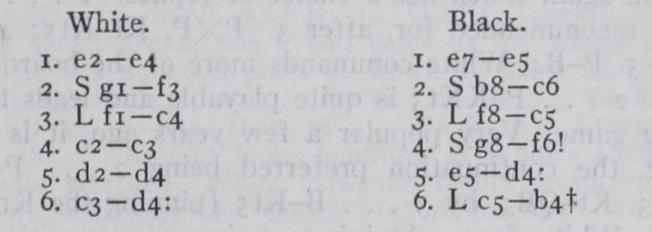
In the German notation the moves are sometimes still further abbreviated, e.g., the moves given above could also be given thus: