
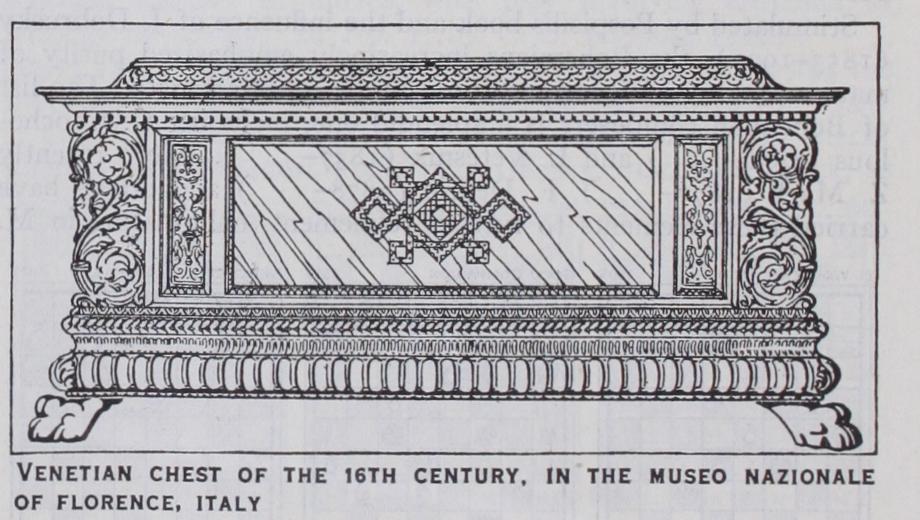
CHEST, a large box of wood or metal with a hinged lid. The term is used for many different kinds of receptacles ; and in anatomy is transferred to the portion of the body covered by the ribs and breastbone (see RESPIRATORY SYSTEM). Chests as articles of furniture are of the greatest antiquity. The chest was the com mon receptacle for clothes and valuables, and was the direct an cestor of the "chest of drawers," which was formed by enlarging the chest and cutting up the front. It was also frequently used as a seat. Indeed, in its origin it took in great measure the place of the chair, which, although familiar enough to the ancients, was a luxury in the days when the chest was already an almost uni versal possession. In the early middle ages the rich possessed them in profusion, used them as portmanteaux, and carried them about from castle to castle. These portable receptacles were often covered with leather and emblazoned with heraldic designs. As houses gradually became more amply furnished, chests and beds and other movables were allowed to remain stationary; and the chest finally took the shape in which we best know it—that of an oblong box standing upon raised feet. As a rule it was made of oak, but sometimes of chestnut or other hard wood.
There is usually a strong architectural feeling about the chest, the front being divided into panels, which are plain in the more ordinary examples, and richly carved in the choicer ones.
The plinth and frieze are often of well-defined guilloche work, or are carved with arabesques or conventionalized flowers. Archi tectural detail, especially the de tail of wainscoting, has indeed been followed with considerable fidelity, many of the earlier chests being carved in the linenfold pattern, while the Jacobean examples are often mere reproductions of the pilastered and recessed oaken mantlepieces of the period.
Occasionally a chest is seen which is inlaid with coloured woods, or with geometrical parquetry. Perhaps the most elaborate type of English parquetry chest is that named after the vanished Palace of Nonesuch. Such pieces are, however, rarely met with. The entire front of this type is covered with a representation of the palace in coloured woods. Another class of chest is incised, sometimes rather roughly, but often with considerable geometrical skill.
The more ordinary variety has been of great value to the forger of antique furniture, who has used its carved panels for con version into cupboards and other pieces, the history of which is not easily unravelled by the amateur who collects old oak. Towards the end of the 17th century chests were often made of walnut, or even of exotic woods such as cedar and cypress, and were sometimes clamped with large and ornamental brass bands and hinges. The chests of the 18th century were much larger than those of the preceding period, and as often as not were furnished with two drawers at the bottom—an arrangement but rarely seen in those of the 17th century—while they were often fitted with a small internal box fixed across one end for ready access to small articles. The chest was not infrequently unpanelled and unorna mented, and in the latter period of its history this became the ruling type.
Coffer is the word properly applied to a chest which was in tended for the safe keeping of valuables. As a rule the coffer is much more massive in construction than the domestic chest it is clamped by iron bands, sometimes contains secret receptacles opening with a concealed spring, and is often furnished with an elaborate and complex lock, which occupies the whole of the underside of the lid. Pieces of this type are sometimes described as Spanish chests, from the belief that they were taken from ships belonging to the Armada. However, these strong boxes are frequently of English origin, although the mechanism of the locks may have been due to the subtle skill of foreign lock smiths. A typical example of the treasure chest is that which belonged to Sir Thomas Bodley, and is preserved in the Bodleian library at Oxford. The locks of this description of chest are of steel, and are sometimes richly damascened.
Another kind of chest in use in earlier days was that signified in the expression a "chest of viols." This took the form of a sol idly-constructed, baize-lined press or cupboard, designed to ac commodate stringed musical instruments—in the case of a "chest of viols," six viols of varying sizes.