
CHICAGO, a city, a port of entry and the county seat of Cook county, Illinois, the second city of the United States in population, commerce and manufacture; pop. (1900) 1,698,575; (191o) 2,185,283; (1920) 2,701,705; The in crease in the decade, 1920-30, partly as a result of annexations, was the largest gross gain in the history of the city. The percentage of increase was 25.o, the smallest, except for the decade 1910-20, in the city's history.
The population of the metropolitan district of Chicago, embrac ing suburbs of the city both in Illinois and Indiana, but excluding adjacent communities in Wisconsin, was 4,364,755 in the year 1930.
As is the case with most American cities, the growth of the population of Chicago has decreased relatively to the growth of the outlying communities of its metropolitan area. The rate of regional growth about the city seems to be increasing as the rate of strictly urban growth declines, largely because of the extension of motor traffic and hard-surfaced highways. The percentage of increase in the period 1910-20 was less than that of any other decade, and the percentage for the next decade, 1920-30, while somewhat larger, was the next smallest. Chicago is situated at the south-west corner of Lake Michigan (lat. 41° 5o' N., long. 87° 38' W.), about 913m. distant by railway from New York, 912m. from New Orleans, 2,265m. from Los Angeles and 2,33om. from Seattle. The climate is very changeable and is much affected by the lake; changes of more than 3o° in tem perature within 24 hours are not rare, and changes of 20° are common.
The city is the greatest railway centre of the United States; and was for several decades practically the only commercial outlet of the great agricultural region of the northern Mississippi valley. Trunk-lines reach east to Montreal, Boston, New York, Philadelphia, Baltimore (the nearest point on the Atlantic coast, 854m.) ; south to Charleston, Savannah, Florida, Mobile, New Orleans, Port Arthur and Galveston ; west to the Pacific at Los Angeles, San Francisco, Seattle and Vancouver, and to most of these by a variety of routes. Thirty-two trunk-lines operated by 22 railway companies enter the Chicago terminal district. In this terminal system about 41% of the total freight tonnage of the United States is loaded and 0% unloaded annually. Chicago is also the greatest Canadian railway centre from a traffic stand point. The Canadian National lines and the Canadian Pacific enter it through subsidiaries. Chicago's passenger terminal situa tion, like her intramural rail transit problem, is being altered to fit the great city, which grew up around the original railheads and tl1en passed miles beyond them. In 1911 the passenger station of the Chicago and Northwestern railway, a dignified structure costing $20,000,000, was opened for service. The rail ways using the union station directly south of this terminal—the Pennsylvania, the Burlington, the Chicago and Alton and the St. Paul—completed in 1925 their terminal at a cost of $75,000,000. With the construction of a great postal terminal building near by, this completed the rearrangement of the terminals of the six railroads on the west side of the Chicago river. But the far more numerous railways entering four passenger terminals on the south side, have spent years working out a plan for consolidation and rearrangement among themselves. Decline of railway passenger traffic because of automotive and aerial competition and weakened railway finances have diminished interest in these projects. But the straightening of the Chicago river followed by the building of through streets through the area foreshadows its better use. Building of industrial structures over railway tracks and lease of railway "air rights" has begun. It is hoped that this will ac celerate the electrification of the railway terminals. The first railway electrification was completed July 21, 1926, when the Illinois Central railway opened its electrified suburban passenger service over the 3om. from Matteson, Ill., to Randolph street at a total cost of $40,000,000.
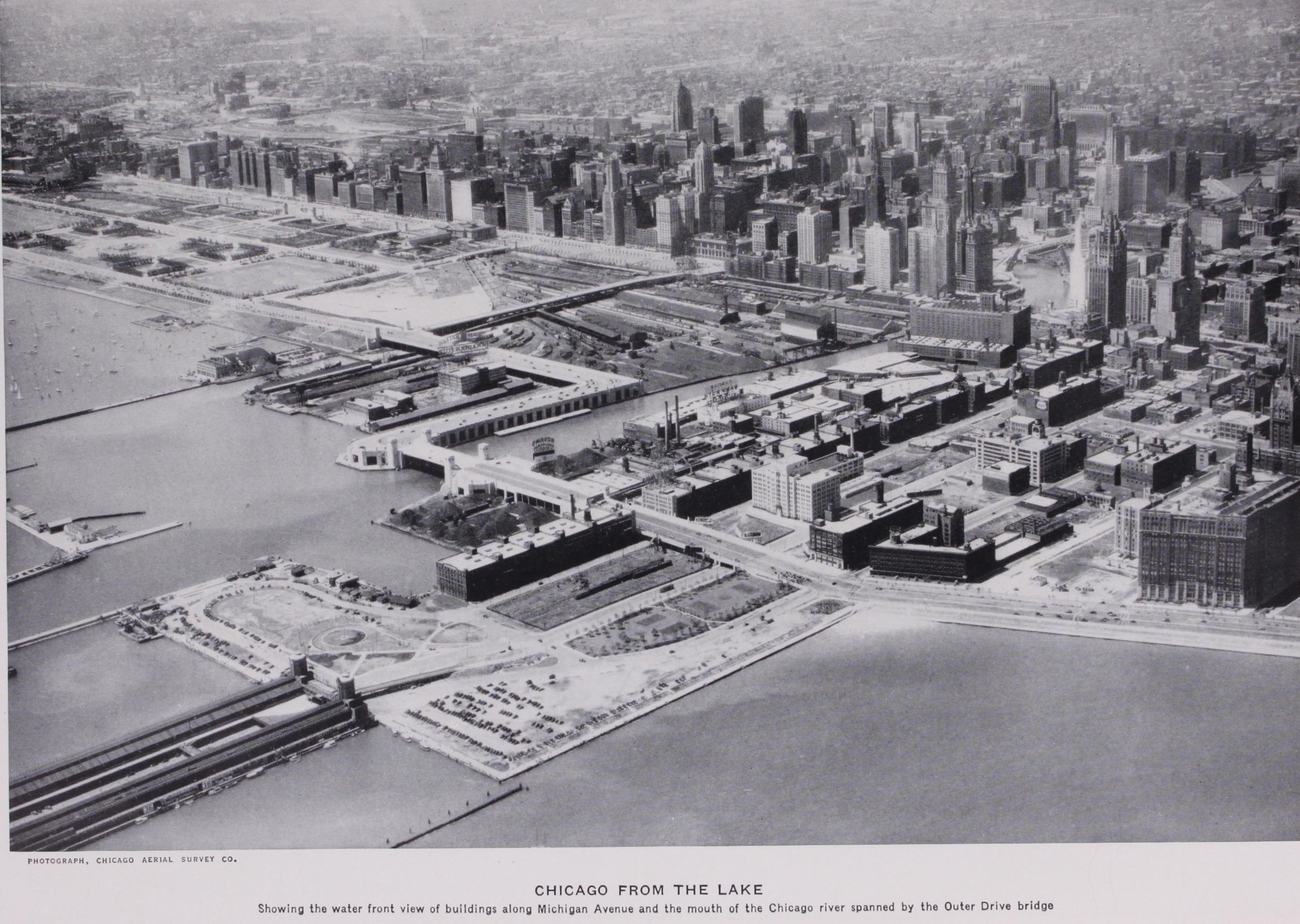
With its suburbs within the area of the Chicago railway terminal district, Chicago occupies a crescent-shaped area, the concave side of which is the shore of Lake Michigan. This Chicago district is 1,119.29 sq.m. in extent, about the size of the State of Rhode Island, and lies along the lake shore for about 55m. (the incorporated city proper for 26.5m.). The city proper has an area of 201.9 sq.m. It spreads loosely and irregularly backward from the lake over a shallow alluvial basin, which is rimmed to the west by a low moraine water-parting that separates the drainage of the lake from that of the Mississippi valley. The city site has been built up out of the Lake Chicago of glacial times, which exceeded in size Lake Michigan. Three lakes—Calu met, 3,122ac. ; Hyde ; and part of Wolf—with a water-surface of some 4, Zooac., lie within the municipal limits. The original eleva tion of what is now the business heart of the city was only about 7ft. above the lake, but the level was greatly raised—in some places more than 'oft.—over a large area, between 1855 and 1860. The west side, especially the north-west near Humboldt park, is much higher (highest point, 75f t.). A narrow inlet from the lake, the Chicago river, runs west from its shore about a mile, dividing then into a north and south branch, which run respectively to the north-west and the south-west, thus cutting the city into three divisions known as the north, the west and the south "sides," which are united by three car-tunnels beneath the river as well as by the bridges across it. The river no longer empties into Lake Michigan since the completion of the drainage canal. Its com mercial importance is yet very great, but with the change in the character of lake traffic it is diminishing, and this stream and harbour upon which Chicago's history and greatness were based are now looked upon primarily as an obstruction to urban street traffic. Agitation for the abolition of the river as a shipway and for the substitution of fixed bridges for the draw, lift and bascule types which now span it, is active. Ship traffic on the lake has become principally a matter of the transport of bulk cargoes of iron ore, coal, coke and limestone direct from mine rail terminals to the great iron, steel and cement plants with their own docks on the south shore of Lake Michigan. Traffic has shifted to the ports on the southern extremities of the city, Calumet, Indiana Harbour, etc. ; and steamers formerly docking in the river call at the municipal pier or dock in the outer harbour. Some lake cargo destined for Chicago is landed at Milwaukee and comes in by rail.
Upon the completion of the Illinois waterway, connecting Chi cago, through the Illinois and Mississippi rivers, with New Orleans by a barge route of 9ft. draft, the Chicago river became an impor tant link for through water traffic, but it is proposed to obviate this by widening a direct canal to connect the south lake har bour with the drainage canal, which will constitute a link of the waterway. The improvement of the outer harbour by the Federal Government was begun in 1833. Great breakwaters protect the river mouth from the silting shore currents of the lake and afford secure shelter in an outer roadstead from its storms, and there is a smaller inner basin (about 45oac., i6ft. depth) as well. The river itself has about 15m. of navigable channel, in part lined with docks. Its channel has been repeatedly deepened and, especially since 1896, after its control as a navigable stream passed (1890) to the Federal Government, widened and straightened by the removal of jutting building constructions along its shores. Grain elevators of enormous size, coal-yards and once warehouses crowded close upon it. In 1927 the south bank of the river from the Michigan avenue bridge to Lake street, which is the northern boundary of the Loop business district, was completely denuded of abutting buildings by the opening of the two-level Wacker drive, a broad boulevard upon a gigantic concrete structure occupying the space of former blocks of buildings and streets. This construc tion, which cost about $28,000,000, and which connects with the new Michigan avenue bridge and the two-level boulevards ap proaching it, is the first item of a programme designed to con vert the entire south and east banks of the river into broad traffic arteries. Farther south, under an agreement of the railways, property owners and the city, the south branch of the river which curves to the east for about a mile of its length was moved westward for a maximum distance of a quarter of a mile, to allow of the construction of four wide streets leading from the south into the Loop district. This plan, which is also an aid to the recon struction and electrification of the south side railways, is estimated to have cost $8,000,000, with an ultimate expenditure of $162, 000,000 by the railroads affected, in the reconstruction of the south side railway terminals.
The plan of the city was originally regular, i.e., rigidly rec tangular, and the original streets were wide according to the stand ards of the days of horse-drawn traffic. The original plan has been altered by the construction of a great number of boulevards in the outer areas, which in connection with the growth of the park sys tem and the construction of driveways in the parks have provided numbers of diagonal traffic arteries. The recovery of land from the lake and the construction of a great parkway system along the lake front have also led to the belting of the down town areas on the east with a number of north and south boulevards not in keeping with the original plan of the city. The initiation and completion of these projects have been so rapid and the number of new plans in various stages of execution is so great that the older parts of Chi cago have been profoundly altered, especially since the beginning of the great building boom in 1922.
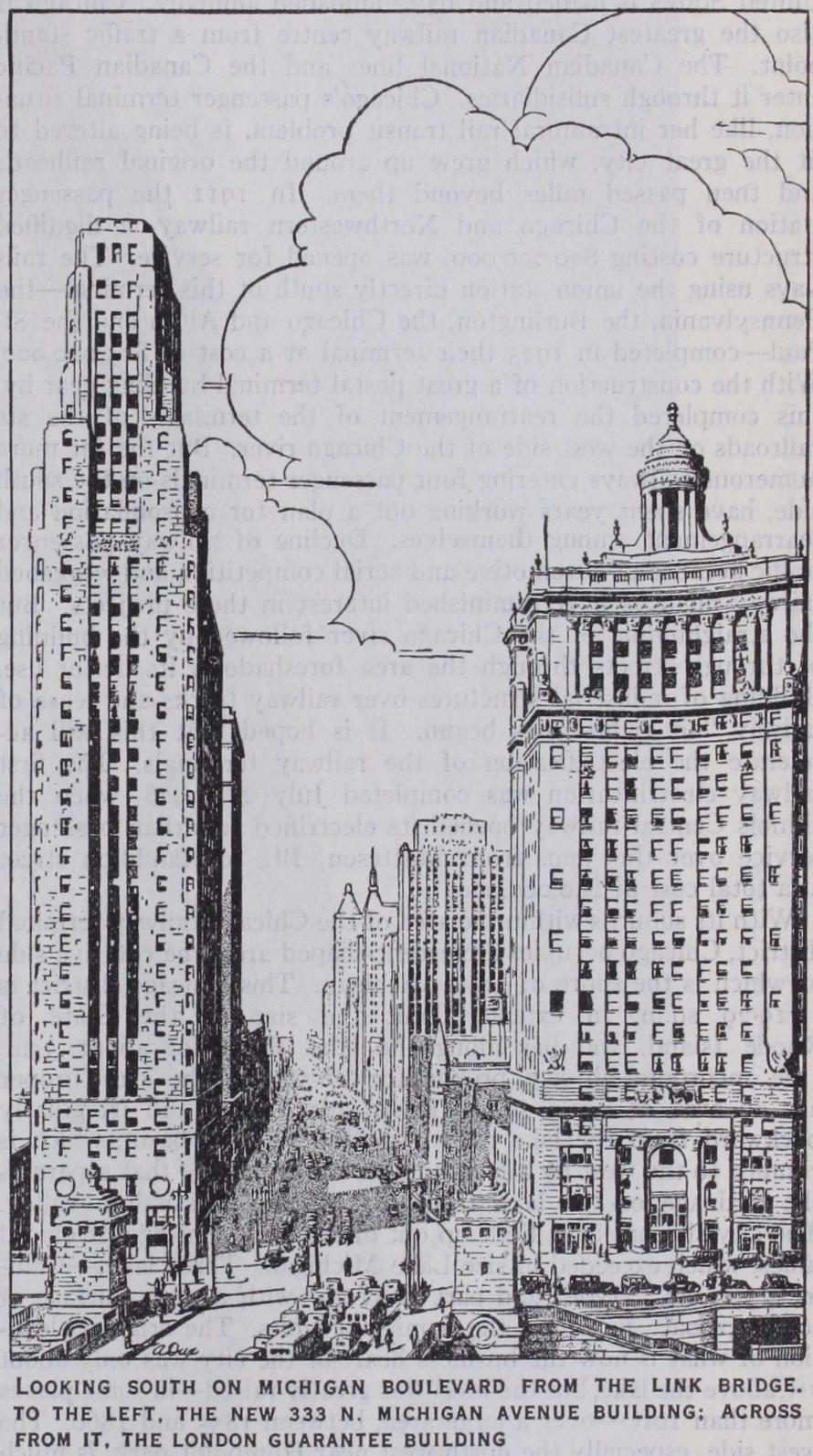
Rapid transit by rail has not kept pace with these improvements in streets. One result of this is that a number of outlying business, hotel and apartment centres have grown up, which are beginning in the aggregate to rival the Loop, the former business, financial, theatrical and hotel centre. Chicago has begun to develop into a series of urban centres rather than a centralized city on the usual American model. Notwithstanding the growth of these outlying centres, however, the construction of great buildings within the Loop from 1922 to 1928 proceeded at a pace never approached before, while the opening of Wacker drive and the Michigan avenue bridge enabled the business district to break out of the narrow confines of the former Loop district—the 1.5 sq.m. lying between the lake, the main Chicago river and the south branch of the river. This northward advance of the business district was accompanied by the construction of numbers of the tower type of office building. This forest of bold and graceful towers has re lieved the former drab monotony of down town Chicago. The construction of so many great office buildings and hotels in the down town district has made the problem of street congestion in creasingly acute despite the enormous expenditures upon new boulevards. Hope for any material relief from the construction of the freight tunnels vanished with the advent of the popular priced automobile, and the capacity of these underground freight ar teries is such that they can handle only a trifling percentage of the movement of goods in the district. A belt of "bad lands"— deteriorated residence, shop and factory property, surrounds the business district except on the north-east. Here a great section crowded with expensive family and apartment hotels has grown up on the lands reclaimed from the lake in the section called "Streeterville"—named from a belligerent old squatter, who long claimed title to these accretions, because his schooner had stranded on that shore. Chicago's architectural achievements are yet blighted by the use of soft coal which after a time smears a drab colour on the finest structures. Vigorous efforts to combat this nuisance have had small results. Yet the skyline, the immensity of the traffic movement and the massiveness of its central district give the city a distinct tone, found nowhere else.

The unstable soil of sand, clay and boulders that underlies the city is unfavourable to tall constructions, and necessitates ex traordinary attention to foundations. The bed-rock lies, on an average, soft. below the level of the lake (in places more than loo). The foundations are often sunk to the rock in caissons, the buildings resting on monster columns of concrete and steel. In other cases great "pads" of the same materials, resting or "float ing" upon the clay, sustain and distribute the weight of the build ing.
Buildings notable for their architectural boldness and the beauty which has resulted from the conversion of the economics of the tall structure to aesthetic purposes are the Chicago temple, a spire above an office pile, the Tribune tower distinguished for its flying buttresses, the Wrigley building with its campanile tower, the Civic Opera building which faces across the river, the ultra modern Daily News building and Plaza.
A large part of the business of the former dry goods wholesale district is now housed in the huge Merchandise Mart on the north bank of the river which could hold the entire population of the city standing.
The new Board of Trade building topped by a statue of Ceres poised 612 feet in the air towers over a forest of towers in the financial district of LaSalle street.
Older buildings associated with the city's history or notable architectural triumphs of their day are the Auditorium containing a hotel and a theatre which seats 5,000, long the home of Grand opera, the Masonic temple, the Monadnock, the People's Gas building, the La Salle, Blackstone and Sherman hotels and the Marquette building. There are a number of enormous retail stores. The largest, and one of the finest in the world, is that of Marshall Field and Co.
The city hall and county court house (cost $4,500,000) is an enormous double building in a free French Renaissance style, with columned facades.
The Federal building (finished in 1905; cost, $4,750,000) is a massive edifice (a low rectangle surmounted by a higher inner cross and crowned with a dome) . The public library (1893-97, $2,125,000), constructed of dark granite and limestone, with rich interior decorations of varied frescoes, mosaics, ornamental bronze and iron work, and mottoes, is one of the handsomest libraries of the country. The Chicago Art Institute, the Chicago Orchestra building, and the Rosenwald Museum of Science and Industry, are also noteworthy. The Field museum completed in 1920 at a cost of $6,000,000 is a white marble structure in Ionic style, 35oft. wide and 7ooft. long.
Navy pier, completed in 1915, projects 3,000ft. into Lake Michigan, north of the mouth of the Chicago river and corn bines the functions of an enormous dock and a playground; the outer portion, 66oft. long, is a three-decked structure devoted to amusement and recreation purposes. The movement of wealthier residents to surrounding communities has left the city proper with out any notable street of private homes, although many of the older boulevards are fringed by dignified houses. The physical growth of Chicago in the 27-year period prior to 1936, was guided by a definite plan laid down by the Chicago plan commis sion, created by the city council during the administration of Mayor Fred A. Busse. The plan had its genesis in a report of Daniel H. Burnham and was submitted by the Commercial club to the city and adopted as an enduring policy. It took cognizance of the natural features of Chicago's site and environs and proposed the gradual adaptation of the city then existing, and the city as it grew, to the best uses of its natural setting—from a commercial, industrial, social and cultural standpoint. Eighteen of the major projects of the Chicago plan have already been realized. In its original entirety the plan will probably be completed in 1950, but it has been constantly modified and expanded to keep pace with new conditions and problems. Railroads, public utility corn panies and industrialists have co-operated to carry out its designs. The Chicago plan has demonstrated that the most intensive mod ern industrialism and commercial activity can be profitably har monized with beauty, social welfare and ample recreational and cultural centres for the people of a metropolitan city.
The first adverse decision by the Supreme Court was handed down Jan. 5, 1925. Finally that tribunal decreed that the diver sion of water should be reduced to I soo cu.ft. per second by 1938. The sanitary district was given time to construct sewage purifi cation works, but its extravagance and depleted resources would have made that impossible had it not been for the aid of the Federal treasury extended as a part of the grants designed to relieve unemployment.
Chicago was early a center of aerial transport. The municipal airport was established in 1927 and is now the busiest in America. In 1935 the average arrivals and departures of regular scheduled planes per day was slightly in excess of zoo. In pas sengers arrived at and 61,006 departed from the port. Auxiliary airports available for both military and civil purposes are located at convenient points throughout the metropolitan district and lighted routes make night flying possible from Chicago to the Atlantic and Pacific coasts. Regular flying time to New York has been cut to four hours and a half. Overnight schedules to the Pacific ports are maintained by the air lines.
Atrophy of the city's internal traction and elevated systems during the period 1907-27 was partially compensated for by the establishment of numerous motor bus lines on the boulevards and parkways, and by the extension and modernization of electric rail ways in the outlying regions. Numerous bus lines connecting Chicago with other towns and cities have come into competition with the railways. Another great improvement was begun in 1901 by a private telephone company. This is an elaborate system of freight subways, more than 65m. of which, underlying the entire business district, had been constructed before 1909. It is the only subway system in the world that seeks to clear the streets by the lessening of trucking, in place of devoting itself to the transporta tion of passengers. Direct connection is made with the freight sta tions of all railways and the basements of important business buildings, and coal, building materials, ashes and garbage, railway luggage, heavy mail and other kinds of heavy freight are, ex peditiously removed and delivered. Telegraph and telephone wires are carried through the tunnel, and can be readily repaired. The subway was opened for partial operation in 1905. However, street traffic growth has been so great and the capacity of the tunnels so small, that the 120 locomotives and 3,00o cars operated in the tunnels handle less than i o% of railway freight loaded or un loaded in the business district.
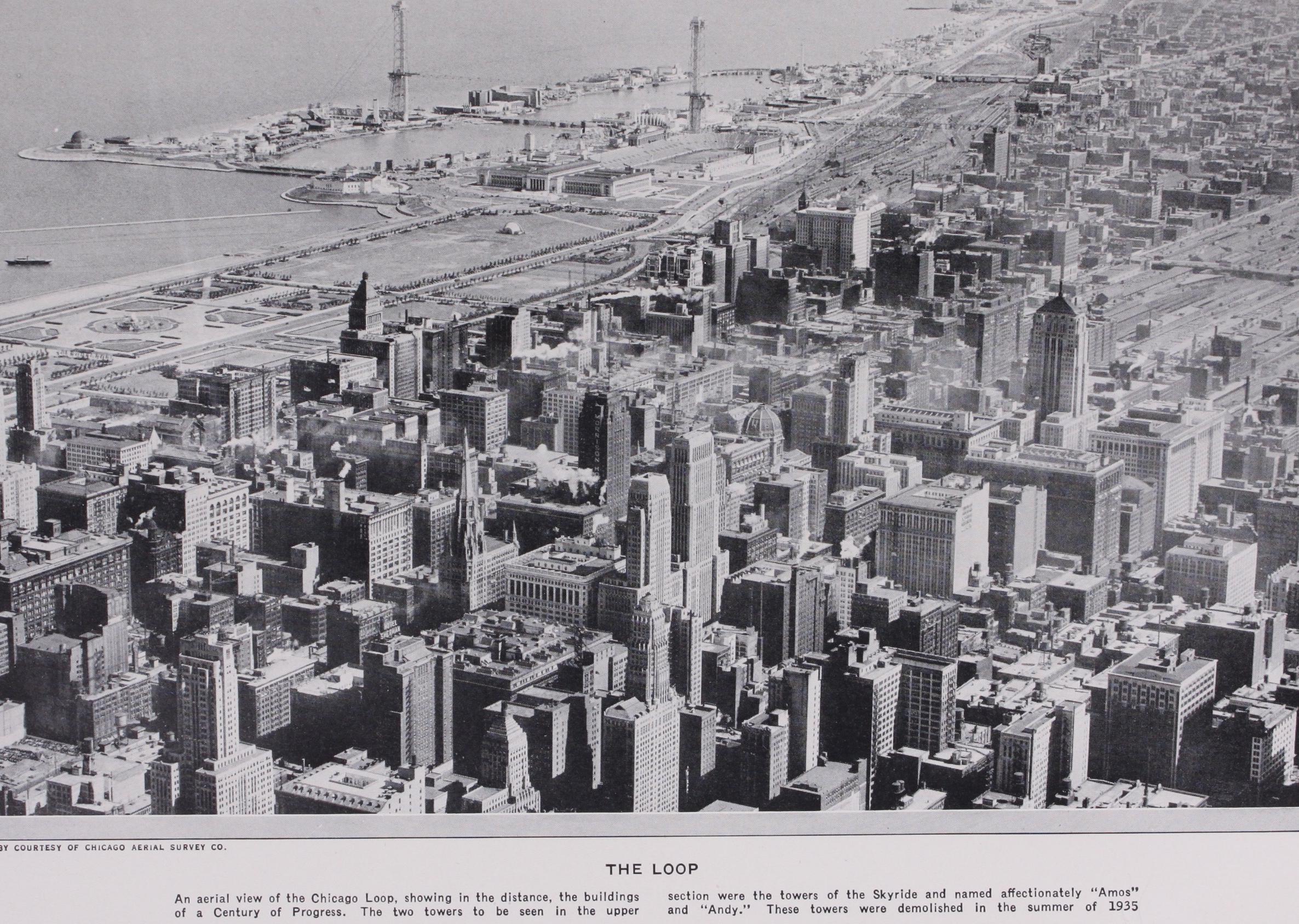
The older parks include several of great size and beauty. Lincoln park, on the lake shore of the north side, has been much enlarged by an addition reclaimed from the lake. It has fine monuments, conservatories, a zoological garden and the collections of the Academy of Sciences. Jackson park, on the lake shore of the south side, was the main site of the World's Columbian Exposition of 1893. It is joined with Washington park by the Midway Plaisance, a wide boulevard. Along the Midway are the greystone buildings of the University of Chicago, and of its (Blaine) School of Educa tion. On the west side are three large parks—Douglas, Garfield (with a fine conservatory) and Humboldt, which has a remark able rose garden, and in the extreme south side several others, in cluding Calumet, by the lake side, and Marquette. Jackson boule vard, Western avenue boulevard and Marshall boulevard join the south and the west park systems. The shore of the north side is quite free, and beginning a short distance above the river is skirted for almost 3om. by Lake Shore drive, Lincoln park and Sheridan Road. In Grant park is the building of the Art Institute, the Shedd Aquarium, the Adler Planetarium, the Field Museum of Natural History and Soldier field, a great stadium de voted to sports and pageants, with a capacity of about 125,00o. About two-thirds of the city's frontage on the lake was composed of parks or boulevards in 1927. The inner boulevards and the drives through the lake front parks are parked ways ranging from 15o to 300f t. in width.
Art.—A city art commission approves all works of art before they become the property of the city, and at the request of the mayor acts in various ways for the city's aesthetic betterment. The Architectural club labours for the same end. A municipal art league (organized in 189o) has done good work in arousing civic pride ; it has undertaken, among other things, campaigns against bill-board advertisements and against the smoke nuisance. The Art Institute of Chicago contains valuable collections of paint ings, reproductions of bronzes and sculpture, architectural casts and other objects of art. Connected with it is the largest and most comprehensive art school of the country—including classes in newspaper illustration and a normal school for the training of teachers of drawing in the public schools. The courses in archi tecture are given with the co-operation of the Armour Institute of Technology. The Kenneth Sawyer Goodman memorial theatre, associated with the institute, opened its first season of endowed repertory in 1925. A school of the drama is conducted in con nection with the theatre. The trustees of the Art Institute admin ister the Ferguson monument fund, left by the will of Benjamin Franklin Ferguson, to be used for the erection of statuary and monuments in Chicago. Among others, two notable pieces by Lorado Taft have been purchased: "The Fountain of the Great Lakes" stands just to the south of the Art Institute; "The Foun tain of Time," at the head of the Midway, between Washington and Jackson parks. The Field museum of natural history, estab lished (1894) largely by Marshall Field, is mainly devoted to anthropology and natural history. The nucleus of its great col lection was formed by various exhibits of the Columbian Exposi tion which were presented to it. Its collections of American eth nology, of exceptional richness and value, are constantly aug mented by research expeditions.
The Chicago Grand Opera company organized in 1910 was reorganized in 1915 as the Chicago Opera association and in 1921 as the Chicago Civic Opera company. Heavy deficits and a pre carious life have been characteristic of the art, but the Chicago City Opera survives. The Chicago Symphony orchestra was founded in 1891 by Theodore Thomas, who conducted it until his death on Jan. 4, 1905. He was succeeded by Frederick A. Stock. Late in 1904 Orchestra hall was built from money raised by popu lar subscription, and this building has made the orchestra self-supporting. The orchestra plays from 110 to 120 concerts each season. In addition Chicago has dozens of lesser orchestras, choral organizations, and many musical schools of large member ship.
The oldest choral organization is the Apollo Musical club which dates back before the great fire of 1871.
Libraries.—At the head of the libraries of the city stands the public library established in 1872, the nucleus of which was a collection of books from England made by Thomas Hughes, author of Tom Brown's School Days, of ter the great Chicago fire of 1871, a collection to which Queen Victoria and other contemporary British notables made contributions. The library was opened in 1874. The main library has 1,687,288 volumes, in addition to independent collections ranging from 5,00o to 50,000 in 45 gen eral branches, 3o high school branches and 12 sub-branches. The circulation of books in 1932, in addition to those used on the main shelves of the central library, was 15,558,622. The John Crerar library, endowed in 1889 by John Crerar, wealthy manu facturer of railway supplies, had in volumes and 300,00o pamphlets on social, physical, natural and medical sci ences and their applications. It occupies a large building across the street from the main building of the public library at Randolph street and Michigan avenue. The Newberry library, endowed by a bequest of Walter L. Newberry, in 1933 contained 493,549 volumes, chiefly in the field of the humanities, history and litera ture. These three libraries co-operate to avoid useless duplication and each has certain special fields. Other important collections are the library of the University of Chicago, the Burnham library of Architecture and the Ryerson library in the Art Institute, devoted to fine arts and travel, the library of Northwestern University, the Field Museum, the Rosenwald Museum, the Virginia, the Lewis Institute, the Elbert H. Gary law library, the Loyola university, the Garrett Biblical institute and the municipal reference library containing a great collection of documents and data on municipal government in Chicago and elsewhere.
Many trade, engineering and professional organizations main tain special libraries at their national or sectional headquarters in Chicago.
Industry and Commerce.—Chicago's situation at the head of the most south-western of the Great Lakes has given it great importance in trade and industry. The growth of its trade has been marvellous. Since the beginning of the loth century, how ever, Chicago has undergone an industrial and commercial trans formation roughly parallel to that of the United States as a whole. The city's paramount position as a great market in the 19th cen tury was associated with the extractive industry of the American economy of that day, and Chicago's trade consisted principally in the assembly and distribution of the raw crops and resources of fields and forests—her industries were mainly processing raw products, such as meat-packing, wood-working, flour-milling, tan ning, etc. While these great industries remain important, Chicago's leading position in regard to them, except in meat-packing, has disappeared, but this has been made up many times by the growth of an intensive industrialism. The city has made great strides as a centre of the iron and steel industry, including many other products such as cement. The Calumet steel and iron region south of the city has made tremendous progress since the found ing of the steel city of Gary in 1906 just across the Indiana State boundary, and in manufacturing plants for heavy iron and steel products the Chicago region now stands to the Pittsburgh dis trict—America's leading steel region—in the ratio of 1 o to 13, while the operations are more continuous in the Chicago district.
The last years of the 19th century showed, however, an in evitable loss to Chicago in the growth of Duluth, Kansas city and other rivals in strategic situations. In particular the struggle of the north and south railway lines in the Mississippi valley to divert grain and other freight to ports on the Gulf of Mexico caused great losses to Chicago. An enormous increase in the cereal trade of Philadelphia, Baltimore, Newport News and Norfolk was partly due to the traffic eastward over lines south of Chicago. The traffic of the routes through Duluth and Canada does not, indeed, represent actual losses, for the traffic is largely a new growth ; but there has been nevertheless a considerable drain to these routes from American territory which was once tributary to Chi cago. Altogether the competition of the Gulf roads and the lines running south-west from Duluth had largely excluded Chi cago by 1899 (according to its Board of Trade) from the grain trade west of the Missouri river ; its facilities for receiving and distributing remain nevertheless unequalled, and it still practically monopolizes the traffic between the northern Atlantic seaboard and the Central West. The city's position as a gateway for passing trade is indicated by the fact that one-eighth of the traffic of its railway terminals is through traffic.
With the completion of the Lakes to the Gulf waterway, and the conversion of Chicago into a virtual seaport by the construction of a shipway through the lakes and the St. Lawrence river to the Atlantic, Chicago may again become relatively as important as it was in the 19th century, as an outlet for the midwest and the mountain States. New York alone among American cities has a greater trade. Chicago is the greatest railway centre, the greatest grain market, the greatest livestock market and meat-packing centre in the world and holds world primacy in a large number of smaller manufacturing industries.
Chicago has never participated to a great extent in interna tional finance. The collapse of the speculative boom of 1929 and the bankruptcy of the Insull utility investment corporations checked a promising growth of domestic finance and investment banking.
Annual bank clearings for 1934 totalled $9,241,377,454, or about a fourth of the clearings of 1928. At the close of Chicago banks had loans and discounts of $J94,165,000, deposits of $2,077,575,000, cash resources of $744,033,000 and savings deposits of The city's wholesale trade was estimated in 1875 at $293,900, 000. In dollar value it reached a peak of $5,870,166,410 net sales disclosed by the census of distribution for 1929. In the ensuing depression money value declined greatly and physical vol ume fell off to a lesser extent. The retail trade of the city re ported by the census of 1929 amounted to $2,127,520,000 in net sales.
Although the Chicago board of trade remains the greatest spec ulative grain market in the world, governmental regulations of increasing stringency have restricted trading upon the board. The grain elevators are yet among the sights of Chicago. They are enormous storehouses into which the grain is elevated from ships and cars, sorted into grades and reloaded for shipment, all the work being done by machinery. America has almost ceased to be an exporter of beef, but shipment of pork products—mostly hams, shoulders, bacon and lard—is yet an important item in Chicago's foreign trade. Chicago's direct foreign trade is mostly by rail through other ports, although vessels of less than 14f t. draft come in from the Atlantic on special trade voyages. Im ports for the fiscal year 1934 (mostly in bond by rail) amounted to $29,620,844. Direct exports for the fiscal year 1934 were valued at $5,504,214.
The Chicago industrial district comprising the counties of Cook, Du Page, Kane, Will and Lake in Illinois and Lake in Indiana is the second largest in the United States. In 1929 the district had 11,774 manufacturing establishments, 550,903 factory wage earners and produced goods valued at $5,558,331,242. In 1931 economic depression had reduced the number of establish ments to 10,274. The number of wage earners was 38 2,85 2 and the value of goods produced was $3,097,672,800. Substantial recovery began in 1933 but in both manufacturing and trade the depressed condition persisted through 1935. As high as 192,000 families were on public relief rolls in Cook county at one time at a monthly expense of $6,063,207.
Products of manufacturing establishments of the Chicago in dustrial area in 1931 included meat packing $379,404,266, electri cal machinery $160,879,725, railway cars $27,223,372, men's clothing $56,699,877, women's clothing $46,076,313, bread and bakery products $90,072,065, foundry products $113,181,754, iron and steel works products $208,480,503, motor vehicles, bodies and parts $36,095,385, paints and varnishes printing and publishing $240,672,723, furniture $37,574,162, con fectionery $73,380,810, perfumes and cosmetics $22,077,698, radio and phonographs $35,061,288. The International Harvester company, successor to the McCormick Harvester company, is the largest manufacturer of agricultural machinery in the world and the Western Electric company holds the same position in the manufacture of telephone equipment. The Pullman company not only manufactures railway freight and passenger cars but operates sleeping and drawing-room cars on practically all the railways of the country. Meatpacking, for which Chicago is best known, is the greatest local industry. In the enormous stock-yards (about 5ooac. in area) from two-thirds to four-fifths of the cattle and hogs received are killed, and sent out in various forms of pre pared meats and by-products (lard, fertilizers, glue, butterine, soap, candles, etc.).
The company serving the incorporated city consumes about tons of coal annually and for condensing purposes alone pumps an average of 1,220,000,000 gallons of skater per day; more than the daily pumpage of the city water works. The local gas industry serves 830,000 consumers within the incorporated city and is inter-connected by pipe lines with the natural gas fields of Texas and with producing plants and consumers within a wide radius of the city.
It makes use of surplus by-product gases generated in the steel and iron industry. Telephonic communication is in almost uni versal use by householders and in 1935 the work of converting the telephone system to the automatic switching type was almost completed.
Like most American cities Chicago has a dual city and county government. Cook county, which contains Chicago, retains prac tically all of the extensive government functions of rural counties of the type which arose in Virginia and the southern colonies, and in which the county was the real unit of local government. This complication of dual government in Cook county extends to the suburbs of Chicago, which have separate municipal organizations, while the county itself was laid out after 1848 in townships, some what on the New England town model. It was not until 1900 that the town organizations within the territory gradually annexed to the original village of Chicago were deprived of their politi cal structure and divested of governmental functions within the city, and as late as 1903 ten townships exercised taxing power within the municipal area. A plan for the consolidation of local government was rejected by the people in 1920. In addition to the original duplications of government, new quasi-governmental bodies have been set up for special purposes and in some cases granted police and tax powers.
There are 410 distinct political units in Cook county, empow ered to levy 60o different sorts of taxes. The average citizen of Chicago is under the jurisdiction of or in contact with 25 different kinds of governments. But in 1934 the voters approved the con solidation of 22 formerly independent park districts, and these great properties with annual budgets of many millions are now under a board of five appointed by the mayor. Formerly they were a species of independent principalities within the city. Officials of some were appointed by the governor of Illinois, some were elected by the judges of the courts, some by the voters of the districts. They had powers of police, taxation and debt incurment.
In 5906 the archaic system of administering petty justice through the justices of the peace was abolished and a co-ordinated municipal court with numerous judges and a chief justice was established. The juridical system is complicated by the fact that the circuit court is a constitutionally established court of the State of Illinois. The superior, municipal and other special courts are created by statute. The sanitary district, practically an inde pendent government in itself, with powers of tax levy and debt making, is superimposed over the territory of Chicago and Cook county. Both the State of Illinois and the Federal Government have also extended the legislative and administrative regulation of industry and commerce, and maintain large staffs of officials and inquisitors in Chicago. The school board has been nominally separate from and almost independent of the city government in its powers since 1857. The forest preserves adjacent to the city's boundaries are also quasi-governmental bodies exercising some sovereign powers.
The initiative and referendum in local matters have been made possible by the State, and this power has beep frequently exer cised. Increases of the public debt are subject to popular vote, but financial arrangements under such a complex system of gov ernment are naturally loose and inefficient—co-ordinated budget ing being virtually impossible. The grant of independent taxing power to so many governmental bodies, in the Chicago area, as elsewhere in America, is one result of State constitutional limita tions upon the public debt. Chicago, as a municipal corporation, is prohibited from incurring debt in excess of 5% of the value of the property within the city. The inevitable result of such a restric tion, when a great public necessity has arisen, is the creation of another taxing body not limited by pre-existing debt limits cover ing a given territory, within the jurisdiction of an existing govern mental body.
Finances.—The budget for the city of Chicago proper for called for the expenditure of $285,146,162, of which $71, 356,028 was to be expended by the school board, $18,185,330 by the water department, $1,884,816 by the municipal tuberculosis sanatorium, $936,175 on rivers and harbours, $1,775,397 by the public library board, $2,750,000 by the board in charge of fire men's pensions, $3,218,000 by the board administering police pensions, and $1,609,000 by the board in charge of pensions for other municipal employees. Other funds in the budget out of which a great variety of expenses are met, such as police, fire department and street and bridge maintenance, are the corpora tion fund of $65,274,986, and the debt service funds, amounting to $22,773,550. In 1935 Chicago's revenues were disorganized and sadly deficient as the result of the worst financial crisis in the city's history. The full effect of the economic depression of 1929 struck the city in the midst of a general reassessment of real prop erty to adjust gross inequalities of tax burdens. Taxpayers re fused or were unable to pay their taxes. Forty-one per cent of taxes due were delinquent in 1933. Teachers and other public em ployes went for months without pay. Subventions from the fed eral government in the form of relief allotments and make work grants helped the city tide over its crisis while rigid retrenchments were instituted. On January 1, 1934 the gross city debt was reck oned at $383,458,022 or $113 per capita, not a heavy burden as compared with New York or Philadelphia, but grievous because of demoralized revenues. During the crisis the city sold tax antici pation warrants and practically lived on future revenues, the collection of much of which was dubious.
Transit Problems.—Chicago's conspicuous failure as a city has been in the lack of providing adequate rapid transit facili ties. In 1935 the traction question remained unsettled and was still a "football of politics," although the popular temper as manifested at the referendum election of 1925, when a compro mise plan for instituting municipal ownership was defeated by a large majority, indicates that an eventual solution will be found on lines of ownership and control by a strictly regulated private cor poration. At the mayor's election in 1905 the successful party stood for immediate municipal acquisition of all roads. Mean while, under the State Referendum Act, the city in 1902 voted overwhelmingly for municipal ownership and operation (142,826 to 27.990) ; the legislature in 1903 by the Meuller law gave the city the requisite powers ; the people accepted the law, again declared for municipal ownership, and for temporary compulsion of adequate service, and against granting any franchise to any company, by four additional votes similarly conclusive. At last, after tedious negotiations, a definite agreement was reached in 1906 assuring an early acquisition of all roads by the city. The is sue of bonds for municipal railways was, however, declared uncon stitutional that year. At the municipal elections of 1907 there was a complete reversal of policy; a large majority voted this time against municipal ownership in favour of leaving the working of the street railways in private hands and strengthening the powers of municipal control. For 20 years after 1907 the surface car lines of Chicago were operated under unified management and rendered excellent service. The system was completely rebuilt, and that work led to the repaving of the city, so that the coming of the automobile age found Chicago comparatively well equipped for motor transport. But with the growth of the city and the congestion of the streets by motor traffic, transportation by sur face electric railways became too slow to meet the demands of the population. In the meantime the construction of elevated railway lines practically ceased, except for extensions outside the incorporated city limits where the political factor did not enter into calculations. Proposals for the consolidation of the elevated and surface lines and the construction of subways, either inde pendent systems or to be operated in connection with the elevated or surface lines or both, were made without number and the city spent great sums upon engineering investigations and reports. With the rise in the general price level during the World War the five cent fare became impossible and increases were obtained either through the Illinois commerce commission or by court action. This aroused more popular resentment and revived trac tion as a political issue.
Under the franchise arrangement of 1907 the city received 55% of the divisible net receipts of the surface lines—after payment of 5% on agreed capital which with interest earned on the fund amounted to $68,730,228 January 1, 1933. The city also has power to subject adjacent property to special assessments in aid of sub way construction. When the 1907 franchise expired in 1927 no agreement was reached.
The lines are operated under temporary agreements pending an adjustment of the conflicting claims and proposals. The State of Illinois has enacted legislation to empower the city of Chi cago to take the necessary steps toward a re-organization of the entire transit system.
The surface lines, consisting of 1,360m. carried 651,602,518 revenue passengers in 1934 The elevated system operates 231m. of track, in double, triple and four track sections, and carried Passengers in Education and Charity.—The school board is appointed by the mayor. Since 1904 a merit system has been applied in the advancement of teachers; civil service rules cover the rest of the employees. Free evening schools, very practical in their courses, are utilized mainly by foreigners. Vacation schools were begun in 1896. As far as possible the school buildings are kept open for school lectures and entertainments, serving as social centres; thus a more adequate use is made of the large investment which they represent. In all the public schools manual training, house hold arts and economy, and commercial studies are a regular part of the curriculum.
A department of scientific pedagogy and child study (1900) seeks to secure a development of the school system in harmony with the results of scientific study of children (the combination of hand and brain training, the use of audito-visual methods, an elastic curriculum during the adolescent period, etc.). Enrolment in the schools in 1934 totalled The teaching staff numbered 12,794- In 1934 the sum of $8,925,512 was devoted to new school buildings. There were 35 high schools, and 325 grade schools in Hospitals, infirmaries, dispensaries, asylums, shelters and homes for the defective, destitute, orphaned, aged, erring, friendless and incurably diseased; various relief societies, and associations that sift the good from the bad among the mendicant, the economically inefficient and the viciously pauper, represent the charity work of the city. The most important charitable societies of the city are the United Charities of Chicago (1909), the United Hebrew Charities (1857), and the Associated Jewish Charities (19o0) . A famous institution is Hull House, a social settlement of women, which aims at being a social, charitable and educational district centre. It was established in 1889 by the late Jane Addams, who became the head-worker, and Miss Ellen Gates Starr. It includes an art building, a free kindergarten, a fine gymnasium, a crèche and a diet kitchen; and supports classes, lectures and concerts. It has had a very great influence throughout the United States. The major portion of social work in Chicago is performed by 38 general welfare agencies, 24 general health agencies, 110 hospitals and 73 dispensaries, 55 infant welfare centres, 34 agencies for family relief and rehabilitation, 148 child-caring institutions, 70 boarding clubs and hotels for men and women, 29 employment and vocational guidance organizations, 6o homes and emergency shel ters for adults, 49 summer camps, 6o institutions for civic, legal and protective work. There are also institutions for the shelter of abandoned and stray dogs, cats and other animals. The total financial outlay, public and private for such work has been esti mated by the Chicago Council of Social Agencies at $50,000,000 per year, and it is increasing much faster than the rate of popula tion growth. One of the most important municipal undertakings is the municipal tuberculosis sanatorium, erected after 1909, in which year a site of 164ac. was acquired in the north-western part of the city.
Partly because of the high percentage of youthful adults in the population of Chicago, drawn to the city from other lands and from the rural districts and smaller cities of the United States, the death rate of the city is among the lowest urban rates in America. In 1933 the death rate was 9.7o per 1,000 of popula tion. Births maintain a lead over deaths, so that the city has a substantial, natural rate of increase of population, irrespective of immigration. The growth of Chicago has been remarkable even for American cities. Any resident of four-score years living in 1900 had seen it grow from a frontier military post among the Indians, to a great metropolis, fifth in size among the cities of the world. In 1828 what is now the business centre was fenced in as a pasture ; in 1831 the Chicago mail was deposited in a dry goods box; the tax levy of 1834 was $48.9o, and a well which constituted the city water-works was sunk at a cost of in 1843 pigs were barred from the town streets. Such facts impress upon one, as nothing else can, the marvellously rapid growth of the city.
The money contributions from the United States and abroad were ; of this foreign countries contributed nearly $1,000,000 (England half of this). These funds, which were over and above gifts of food, clothing and supplies, were made to last till the close of 1876. Out of them temporary homes were pro vided for nearly 40,000 people ; barracks and better houses were erected, workmen were supplied with tools, and women with sewing-machines; the sick were cared for and the dead buried; and the poorer classes of Chicago were probably never so com fortable as during the first two or three years after the fire. The rebuilding of the city was accomplished with wonderful rapidity. The business district was largely rebuilt within a year, and within three there were few scars of the calamity. Wood was barred from a large area (and subsequently from the entire city) , and a new Chicago of brick and stone, larger, finer and wealthier, had taken the place of the old. Business and population showed no set-back in their progress. The solidity and permanence of this prosperity were confirmed during the financial panic of 1873, when Chicago banks alone, among those of the large cities of the country, continued steadily to pay out current funds.
In its later history Chicago has been a storm centre of labour troubles, some of them of specially spectacular character. There I were great strikes in the packing industry in 1886, 1894 and 1904. But more noteworthy are the railway strike of 1894 and the unsuc cessful teamsters' strike of 1905. The former began in the works of the Pullman Car Company, and its leader was Eugene Victor Debs. When the contentions of the Pullman employees were taken up by the American Railway union the strike immediately extended to tremendous proportions. Chicago, as the greatest railway centre of the country and the home of the strike, was naturally the seat of the most serious complications. There was much rioting and destruction of property, and the railway service was completely disorganized. President Cleveland, on the ground of preventing obstruction of the mail service, and of protecting other Federal interests, ordered a small number of Federal troops to Chicago. Governor Altgeld denied the inability of the State to deal with the difficulty, and entered a strong protest against Federal interference; but he did nothing to put down the disorder. Federal troops entered the State, and almost immediately the strike collapsed. The high officials of the Railway union, for ignoring a court injunction restraining them from interfering with the movement of the mails, were imprisoned for long terms for contempt of court.
Out of the strike in the McCormick works in 1886 there sprang another famous incident in Chicago's history. The international anarchists of Chicago had been organized in groups about two years earlier, and were very active. They were advocating a "gen eral strike" for an eight hour day, and the tense excitement among the labourers of the city, owing to the McCormick strike, induced unusually extreme utterances. There was a riot at the McCormick works on May 3, in which several men were killed by the police. An anarchist meeting was called for the next day at the Hay market, a square in Randolph street, and when the authorities judged that the speeches were too revolutionary to be allowed to continue, the police undertook to disperse the meeting. A bomb was thrown, and many policemen were injured, seven fatally. No person could be proved to have thrown the bomb, or to have been directly implicated in its throwing; but on the ground that they were morally conspirators and accomplices in the killing, because they had repeatedly and publicly advocated such acts against the servants of government, seven anarchists were con demned to death. An application to the United States Supreme Court for a writ of error was unanimously refused.
Four were hanged, one committed suicide, two had their death sentence commuted to life imprisonment, the eighth was sen tenced to imprisonment for 15 years. Governor J. P. Altgeld in 1893 pardoned the three in prison on the ground that the jury was "packed" and consequently incompetent, that no evidence connected the prisoners with the crime, and that the presiding judge was prejudiced (see an article by Judge J. E. Gary, who presided at the trial, in the Century Magazine, April, 1893).
Chicago is still what is known as a union town, but interest in trade-unionism among the city's workers apparently reached its climax in about 1912. After the World War the effect of the greater mechanization of industry, the increased productivity of labour, the immigration restrictions and the maintenance of high wage rates without strikes, was evidenced in greater industrial tranquillity. In the building trades, however, labour unionism remained a powerful factor, despite a great deal of faction and many charges of corruption and of collusion between labour leaders and gangsters pursuing unlawful avocations. A later phase of trade-union organization has been the extension of unionism among small merchants and shop-owners, for purposes of price maintenance and limitation of competition. The extension of this form of organization has been linked with bombing, terrorism and extortion, but the greater part of the trade-union movement in Chicago has not been affected by such methods.
The 400th anniversary of the discovery of America was com memorated by a World's Columbian Exposition held at Chicago. The site was in Jackson park and the adjoining Midway, and in cluded 686ac., of which 188 were covered by buildings. On Oct. 21, 1892—corresponding to Oct. 12, 1492, 0.S.—the grounds were formally dedicated, and on the following May 1, opened to the public, continuing open for six months. The number of paid admissions was 21,500,00o; of total admissions 27,539,521. The buildings, planned by a commission of architects—of whom John W. Root and Daniel H. Burnham of Chicago were responsible for the general scheme—formed a collection of remarkable beauty.
Forty years later Chicago threw open the gates of her second international exposition—A Century of Progress, celebrating the centennial of the incorporation of the municipality. In the period the paid attendance was 22,320,456 and in 1934, 16,314,480. Bold experimental architecture and startling effects in color and lighting were the dominant features of the exposition which laid emphasis upon scientific and technological development. The success of the exposition in the midst of a world wide depression had a stimulating effect upon the city's morale as well as its business.
In the late '9os the city began a great civic awakening. A civil service system was inaugurated in 1895. The salaries of the councilmen were raised with good results. Numerous reform asso ciations were started to rouse public opinion, such as the Citizens' Association of Chicago, organized in 1874, the Civic Federation (1894), the Municipal Voters' League (1896), the Legislative Voters' League 0900, the Municipal Lectures Association (1902) , the Referendum League of Illinois (1 go 1) , the Civil Serv ice Reform Association of Chicago, the Civil Service Reform Association of Illinois (1902), the Merchants' Club, the City Club (19o3), and Law and Order League (1904), Society of Social Hygiene (1906) ; and many of the women's clubs took an active part. They stood for effective enforcement of the laws, sanitation, pure food, public health, the improvement of the schools and the widening of their social influence, and (here espe cially the women's clubs) aesthetic, social and moral progress. The Merchants' Club reformed the city's book-keeping, and se cured the establishment (1899) of the first State pawnbrokers' society. The Civic Federation demonstrated (1896) that it could clean the central streets for slightly over half what the city was paying (the city has since saved the difference) ; it originated the movement for vacation schools and other educational advances, and started the Committee of One Hundred (1897), from which sprang various other reform clubs. The Municipal Voters' League investigated and published the records of candidates for the city council, and recommended their election or defeat. Moreover, a municipal museum was organized in 1905, mainly supported by private aid, but in part by the board of education, in order to collect and make educational use of materials illustrating munic ipal administration and conditions, physical and social.
The reform movement in its various phases came to its full tide under the administration of Carter H. Harrison, Jr., who was elected in his fifth term in 1911, thereby equalling his father's record of elections to the highest office within the gift of the people of the city. In 1912 District Attorney Waymon closed the city's tolerated vice district, and it has never been allowed to operate openly since.
With the adoption of the prohibition amendment to the Federal Constitution in Jan. 1919, and the flocking to the city of many adventurous characters attracted by the building boom and the prosperity following the war, there was a growth of violent crime in Chicago. The huge profits of the illicit liquor trade led to the organization of powerful criminal gangs to exploit the traffic, and competition between these organizations led to murder and ban ditry, which attracted world-wide attention.
Growth of the gang system coincided with an era of spoils poli tics under Mayor William Hale Thompson, Republican-1915 and 1927-1931. The reformist interlude of Mayor William E. Dever, Democrat, 1923-1927 did not abate growing disorders. In 1931 Chicago returned to its normal Democratic moorings under Mayor Anton J. Cermak a machine politician but a man of force ful character who began a clean up of the city. He was shot by a criminal anarchist who was attempting to kill President-elect Franklin D. Roosevelt and hit Cermak by mistake at Miami, Fla.
Cermak died March 6, 1933 but his organization remains firmly entrenched under Mayor Edward J. Kelly, Democrat. Repeal of national prohibition in 1933 followed by vigorous police and court offensives have quelled the organized criminal elements.
Under the centralized regime introduced by Cermak, Chicago politics, long a quasi tribal and feudal system under ward and dis trict leaders, is developing along the lines which Tammany long since laid down in New York—domination by a powerful organiza tion which brooks no rebellion within its ranks. In this change Chicago witnesses the passing of the last of its frontier town characteristics, which persisted for a century.
Because of its central location, Chicago has been America's most famous convention city and the scene of much national political history. Lincoln (186o), Grant (1868), Garfield (188o), Cleveland (1884 and 1892), Harrison (1888), Roosevelt (1904), Taft (1908), Harding (1920) and Roosevelt (1932) were all nominated for president in Chicago in addition to a number of unsuccessful candidates nominated in stirring conventions.
reports of city departments, school board, park commissioners, etc. Reports of the bureau of the census. Files of the Chicago press. Report of the Committee on Co-ordination of Chi cago railway terminals, Engineers' reports on Chicago traction situa tion. Corporation statements of public utility companies. Reports of the Chicago board of trade. Documents in the Municipal Reference Library of Chicago. A. T. Andreas, History of Chicago (1884-86) ; R. Blanchard, Discovery and Conquest of the North-west with the His tory of Chicago (1898-1903) ; J. Kirkland, Story of Chicago (1892) ; issues of the Fergus Historical Series (1876, ff.) ; S. E. Sparling, Municipal History and Present Organization of the City of Chicago (University of Wisconsin, doctoral dissertation, Madison 1898) ; T. J. Riley, A Study of the Higher Life of Chicago (Chicago university, doc toral dissertation, 5905). Periodical literature contains a vast amount of information on Chicago's progress and conditions that is elsewhere unobtainable ; exact references may be obtained in Poole's Index to Periodical Literature and Reader's Guide to Periodical Literature.