SCOPE OF CENSUS NARROWED Competent discussion between 1890 and 190o fastened on this point, and under the law of 1899 the scope of the census of 1900 was greatly narrowed. This was secured not by abandoning any of the numerous inquiries which had overloaded the two preced ing censuses, but by dividing them into major and minor groups, the major group embracing those inquiries, population vital statis tics, agriculture and manufactures, for making which enumerators were needed in the field; the minor group embracing those which could be conducted by correspondence supplemented to a slight degree, if necessary, by field agents at strategic points. The law required the completion of the major inquiries in three years (the two preceding censuses had taken more than twice as long to finish) and postponed the minor inquiries until the major group was completed. The new law thus foreshadowed, but did not establish, an office functioning without interruption, and as a natural consequence of it, in 1902 the Bureau of the Census was made permanent. This important and salutary change has been maintained in all subsequent legislation.
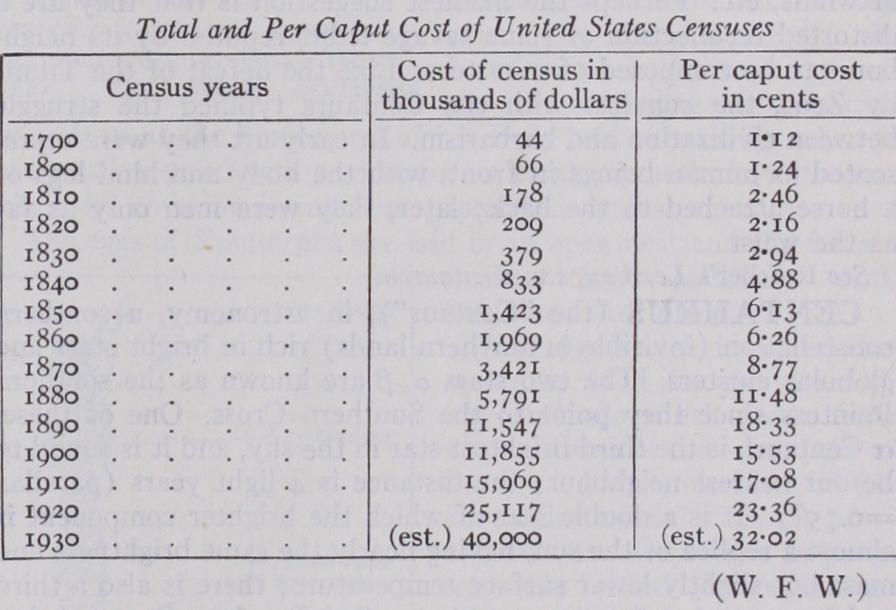
In no field of census work has it been more beneficial than in that of vital statistics. Laws dealing with births, marriages and deaths cannot be enacted constitutionally by the Federal Govern ment ; only the States or municipalities have jurisdiction over those subjects. As a consequence the registration of such events is a State or local function, and before 190o it had developed in desultory fashion, leaving the United States as the only large, wealthy and highly civilized country in the world which lacked a national registration system. After the establishment of a perma nent census office the situation began to mend. With the help of committees from several national organizations interested in public health, a model law for the registration of deaths was drafted and submitted to the States. At the same time Congress passed a joint resolution commending the draft to their attention. Those States which were already registering deaths adopted or adapted the law, prescribed the model form of death certificate contained in it, and thus laid the basis for uniform records of deaths. State after State among those which had no system of registering deaths fell in line, and as a result, in 1915, a similar plan was applied to the registration of births. In 1927, 42 of the 48 States with 21 cities in the other six States registered their deaths under the model law and practice. These districts, including more than nine-tenths of the country's population, make up the death registration area of the United States, within which the death records are copied from State sources and compiled and published by the Census Bureau in its annual volumes of Mortality Statistics. In similar fashion since 1915 the birth records in a "birth registration area" are copied, compiled and published by the Census Bureau in the annual volumes of Birth, Stillbirth, and Infant Mortality Statistics, which now relate to more than eight tenths of the population of the United States. Both systems are extending so rapidly as to justify the hope that within a few years they will have become country-wide. Beginning with 1922 the Bureau of the Census has been publishing annual reports also on marriage and divorce in the United States, so that now it has a promising and steadily improving system of vital statistics under a unique system of voluntary co-operation between the States and the Federal Government. The gradual extension of this system and its present situation appear in the tables.
In addition to its original field of population and its new field of vital statistics, the Federal census has long made periodical reports upon agriculture and manufactures. Between 184o and 1925 these reports were made only as parts of the decennial cen suses, but in 1919 provision was made for quinquennial censuses, those taken between successive decennial censuses being much Number of Registered Deaths, Births, Marriages and Divorces in the tration Area of Continental United States to Nearest Thousand for Each Fifth Year Since 1900, and Per Cent of Population Covered by the Returns narrower in range than the others. Twenty years earlier a similar change had been made in the field of manufactures, and between 1900 and 1920, reports on that subject were issued quinquennially. But after the later date and beginning with 1921, reports on manu factures appeared biennially. The earlier quinquennial inquiries aimed to cover not merely all manufacturing establishments or factories, but also household or hand industries. The enumeration of the latter was far from complete, and after the census of 1900 the hand industries were excluded.
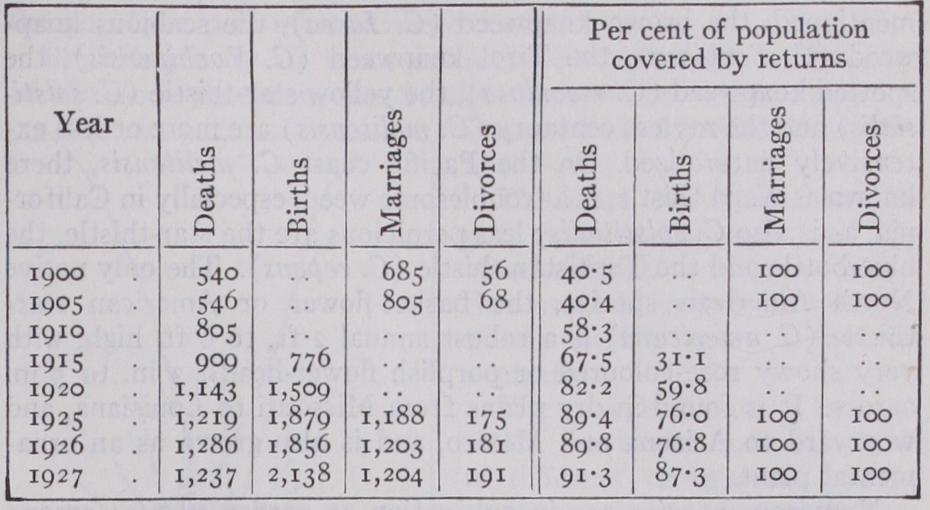
In comparison with the cost of European censuses the American census is very expensive. The following table gives the cost in thousands of dollars and the per caput cost of each census. The per caput cost for the last five censuses is computed after includ ing the Indian population, that of Alaska, and, from the date of their acquisition, that of the various outlying possessions other than the Philippine Islands and the Virgin islands.