
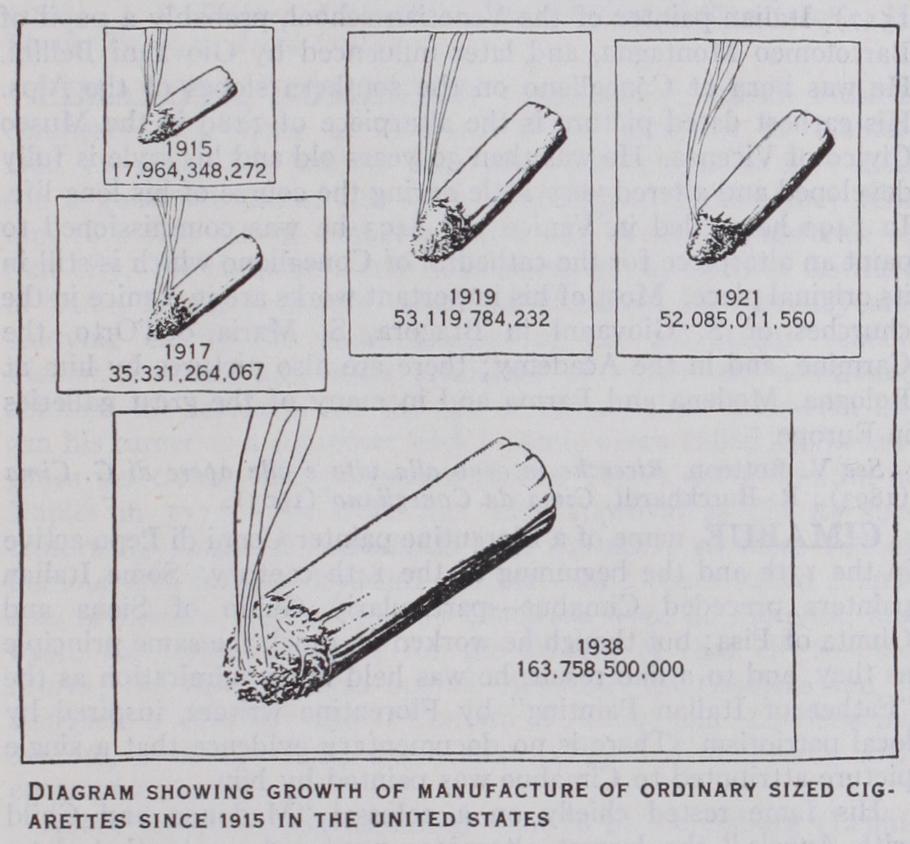
AMERICAN CIGARETTES Internal Revenue figures issued by the United States Govern ment for the year 1938 show that revenue stamps were sold for 163,758,500,00o cigarettes. Production in 1915 was 17,964,000, 000; in 53,I Z0,0o0,0o0; in 1925, 82,247,000,000. About 1917, the blended type of cigarette began to become popular with the American public and in "straight" cigarettes made from one type of tobacco such as Bright Virginia or Turkish, accounted for only a very small part of the total production. The enormous growth in manufacture may be attributed to the increase of smok ing by women and to the convenience and quality of the modern cigarette.
In general, there are four types of tobaccos used in American cigarettes—Burley, grown mainly in Kentucky and Tennessee, but also in States in the Ohio valley: Ohio, Indiana, and West Virginia. Burley tobacco formerly was used almost exclusively for chewing and pipe tobaccos. Today the heavier-bodied types are extensively used in smoking or pipe tobaccos, while the lighter-bodied grades are used in cigarettes.
Bright Flue-cured tobacco, known to a great extent as Virginia, is grown in Virginia, North Carolina, South Carolina, Georgia, and Florida. This type is predominant in most cigarettes manufactured in the United States, whereas in England it is used almost exclusively. This type of tobacco was first grown in the United States several hundred years ago.
Turkish tobacco, which is imported mainly from Turkey and Greece, but also from Bulgaria, Italy, and Russia, is an entirely different type from that grown in the United States, having very distinctive char acteristics and aromatic flavour.
Maryland tobacco, grown in the State of Maryland, is used to a small extent in cigarettes.
The quality of tobacco used in the better cigarettes has greatly im proved with advent of Government aid in educating the farmer to produce better crops. After being aged naturally in storage, the tobacco is processed in modern factories. Extensive research has helped to produce a uniform quality product. The use of high heat and ultra violet-ray has the effect of producing a mild, mellow product.
The popular package of twenty cigarettes is first wrapped in paper backed foil and next in a paper label. A revenue stamp seals the package, all of which is enclosed in moisture-proof cellophane, which helps to protect the cigarettes in varying climatic conditions.