
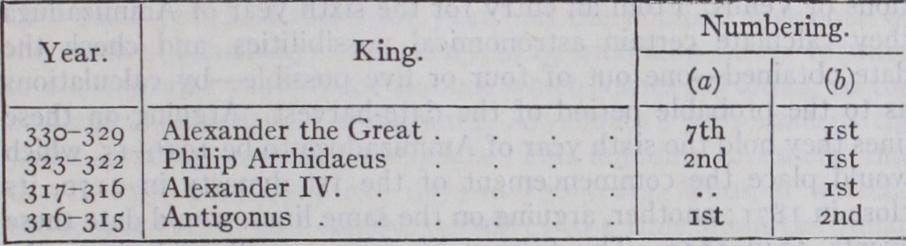
BABYLONIAN AND ASSYRIAN - CHRONOLOGY Evidence of Babylonian documents, from 33o B.C. onwards, dated by kings' regnal years has settled many points in relation to the chronology of late as well as of early periods, though this evidence has been much discussed and often wrongly represented. It is now fairly Clear that the era of the Arsacid dynasty was reckoned from 1st Nisan, 246, and that apparent divergences from this reckoning depend on ancient scribal errors or modern errors of interpretation. The Seleucid era was reckoned from 1st Nisan 311. There was no difference between "civil" and "relig ious" reckoning, as has sometimes been maintained. The reckon ing of the Seleucid era from 311 B.C. must have been introduced in or before 305 B.C. ; the years before that were actually spent by the Babylonians in a state of confusion as to dating which was introduced with the advent of Alexander the Great. The con fusion was due in part to the use of two systems; in one reckon ing, the year-dates according to the Macedonians was used, in another a dating strictly true of Babylon only, but this will not explain every case. The effect of this may be seen from the fol lowing list:— The exact method of dating between 311 and 305 is not certain; a broken document renders it possible that 311 was called "the seventh year of Alexander and Seleucus," i.e., that Seleucus as sociated his name with the king's for the first time, and that would account for the Babylonian reckoning of the Seleucid era. It should be noted that from the advent of Alexander the year reckoning commenced immediately from the accession of the king.

The Babylonian chronology of the time is less certain. Ptolemy's canon and cuneiform documents give the regnal years from Na bonassar's first year, 747 B.C. The belief that some kind of era commenced then is baseless; it was chosen by Ptolemy for some accidental reason, perhaps because that was the first fixed point that was known to him, but not for any scientific reason. Before Nabonassar, the continuous king-list is now known to have in cluded between Shamash-mudammiq, who was reigning about 910 B.C., and Nabonassar 16 names, an average of about 1 o years apiece, but the exact lengths of reigns cannot yet be ascertained.
Babylonia Assyria Shamash-mudammiq, abt. 910 Adad-nirari II. . . 911-889 Nabu-shum-ukin Tukulti-Enurta II. . . 889-884 Nabu-apal-iddin . ?-851 Ashurnasirpal II. . . Marduk-bel-usate . . 851-85o Shalmaneser III. . . 859-824 Marduk-zakir-shum . 850-839 Marduk-balatsu-iqbi . ?-811 Bau-akh-iddin . . . 810 Shamshi-Adad V. . . 824-812 (Five names missing in cluding Adad-shum-ibni) Adad-nirari III. . . 811-782 Marduk-bel-zeri Sha Marduk-apal-usur Eriba-Marduk Nabu-shum-ukin IV 7-772 Ashur-dannese . 82 III. 772-754Nabu-shum-ukin Ashur-nirari V. . • 754-745 Nabonassar . Tiglathpileser III. . • 745-727 Nabu-nadin-zer . . 733-732 Nabu-shum-ukin . . 732 Ukin-zer . . . . 731 Pulu (-T.-P.III.) . . 731-727 Shalmaneser V. . . 726-722 L'lulai . . 726-722 Sargon II. . . . Merodachbaladan II. . 721-710 Sargon . . . . 709-705 Sennacherib . . . 705-681 Sennacherib . 705-703 Merodachbaladan III. . 703-702 Bel-ibni . . . . 702-700 Ashur-nadin-shum . . 699-694 Nergal-ushezib . . 693-69 2 Mushezib-Marduk . . 692-689 Sennacherib . . . 688--681 • Esarhaddon . . . 680-669 Esarhaddon . . . 68o-669 Shamash-shum-ukin . 668-648 Kandalanu . . 647-626 Ashurbanipal . . 668-638 (?) From About 1380-911 B.C.—There are broken limmu lists which once gave the eponymous officials from about 1200 B.C. ; in their present state they give a framework for the Assyrian kings from about 1068-911, the margin of error within which is not more than ten years. Complete king-lists for Assyria being now obtained from broken documents, approximate dates for the kings of the 13th century can be based on intervals sometimes mentioned between them and later kings. The approximate date of Ashur ubaliit can be determined from his correspondence with Akhnaton, the Pharaoh of Egypt, with a marginal error of ten years, as about 1380.
Babylonian chronology depends upon the cases where the num ber of years are known, and on synchronisms with the Assyrian kings. The result can only be an approximation with a margin of error perhaps exceeding a decade. The arrangement is then roughly :— Before 1380 B.C.—All earlier chronology must be subject to considerable margin of error. It depends on (I) Babylonian king lists which give the number of regnal years; in many instances, where these figures can be checked by other sources, they are proved unreliable ; (2) statements of Assyrian kings about their predecessors ; the figures given are sometimes round numbers, and are never absolutely reliable ; (3) dead reckoning on the basis of generations, coupled with the use of the rare synchronisms known between the two countries.
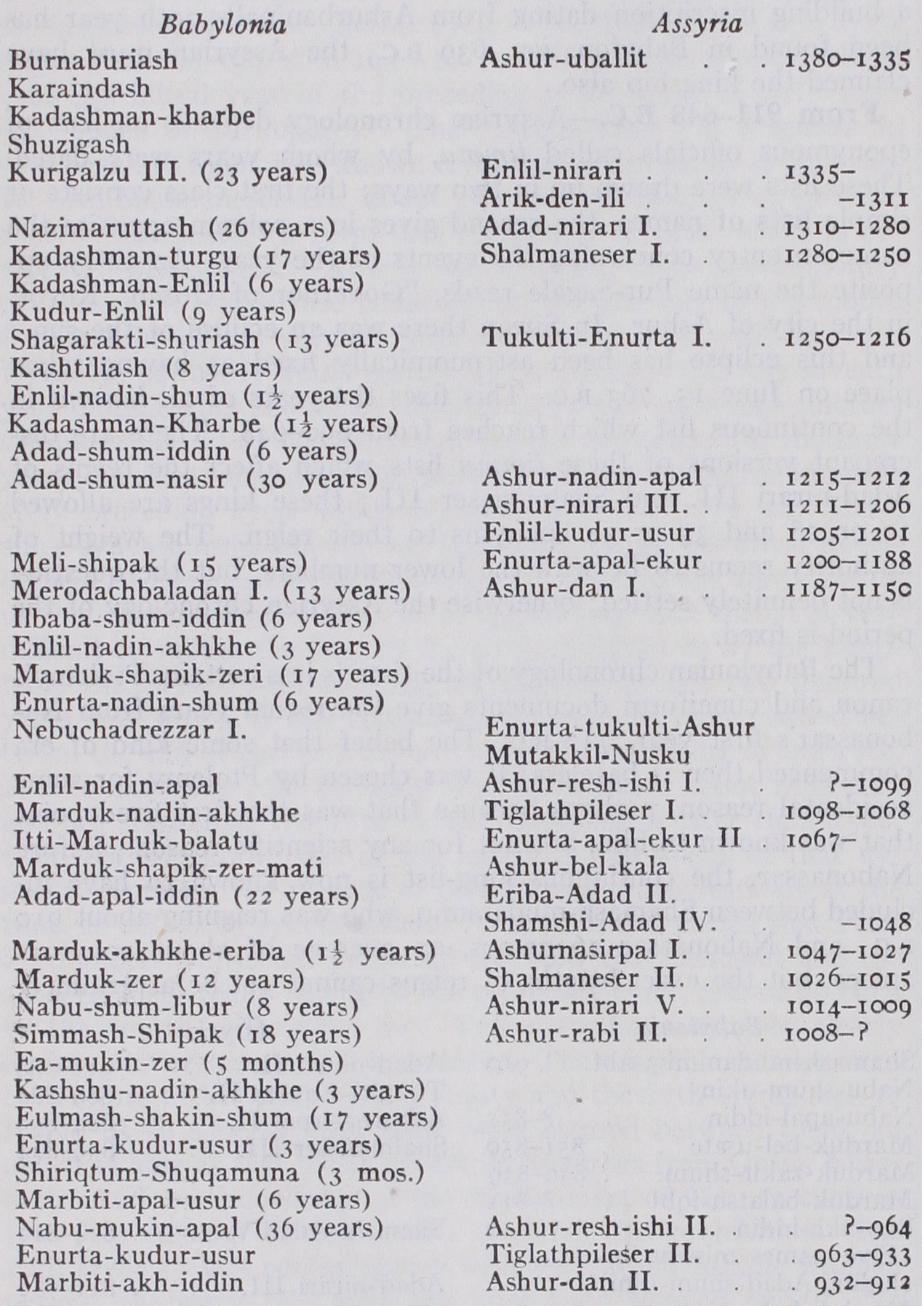
The Babylonian king-list allows 36 kings, and S76 years 9 months for the period during which the country was ruled by Kassite kings. Enlil-nadin-akhkhe, the last of the dynasty, suc ceeded to the throne in the time of Ashur-dan I., roughly about 117o, within a decade, and ruled three years : this would place Gandash, the first king, about 1743-42, but an increased margin of error must be allowed owing to the inaccuracy of the list. The 13th Kassite king, Ulam-Buriash, may have ruled about 1530-20; he occupied the Sea-land, the marshes at the head of the Persian gulf, when the last independent king of the Sea-land fled to Elam. This Sea-land dynasty numbered, according to variant accounts, 11 or 12 kings, who ruled for the long period of 368 years, which would place Iluma-ilum, the first king, about 190o B.C., if the last king fled just before 1530. But Iluma-ilum can be proved by vari ous documents to be a contemporary of Samsu-iluna and Abi-eshu', kings of the Ist dynasty of Babylon. Ilumailum is said to have reigned 6o years, and Samsu-iluna and Abi-eshu' reigned re spectively 38 and 28; it is not probable that Samsu-iluna began to reign before Iluma-ilum, and if he be assigned a date about 1900-1863, the end of the 1st dynasty is brought to about 1746, almost immediately before the accession of the first Kassite king. This cross-reckoning is satisfactory in itself and supported by the Assyrian king-list. There were 42 kings between Ilushuma, an early governor of Ashur, and Ashur-uballit, about 1380. Accord ing to kings' statements Ilushuma lived about 2000 B.C., and this accords roughly with other statements about his son. It is certain from an entry in a chronicle that Ilushuma carried out some mili tary enterprise in Babylonia in the time of Sumu–abu, the first king of the 1st dynasty. If the 1st dynasty ended about the first king dated about 2045-44 to 2032-31. This would accord with the Assyrian statements.
Some modern authorities hold that a fixed dating, not based on the king-lists, can be secured from tablets dealing with observa tions of Venus. From an entry for the sixth year of Ammizaduga they calculate certain astronomical possibilities, and check the date obtained—one out of four or five possible—by calculations as to the probable period of the date-harvest. Arguing on these lines they hold the sixth year of Ammizaduga to be 1916-15, which would place the commencement of the 1st dynasty in 2170, its close in 1871; another, arguing on the same lines, would date these events 2049-1750. The former, if correct, will necessitate the abandonment of a great deal of Babylonian historical writing as worthless; the question is at present open, and scholars differ by some 120 to 130 years for this period.
Accepting the dating 2045-1745, admittedly open to a margin of error, for the I st dynasty as fairly accurate, the date lists for the kings' reigns provide an accurate scheme which correct the king lists in many places. These date-lists arose from the custom of naming a year by some event ; in some cases the event was one of religious importance, and may actually have taken place in the year so named, but where military campaigns are mentioned the event probably belongs to the previous year. These date lists establish a synchronism between Hammurabi and Rim-Sin which leads to a date about 2175 for the commencement of the rival dynasties of Isin and Larsa, subject to an error not greater than the date given for the 1st dynasty. Similarly, the 3rd dynasty of Ur of which date-lists are extant may be dated 2282-2175 with the same error. Probably less than seven years actually passed between the accession of Utu-khegal, who ended the oppression by the foreign dynasty of Gutium, and Ur-Nammu's assumption of sovereignty in 2282 ; this places the Gutium dynasty about with an increased margin of error. Dating earlier than this is a matter of speculation, for the king-lists, which are com plete, give figures that cannot be checked, and for earlier dynasties quite impossible reigns are assigned. There is a general probability that Sargon of Agade commenced his reign between 255o and 2525, and that the 4th dynasty of Kish began to rule not earlier than 2580. An estimate for the 1st dynasty of Ur, the third after the Flood, based upon comparison with objects from Lagash and the generations, would assign a date between 300o and 2900 for the commencement of that dynasty, the earliest historical kings known belonging to it. (S. Sm.) BIBLIOGRAPIIY.-F. X. Kugler, Sternkunde and Sterndienst in Babel Bibliograpiiy.-F. X. Kugler, Sternkunde and Sterndienst in Babel (1914-24) ; Cambridge Ancient History, vols. i. and ii. bibl.) ; Sidney Smith, Early History of Assyria (1928; bibl.).