
CHINA - ETHNOLOGY.
Although man probably existed in China before or at the be ginning of the deposition of the loess (see ASIA, section Anthro pology) there is at present no certain evidence of palaeolithic man in China. Two specimens have been found which have been considered to point to early man. A sacrum, undoubtedly human, was found in Honan, and described by Matsumoto, who failed to realize that its characters were rather akin to those of the mod ern Chinese. In 1921 Dr. Andersson discovered in a rich f ossilif erous deposit at Chou Kou Tien, south-west of Peking, a number of specimens including a premolar and a molar tooth. Black considers these to resemble in general form a fossil molar or "dragon's tooth" bought in Peking by a German palaeontolo gist called Schlosser. Fossil bones ground to powder are much used as medicine by Chinese and no data appear to be forth coming as to the origin of Schlosser's specimen. While Black is convinced that the teeth represent "archaic hominid fossil ma terial," other palaeontologists are less certain and the matter still awaits definite confirmation.
Apart from these doubtful specimens nothing of remote an tiquity has been found in China. The earliest discoveries by the people themselves of whom there is definite knowledge are asso ciated with the chalcolithic culture, and although differing in some respects from modern Chinese, are of essentially the same racial stock. Traditionally the Chinese are said to have come from the Tarim basin and to have spread down the valley of the Wei Ho into the great plain. Their extension into southern China is a matter of recent history and is still proceeding. While the cul tural evidence for this extension seems to be satisfactory, the racial characters of the chalcolithic skeletons make it possible that the Chinese claim to have come from outside China and to have driven out the barbarians, some of whom still lingered even in Honan until recent times, may not be so true racially as it is culturally. In any case the oldest culture known in China, and it probably is not of a very early date, shows affinities with the West, while the people living in China at that time were like the Chinese today; on the other hand the Mongols, whose culture is entirely alien to the Chinese, are physically akin to the peoples of the West.
The true home of the Chinese, whatever their original centre of dispersion, seems to be the basin of the lower Hwang Ha; but they have dominated, racially and culturally, both the original 18 provinces, and Manchuria, Korea, and to some degree Japan. There seem to be two physical types, a northern and a southern, though the differences between them are not very great, the north erners being generally somewhat taller.
These northerners themselves probably consist of a blend of two minor types, one akin to the Khams Tibetan—tall, long headed, big-boned, mainly proto-Nordic in origin. The second stock is similar if not identical with the southern Chinese, who are smaller and more roundheaded. They represent that branch of Yellow Man designated "Pareoean," meaning the people from beside the dawn. It is probable that there is in China a mixture of many stocks; not only have the Chinese invaded aboriginal territory and absorbed the inhabitants, but China itself has been continuously invaded especially from the north. The skin colour is generally light yellow, the hair is dark and straight. The Mon golian eyef old is conspicuous. The stature is medium and the head-form ranges from long to round; the nose is of medium width. Here and there are fair, light-eyed, wavy-haired groups, evidence of the alien stocks which have penetrated into this area.
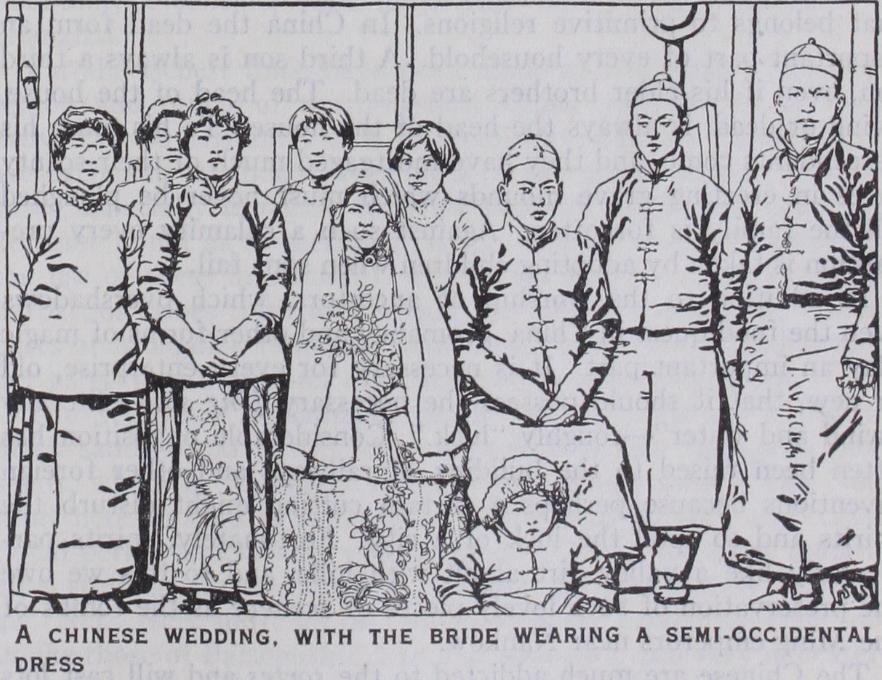
Polygamy is permissible, but it is naturally a luxury of the wealthy rather than a gen eral practice among the poor. Marriages are arranged by the parents of the prospec tive couple, but secondary marriages are usually "love matches." Where no sons are born the practice of adoption is used, both among rich and poor. By the rule of ex ogamy marriages were forbidden between persons bearing the same family name.
With the exception of a few families, notably the descendants of Confucius, China has no aristocracy. Position de pended entirely on success in the great examinations for literary degrees, from the successful candidates of which officials were chosen. Side by side with the official class there has always been a merchant class enjoying the advantages of wealth. The levelling effects of dependents have probably con tributed much to these democratic conditions. The higher a man pushed himself up the more numerous became his household, and it was a necessity under the old Chinese system that a magistrate should never hold office in his own province, otherwise his duties to his family would have outweighed his official duties.
In addition to the worship of ancestors, which overshadows even the food quest in China, geomancy and other forms of magic play an important part. It is necessary for every enterprise, old or new, that it should possess the necessary feng shui—literally "wind and water"—roughly "luck." Considerable opposition has often been raised to the building of railways and other foreign inventions because perhaps a certain cutting might disturb the spirits and so spoil the luck of a city. Fortunately, spirits par ticularly like a valley girt about with hills, and to this we owe the preservation of such lovely pieces of scenery as the tombs of the Ming emperors near Nankow.
The Chinese are much addicted to the sortes and will cast lots before undertaking any enterprise, throwing down two pieces of bamboo root till they turn up in a favourable manner.
BIBLIOGRAPHY.-S. Wells Williams, The Middle Kingdom; A. Little, Bibliography.-S. Wells Williams, The Middle Kingdom; A. Little, The Far East (19o5) ; J. Andersson and D. Black, Various papers, series D, Palaeontologica Sinica, vol. i. (1923-25) ; L. H. D. Buxton, The Peoples of Asia (1925) ; J. Mallory, China the land of Famine (1926) ; S. King, Farmers of Forty Centuries (New ed., 1927).
BIBLIOGRAPHY.-L. H. D. Buxton, The Peoples of Asia, 1925 (BibBibliography.-L. H. D. Buxton, The Peoples of Asia, 1925 (Bib- lio.) ; A. Matsumara, Cephalic Index of the Japanese, Imperial Univer sity of Tokyo, Faculty of Science (Anthropology), Tokyo, 1925.