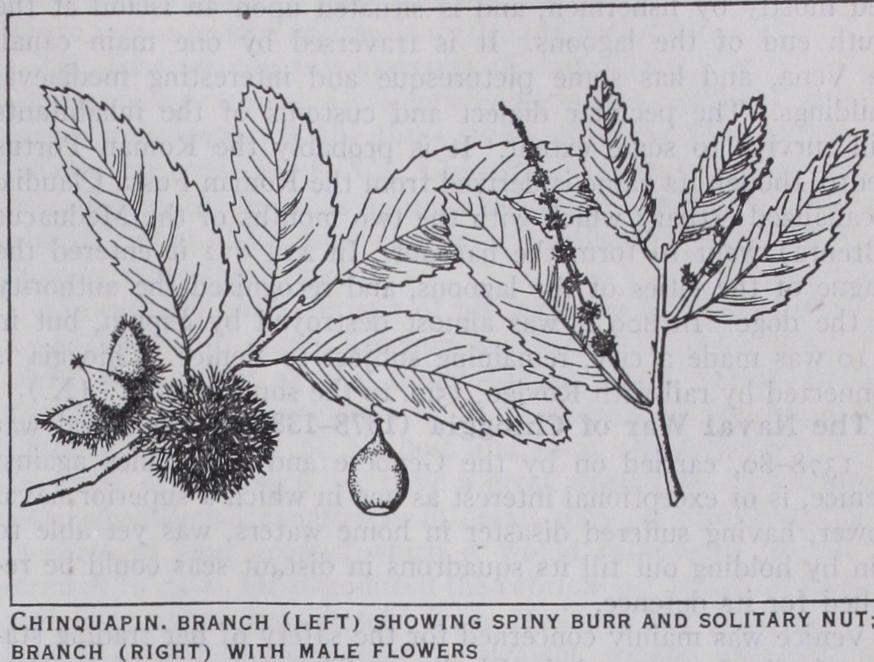
CHINQUAPIN (Castanea pumila). A North American shrub or small tree of the beech family (Fagaceae), found chiefly in dry soils from New Jersey to Missouri and southward to Missouri and Texas. While usually shrubby eastward, it sometimes attains in Arkansas and Texas a height of 45 ft. and a trunk diameter of 3 feet. It is closely related to the chestnut (q.v.) from which it differs in its much smaller leaves, which are white-wooly beneath, and in its usually solitary nut, which, like that of the chestnut, is very sweet and edible. On the Pacific coast the name chinqua pin is given to two species. of Castanopsis, a genus very closely allied to the chestnut. The giant chinquapin or golden-leaved chestnut (C. chrysoplaylla), found from northern Oregon to south ern California, is a magnificent tree which sometimes reaches a height of 15o ft. and a trunk diameter of 1 o feet. The narrow, taper pointed, evergreen leaves, 3 in. to 5 in. long, are closely clothed below, when young, with a fine golden wool. The fruit is chestnut like, containing 1 or 2 nuts with a hard shell and a sweet kernel.
The bush chinquapin (C. sempervirens), of dry mountain slopes in California, is a spreading shrub, i ft. to 8 ft. high, with leaves 1 to 3 in. long., usually not pointed at the apex. The wood of the giant chinquapin, which is reddish-brown, close- and straight grained, takes a fine polish, but is not extensively utilized. The bark, although devoid of tanning value, readily separates itself from the wood and is used to adulterate that of the tan bark oak.