
CHIRDPTERA (Greek for "hand-wings"), an order of mammals containing the bats, all of which are unique in the class in possessing the power of true flight, and have their fore-limbs specially modified for this purpose.
The mammals comprising this order are at once distinguished by the possession of true wings; the thorax is remarkably capa cious, and the ribs are flattened and close together. The shoulder girdle is greatly developed in comparison with the weak pelvic region. The fore-arm (fig. I) consists of a rudimentary ulna, a long curved radius, and a carpus of six bones supporting a thumb and four elongated fingers, between which and the sides of the body and the hinder extremities is spread a thin expansion of skin, the wing-membrane. An elongated cartilaginous process (the calcar), rarely rudimentary or absent, arising from the inner side of the ankle joint, is directed inwards and supports part of the posterior margin of the interfemoral membrane, extending from the tail or hinder part of the body to the hind limbs. The penis is pendent ; the testes are abdominal or inguinal, the teats, usually two in number, thoracic ; the uterus is simple or with more or less long corrlaa; the placenta discoidal and deciduate; and the smooth cerebral hemispheres do not extend backwards over the cerebellum. The teeth comprise incisors, canines, premolars and molars; and the dental formula never exceeds I ; , CI, P3 , M4; total 38. The general number of dorso-lumbar vertebrae is 17, whereof 12 are dorsal; the cervical vertebrae are broad, but short. Except in fruit-bats (Pteropodidae), the vertebrae, from the third cervical backwards, are devoid of spinous processes.
The milk-teeth differ from those of all other mammals in that they are unlike those of the permanent series. They are slender, with pointed recurved cusps, and are soon shed, but exist for a short time with the permanent teeth. The permanent teeth exhibit great variety; in all species they are provided with well developed roots, and their crowns are acutely tuberculate, with more or less well-defined W-shaped cusps in the insectivorous species, or variously hollowed out, or longitudinally grooved in the frugivorous kinds.
The clavicle is long, strong and curved; and the scapula large, oval and triangular, with a long curved coracoid process. The humerus, though long, is scarcely two-thirds the length of the radius; and the rudimentary ulna is welded with the radius. A sesamoid bone exists in the tendon of the triceps muscle. The upper row of the carpus consists of the united scaphoid, lunar and cuneiform bones. The "hand" has five digits, the first, fourth and fifth of which consist each of a metacarpal and two phalanges; but in the second and third the number of phalanges is different in certain families. The first digit terminates in a claw, most developed in the frugivorous species, in most of which the second digit is also clawed, although in other bats this and the remaining digits are unarmed. In the weak pelvis the ilia are long and narrow, while in most species the pubes of opposite sides are loosely united in front in males, and widely separated in females. The foot consists of a short tarsus, and slender, laterally com pressed toes, with much-curved claws.
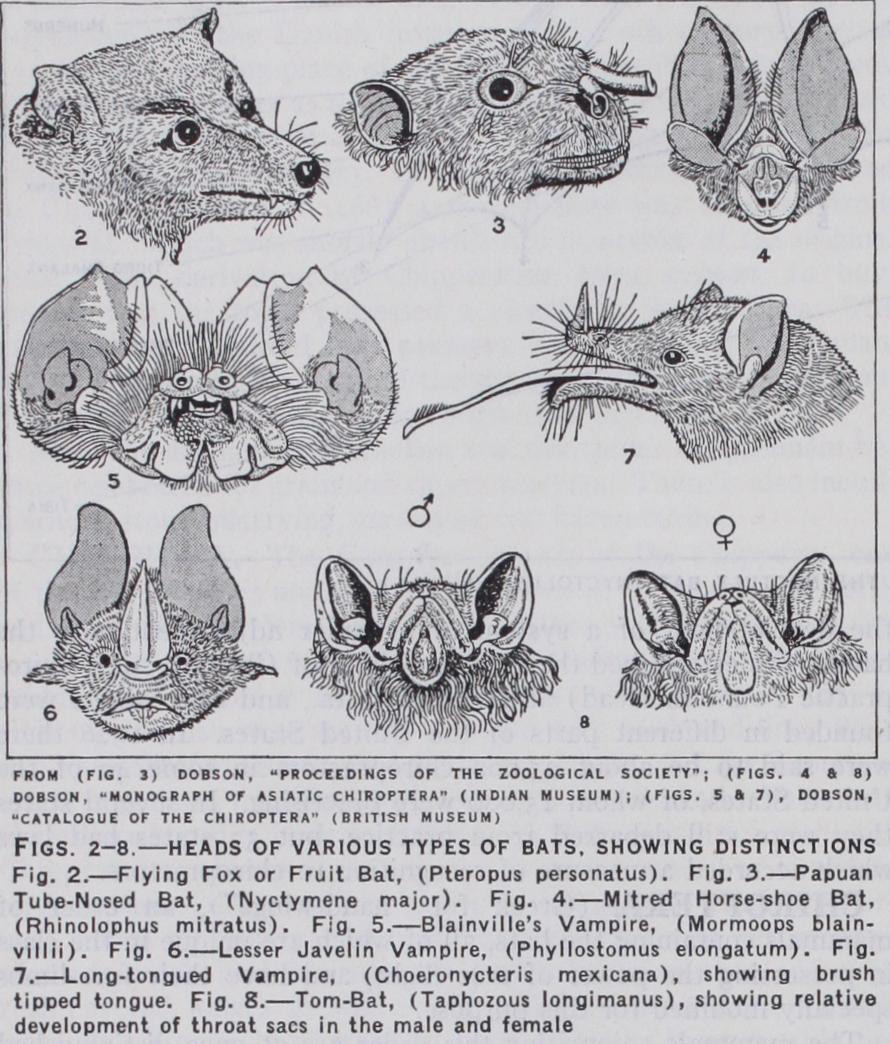
Although the brain is of a low type, probably no animals possess so delicate a sense of touch as bats. In ordinary bats tactile organs exist, not only in the bristles on the sides of the muzzle, but in the sensitive structures forming the wing-membrane and ears, while in many species leaf-like expansions surrounding the nasal aperture or extending backwards behind them are developed. These nose-leaves are made up partly of the extended and thickened skin of the nostrils and partly of the glandular emi nences occupying the sides of the muzzle, in which the sensitive bristles are implanted in other bats. In no mammals are the ears so developed or so variable in form ; in most insectivorous species they are longer than the head, while in the long-eared bat their length nearly equals that of head and body. The "earlet," or tragus, is large, in some cases extending nearly to the outer margin of the conch; its function appears to be to intensify the waves of sound. In the Rhinolophidae, the only family of insec tivorous bats in which the tragus is absent, the auditory bullae reach their greatest size, and the nasal appendages their highest development. In the fruit-eating bats the ear is simple and shows but slight variation. The oesophagus is narrow, especially in blood-sucking vampires. The stomach presents two types of structure, corresponding respectively to the two divisions of the order, Megachiroptera and Microchiroptera ; in the former the pyloric extremity is, with one exception, elongated and folded upon itself, in the latter simple; an exceptional type is met with in the blood-sucker, or vampires, where the cardiac extremity is elon gated, forming a long appendage. The intestine is comparatively short, varying from one and a half to four times the length of the head and body, it is longer in the fruit-eating bats, shorter in the insectivorous species. The liver is characterized by the great size of the left lateral lobe, which occasionally equals half that of the whole organ ; the right and left lateral fissures are usually very deep; in Megachiroptera the spigelian lobe is, with one exception, ill-defined or absent, and the caudate is generally large; but in Microchiroptera the former lobe is large, while the caudate is small. The gall-bladder is generally well-developed.
The wings consist of an "antebrachial membrane," which extends from the point of the shoulder along the humerus and more or less of the f ore-arm to the base of the thumb, the meta carpal bone of which is partially or wholly included in it ; the "wing-membrane" spreading out between the elongated fingers, and extending along the side of the body to the posterior extrem ities, generally reaching to the feet ; and the "interfemoral mem brane," the most variable of all, which is supported between the extremity of the body, the legs and the calcar (fig. i.). The antebrachial and wing membranes are most developed in species fitted only for aerial locomotion which hang with the body en veloped in the wings when at rest. In the Molossidae, which are the best fitted for terrestrial progression, the antebrachial mem brane is quite small and is not developed along the fore-arm, leaving the thumb quite free, while the wing-membrane is narrow and folded in repose under the fore-arm. Scent-glands and pouches opening on the surface of the skin are developed in many species, but in most cases more so in males than females. As a rule bats produce only a single offspring at a birth, which for some time is carried about by the mother, clinging to the fur of her breast.
Bats are divisible into two suborders, Megachiroptera and Microchiroptera.