
CHOKING, the obstruction of a passage. In animals chok ing is an obstruction of the windpipe (q.v.) and may lead to suffocation (q.v.; see also LARYNGOTOMY; and TRACHEOTOMY).
In electricity, a choking coil is designed so that it will pass alter nating currents of low but not of high frequencies (see RADIO RECEIVER). In internal combustion engines (q.v.) a choke-tube is a constriction in a pipe, which increases the velocity of the fluid in its neighbourhood and thus reduces the pressure (see HYDROMECHANICS : Bernonilli's Theorem) ; this results in the liquid from the carburettor being sucked into the tube. CHOLERA, the name formerly given to two distinct diseases, acute infective enteritis and Asiatic cholera but now restricted to Asiatic cholera alone. Although essentially different in causa tion and pathological relationships, these two diseases may in in dividual cases present many symptoms of resemblance.
The second stage is that of collapse or the algide or asphyxial stage. Not infrequently this stage is the first to manifest itself. Often it starts suddenly in the night with diarrhoea of the most violent character, the matters discharged being whey-like ("rice water" stools). They contain large quantities of disintegrated epithelium from the mucous membrane of the intestines. The discharge, which is at first unattended with pain, is soon succeeded by copious vomiting of matters similar to those passed from the bowels, accompanied by severe pain at the pit of the stomach, and intense thirst. The symptoms now advance with rapidity. Agonizing cramps of the legs, feet and abdominal muscles and signs of collapse supervene. The surface of the body becomes cold and blue or purple, the skin is dry and wrinkled, the features are pinched and the eyes deeply sunken, the pulse at the wrist is imperceptible, and the voice is reduced to a hoarse whisper. There is complete suppression of the urine. In this condition death of ten occurs in less than one day, but in epidemics cases are frequently observed where the collapse is so sudden and complete as to prove fatal in one or two hours even without any great amount of previous purging or vomiting. In most instances the mental faculties are comparatively unaffected, although towards the end there is in general more or less apathy. Reaction, how ever, may take place, and this constitutes the third stage. It consists in arrest of the alarming symptoms characterizing the second stage, and gradual but evident improvement in the patient's condition. The urine may remain suppressed for some time, and on returning is often albuminous. Even in this stage, however, the danger is not past, for fatal relapses sometimes occur or reaction may be so imperfect that death from exhaustion may occur two or three weeks from the commencement of the illness. The bodies of persons dying of cholera remain long warm, and the temperature may even rise after death. Peculiar muscular contractions have been observed after death, so that the position of the limbs may become altered. The soft tissues are dry ' and hard, and the muscles dark brown. The blood is tarry in character. The upper portion of the small intestines is generally found dis tended with the rice-water discharges, the mucous membrane is swollen, and there is extensive loss of its epithelium. The kidneys are usually in a state of acute congestion.
The cause of Asiatic cholera is a micro-organism identified by Koch in 1883 (see PARASITIC DISEASES). For some years it was called the "comma bacillus," but it was subsequently found to be a vibrio, not a bacillus. Apparently there are many strains of the vibrio which differ widely in toxicity and other characters. Probably this explains the great variations in epidemics.
Cholera is endemic in the East from Bombay to southern China, but its chief home is British India. It principally affects the allu vial soil near the mouths of the great rivers, particularly the delta of the Ganges. Lower Bengal is pre-eminently the standing focus and centre of diffusion. In some years it is quiescent, though never absent; in others it passes its natural boundaries and is carried east, north and west, it may be to Europe or America. The micro-organism is carried chiefly by infected persons moving from place to place ; but soiled clothes, rags and other articles that have come into contact with persons suffering from the disease may be the means of conveyance to a distance. There is no reason to suppose that it is air-borne, or that atmospheric influences have anything to do with its spread, except in so far as meteorological conditions may be favourable to the growth and activity of the micro-organisms. Beyond all doubt, the great culture ground of the vibrio is the human body, and the discharges from it are the great source of contagion. They may infect the ground, the water, or the immediate surroundings of the patient, the poison finding entrance into the bodies of the healthy by means of food and drink which have become contaminated in various ways, e.g. by flies. Of all the means of local dissemination, contaminated water is the most important, because it affects the greatest numbers, particularly in places with a public water supply. All severe outbreaks of an explosive character are due to this cause. It is also possible that the cholera poison multiplies rapidly in water under favourable conditions, and that a reservoir, for instance, may form a sort of forcing-bed. But it would be a mistake to regard cholera as purely a water-borne disease, even locally. It may infect the soil in localities which have a perfectly pure water-supply, but have defective drainage or no drainage at all, and then it will be found more difficult to get rid of, though less formidable in its effects, than when the water alone is the source of mischief. In all these respects it has a great affinity to enteric fever. With regard to locality, no situation is secure against attack if the disease is introduced and the sanitary conditions are bad; but, speaking generally, low-lying places on alluvial soil near rivers are more liable than those standing high or on a rocky foun dation. Of meteorological conditions it can only be said with cer tainty that a high temperature favours the development of cholera, though a low one does not prevent it. In temperate climates the summer months, and particularly August and September, are the season of its greatest activity.
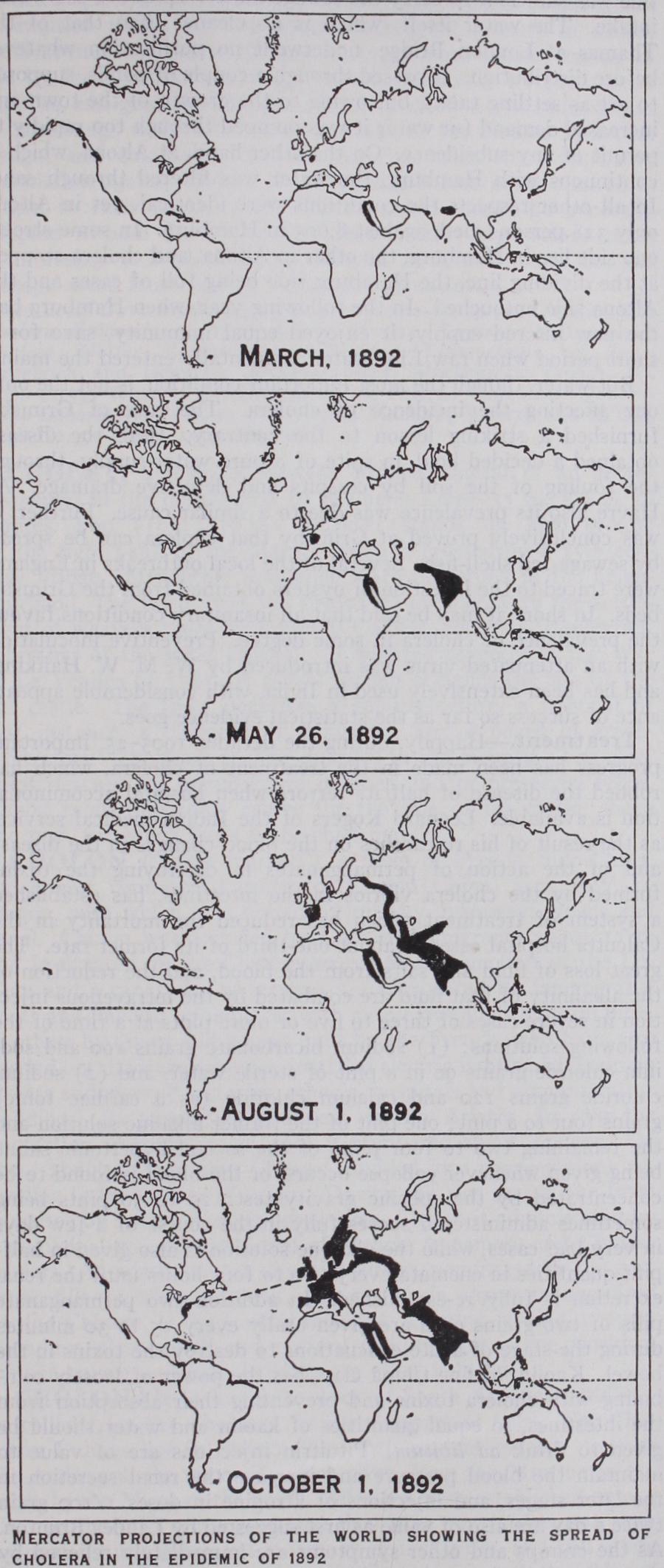
Cholera spreads westwards from India by two routes—(1) by sea to the shores of the Red sea, Egypt and the Mediterranean; and (2) by land to northern India and Afghanistan, thence to Persia and central Asia, and so to Russia. In the great invasions of Europe during the 19th century it sometimes followed one route and sometimes the other. An Indian epidemic of 1817 reached Europe by way of Persia and Russia in 183o and extended to America. Another of 1841 followed the same track and reached Europe and America in 1847. A third took place in the East in 185o and entered Europe in 1853 ; this epidemic was specially severe throughout North and South America. Other epidemics visiting Europe occurred in 1866, 1869-74, 1883-87 ; these trav elled by way of the Mediterranean. The epidemic of 1892-95 re verted to the overland route and travelled with unprecedented rapidity. Within less than five months it travelled from the North West provinces of India to St. Petersburg (Leningrad) and prob ably to Hamburg, and thence in a few days to England and the United States. During the period of 1910-25 cholera continued to be widely prevalent in India, and the recorded mortality exceeded 500,000 in both 1918 and 1919, when the disease was also epidemic in China, but, with the exception of moderate prevalence in eastern and southern Europe, including Italy in 191r, there has been little spread to Europe. Bengal maintains its unenviable reputation as the home of cholera.
The substitution of the procedure above described for the old measures of quarantine and other still more drastic inter ferences with traffic presupposes the existence of a sanitary service and fairly good sanitary conditions if cholera is to be effectually prevented. No doubt if sanitation were perfect in any place or country, cholera, along with many other diseases, might there be ignored, but sanitation is not perfect anywhere, and therefore it requires to be supplemented by a system of notification with prompt segregation of the sick and destruction of infective ma terial. Of general sanitary conditions the most important is unquestionably the water-supply. The classical example is Hamburg. The water-supply is obtained from the Elbe, which became infected by some means not ascertained. The drainage from the town also runs into the river, and the movement of the tide was sufficient to carry the sewage matter up above the water intake. The water itself, which is no cleaner than that of the Thames at London Bridge, underwent no purification whatever before distribution. It passed through a couple of ponds, supposed to act as settling tanks, but owing to the growth of the town and increased demand for water it was pumped through too rapidly to permit of any subsidence. On the other hand, at Altona, which is continuous with Hamburg, the water was filtered through sand. In all other respects the conditions were identical, yet in Altona only 328 persons died, against 8,6o5 in Hamburg. In some streets one side lies in Hamburg, the other in Altona, and cholera stopped at the dividing line, the Hamburg side being full of cases and the Altona side untouched. In the following year, when Hamburg had the new filtered supply, it enjoyed equal immunity, save for a short period when raw Elbe water accidentally entered the mains.
But water, though the most important condition, is not the only one affecting the incidence of cholera. The case of Grimsby furnished a striking lesson to the contrary. Here the disease obtained a decided hold, in spite of a pure water-supply, through the fouling of the soil by cesspits and defective drainage. At Havre also its prevalence was due to a similar cause. Further, it was conclusively proved at Grimsby that cholera can be spread by sewage-fed shell-fish. Several of the local outbreaks in England were traced to the ingestion of oysters obtained from the Grimsby beds. In short, it may be said that all insanitary conditions favour the prevalence of cholera in some degree. Preventive inoculation with an attenuated virus was introduced by W. M. W. Haffkine, and has been extensively used in India, with considerable appear ance of success so far as the statistical evidence goes.
By these methods the mortality in over 1,000 severe cases in the Calcutta cholera ward over a number of years past has been reduced from 6o% to 20% and equally good results were obtained in China in 1919. In the Bombay and Central Provinces the administration of large quantities of permanganate pills in out breaks in villages remote from hospitals has reduced the death rate one-half to one-third of that in untreated cases in the same epidemics, although the severest types require intravenous salines in addition if life is to be saved. The great paucity of skilled medical men in Indian villages alone prevents greater saving of life by these methods, and prevention, especially by good water supplies and greater sanitary control of cholera-spreading places of pilgrimage within the endemic areas of the disease in Lower Bengal and south-east Madras, together with the compulsory inoculation against cholera of all pilgrims before being allowed to return to their homes from cholera areas, should be generally adopted without further loss of time if this very serious cause of mortality in India is to be reduced, as it well might be, and Europe saved from further pandemics of cholera.