
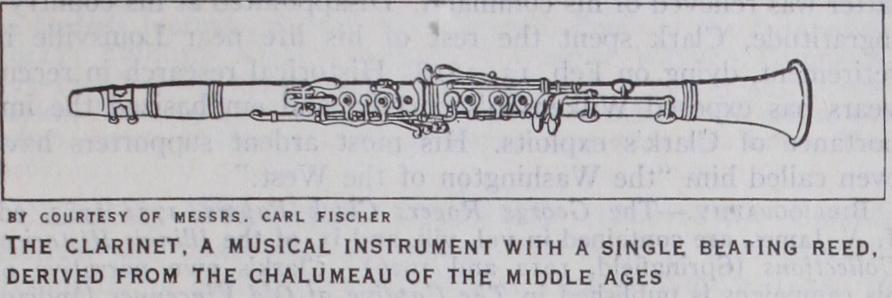
CLARINET, a wood-wind instrument having a cylindrical bore and played by means of a single-reed mouthpiece. The name is sometimes used in a generic sense to denote the whole family, which consists of the clarinet or discant, corresponding to the violin, oboe, etc.; the alto clarinet in E; the basset horn in F (q.v.) ; the bass clarinet (q.v.), and the pedal clarinet (q.v.).
The mouthpiece of the clarinet, including the beating or single reed common to the whole clarinet family, has the appearance of a beak with the point bevelled off and thinned at the edge to cor respond with the end of the reed shaped like a spatula. The under part of the mouthpiece is flattened in order to form a table for the support of the reed, which is adjusted thereon with great nicety, allowing just the amount of play requisite to set in vibra tion the column of air within the tube.
A cylindrical tube played by means of a reed has the acoustic properties of a stopped pipe, i.e., the fundamental tone produced by the tube is an octave lower than the corresponding tone of an open pipe of the same length, and overblows a twelfth ; whereas tubes having a conical bore like the oboe, and played by means of a reed, speak as open pipes and overblow an octave. This forms the fundamental difference between the instruments of the oboe and clarinet families.
Wind instruments depending upon lateral holes for the pro duction of their scale must either have as many holes pierced in the bore as they require notes, or make use of the property pos sessed by the air-column of dividing into harmonics or partials of the fundamental tones. Twenty to twenty-two holes is the number generally accepted as the practical limit for the clarinet. The compass of the instrument is therefore extended through the medium of the harmonic overtones.
In order to facilitate, however, the production of the harmonic notes, a small hole, closed by means of a key and called the "speaker," is bored near the mouthpiece. By means of this small hole the air-column is placed in communication with the external atmosphere, a ventral segment is formed, and the air-column divides into three equal parts, producing a triple number of vibra tions resulting in the third note of the harmonic series, at an interval of a twelfth above the fundamental.
The fundamental scale of the modern clarinet in C extends from E in the bass clef to B flat in the treble. The next octave and a half is obtained by opening the speaker key, whereby each of the fundamental notes is reproduced a twelfth higher, extend ing the range to F in alt, which ends the natural compass of the instrument, although a skilful performer may obtain another oc tave by cross-fingering.
In the West, the instrument was, during the Carolingian period, identified with the tibia of the Romans until such time as the new western civilization ceased to be content to go back to classical Rome for its models, and began to express itself, at first naively and awkwardly, as the 11th century dawned. The name then changed to the derivatives of the Greek kalaros, assuming an al most bewildering variety of forms, of which the commonest are chalemie, chalumeau, schalmey, scalmeye, shawm, calemel, kale mele.
At the beginning of the 18th century various important im provements in the mechanism of the instrument, in particular the invention of the very useful device of the speaker-key—to facilitate the production of the harmonics of the f undamental were effected by J. Christian Denner (1655-1707), and after various subsequent developments the instrument was further im proved during the 19th century by the Belgian makers Bach mann, the elder Sax, Albert and C. Mahillon and others. In Eng land the clarinet has also passed through several progressive stages since its introduction about 1770, first at the hands of Cornelius Ward, and later, as a consequence of still more impor tant improvements due to Richard Carte and others.
As regards music for the clarinet, Mattheson mentions clarinet music in 1713, although Handel, whose rival he was, does not ap pear to have known the instrument. Joh. Christ._ Bach scored for the clarinet in 1763 in his opera Orione, performed in London, and Rameau had already employed the instrument in 1751 in a theatre for his pastoral entitled Acante et Cephise. Later, Mozart wrote for it in his Paris symphony, and since then it has of course long since taken its place as one of the most indispensable members of the orchestral family.