CLEVELAND, a city and port of entry of the State of Ohio, U.S.A., and the county seat of Cuyahoga county, the sixth largest city in the United States. It is on Lake Erie, at the mouth of the Cuyahoga river, about 26om. N.E. of Cincinnati, 357m. E. of Chicago and 623m. W. of New York. Pop. (193o) 900,429, of whom 229,487 were foreign-born, 354,771 native-born but of for eign parentage (i.e., having one or both parents foreign-born), and
negroes. Of the 229,487 foreign-born, Czechs were pre dominant (34,695 or
with the Poles (32,668 or 14.2%), Italians (23,524 or i0.3%), Germans (22,532 or 9.8%) ; Hunga rians (19,073 or 8.3%) ; and Yugoslays (18,326 or 7.9%).
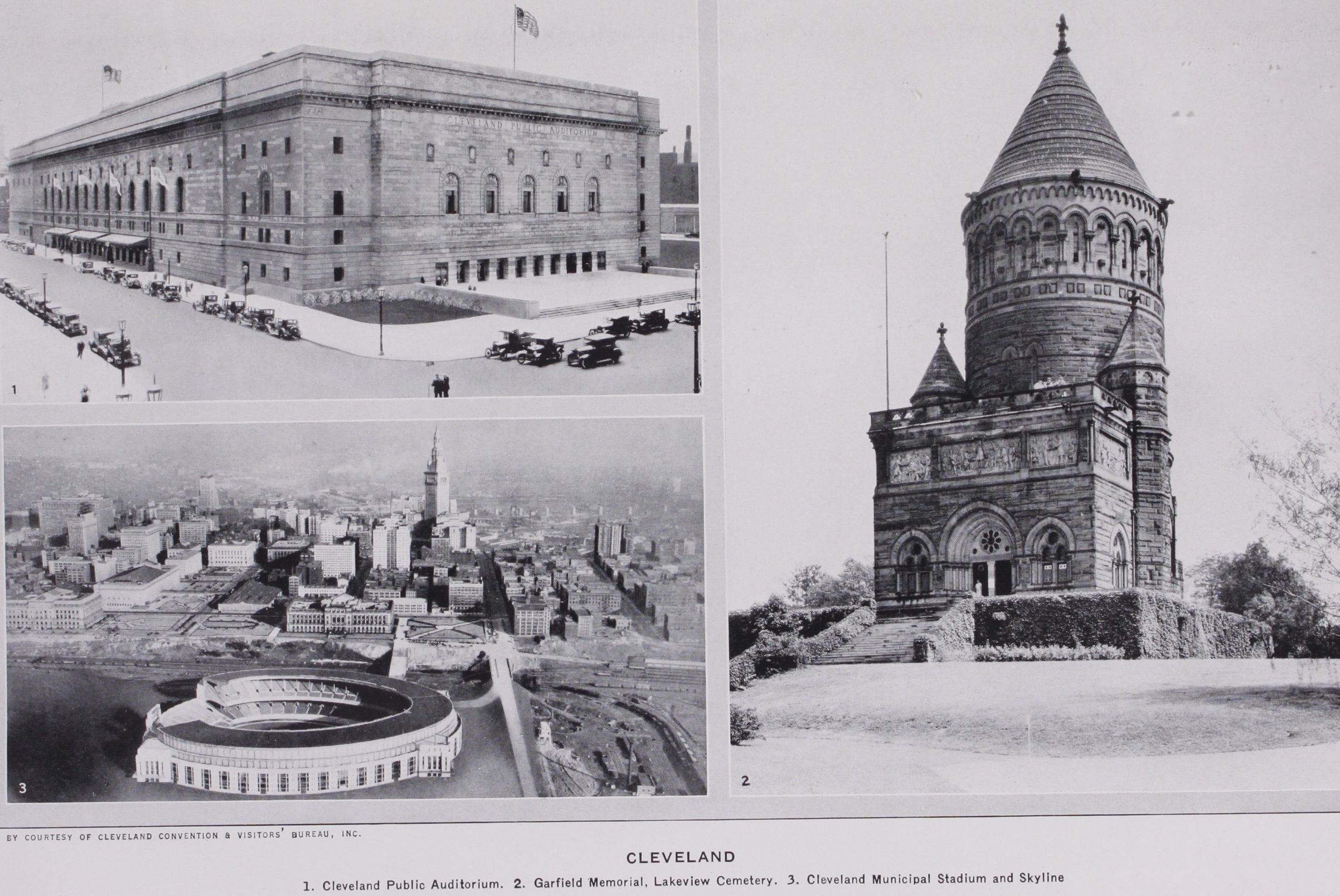
The city commands pleasant views from its position on a plateau, which, at places on bluffs along the shore, has elevations of about 75f t. above the lake level and rises gradually toward the south-east to I I 5f t., and on the extreme east border to more than 2 oof t. above the lake, or about 800ft. above sea-level; the surface has, however, been cut deeply by the Cuyahoga, which here pursues a meandering course through a valley about -km. wide. The city's shore-line is 14.2m. long. The city occupies a total area (1933) of 73.35o sq.m., much the greater part of which is east of the river. The streets are of unusual width (varying from 6of t. to 13 2f t.) and paved chiefly with asphalt and brick. For its many well shaded streets, Cleveland became known as the "Forest city." The municipality maintains an efficient forestry depart ment. About zm. from the lake and the same distance east of the river is the public square, or Monumental park in the business centre of the city. Thence the principal thoroughfares radiate. The river valley is spanned by several viaducts, of which the most noteworthy is the High Level bridge, with central span of 591 f t. in length and 96ft. above water. The total length, with ap proaches, is 5,630f t. ; the cost, $5,4o7,000. Lower Euclid avenue (the old country road to Euclid, O., and Erie, Pa.) is the centre of retail trade. This avenue, east of I2th street, was once bor dered with handsome houses and spacious and beautifully-orna mented grounds, and was famous as one of the finest residential streets in the country. Many houses remain, but the residential sections are elsewhere, in the suburban villages or cities of East Cleveland, Cleveland Heights, Shaker Heights and Lakewood. The building of the Union Terminal station has radically changed lower Superior avenue, once the retail commercial centre, for the south side from the public square westward has been vacated for buildings subsidiary to the railroad enterprises. In 1902 the city arranged for grouping its public buildings—in the so-called "Group Plan." The court-house and city hall are on the edge of the plateau overlooking Lake Erie ; i,000f t. S., on Superior avenue, are the Federal building and the public library. On the west side of 6th street, which leads to the city hall, and near the latter, is the pub lic auditorium, with 12,500 seats, and with a Music Hall and Little Theatre with seating accommodation of 3,700. The "Group plan" called for a mall, 600 ft. wide, leading from the structures on the lake front to those on Superior. The city has, besides, numerous fine office buildings, including that of the Society for Savings (an .institution in which each depositor is virtually a stock-holder), the Williamson, the National City, the Guardian, the Union Trust, the Engineers Bank, the Federal Reserve Bank and Hanna build ings; the Union Terminal building, with its tower 7 20f t. high, visible for many miles from the city ; the Ohio Bell Telephone building, of the newer pyramidal type; the Plain Dealer newspaper building; the Cleveland Trust company's bank; the Museum of Art; Trinity cathedral (Episcopalian), the Church of the Cov enant (Presbyterian), St. Agnes (Catholic), the Temple (Jewish), the Amasa Stone Memorial chapel (Adelbert college), the Allen Memorial Medical library. In the public square is a soldiers' and sailors' monument consisting of a granite shaft rising from a me morial room to a height of 1 2 5f t., and surmounted with a figure of Liberty; in the same park also, are a bronze statue of Moses Cleaveland, the founder of the city, and a bronze statue of Tom L. Johnson, a notable mayor. On a commanding site in Lake View cemetery is the Garfield memorial (finished in 189o) in the form of a tower (165ft. high), designed by George Keller and built mostly of Ohio sandstone; in the base is a chapel containing a statue of Garfield, and several panels on which are portrayed various scenes in his life ; his remains are in the crypt below the statue. A marble statue of Commodore Oliver H. Perry, erected in commemoration of his victory on Lake Erie in 1813, is in Gordon park. In Wade park are the Goethe-Schiller statue and a statue of Kosciuszko. Facing the University Circle is a statue (by Saint-Gaudens) of Marcus Alonzo Hanna (q.v.) the famous Republican statesman.
The 56 parks contain altogether more than 3,16oac., not includ ing the airport of 904 acres. A chain of parks connected by drive ways follows the picturesque valley of Doan Brook, on the east border of the city. At the mouth of the brook, and on the lake front, is the beautiful Gordon park of 12 2ac., formerly the pri vate estate of William J. Gordon, but given by him to the city in 1893 ; from this extends up the Doan valley the large Rocke feller park, which was given to the city in 1896 by John D. Rocke feller and others, and which extends to and adjoins Wade park (85ac., given by J. H. Wade) in which is the Museum of Art. Monumental park is divided into four sections (containing about iac. each) by Superior avenue and Ontario street. Of the several cemeteries, Lake View (about 3ooac.), on an elevated site on the east border, is by far the largest and most beautiful, its natural beauty having been enhanced by the landscape gardener. Besides Garfield, John Hay and Marcus A. Hanna are buried there.
Cleveland has an excellent public-school system. A general State law, enacted in 1904, placed the management of school affairs in the hands of an elective council of seven mem bers, five chosen at large and two by districts. This board has power to appoint a school director and a superintendent of instruc tion. The superintendent appoints the teachers, the director all other employees; appointments are subject to confirmation by the board, and all employees are subject to removal by the executive officials alone. The plan of education minimizes routine, replacing traditional programmes by new curricula based upon a more scien tific study of childhood and youth. Greater attention is also paid to the differing interests and capacities of groups of pupils. In
there were 13 senior and 16 junior high-schools, and 118 schools for grades I to 6, in the city. The $13,358,000 spent was
of city expenses. Besides the public-school system there are many parochial schools; the university school, with an eight years' course ; the Hathaway-Brown and the Laurel school for girls; the Western Reserve university, with its medical school (opened in 1843), the Franklin T. Backus Law school (1892), the dental department (1892), Adelbert college (until 1882 the Western Reserve college, founded in 1826 at Hudson, 0.), the College for Women (1888), the Library school (19o4), the School of Pharmacy (incorporated in 1886, affiliated in 1908), the School of Applied Social Sciences (1916), the School of Nursing (1923), the Graduate school (reorganized in 1926) ; the Case School of Applied Science, founded in 188o by Leonard Case (1820-80) and opened in 188r; Cleveland college, a down-town branch of the university, under a separate board of trustees, and affiliated also with the Case School of Applied Science; the Cleve land School of Art ; John Carroll university, formerly St. Ignatius college (conducted by the Fathers of the Society of Jesus; incor porated 1890), which has an excellent meteorological observatory. In 1936-37 Western Reserve university had over 60o instructors and 4,000 students, including extension courses and the summer session (851 in Adelbert college ; 589 in College for Women; 175 in nursing; 94 in pharmacy ; 261 in medical, 184 in law, 125 in dental and 68 in library school) ; and the Case School of Applied Science zoo instructors and 1,160 students. Important educational work is carried on by the Museum of Art, through classes, lectures and special exhibitions. Another valuable influence has been the Museum of Natural History opened in 1922. The musical develop ment of the city has been stimulated by the creation of a sym phony orchestra and the organization of a school of music. The public library contained 1,872,757 volumes in 1935, the Case library (subscription), 42,000vol., the Hatch library of Adel bert college about 170,000, the library of the College for Women 40,100, the Cleveland Medical library 49,000, the library of the Western Reserve Historical Society over 200,000 and the Cleve land Law library, in the court-house, 51,000 volumes.
The city has a highly developed system of charitable and cor rective institutions. A farm of more than 1,600ac., the Cleveland Farm Colony, 'rm. from the city, takes the place of workhouses, and has many cottages in which live those of the city's poor who were formerly classed as paupers and were sent to poorhouses, and who now apply their labour to the farm and are relieved from the stigma that generally attaches to inmates of poorhouses. On the "farm" the city maintains an "infirmary village," a tubercu losis sanatorium, a detention hospital, a convalescent hospital and houses of correction. On a farm 22M. from the city is the Boys' Home (maintained in connection with the juvenile court) for "incorrigible" boys. The "cottage" plan has been adopted; each cottage is presided over by a man and wife whom the boys call father and mother. At an equal distance from the city but further west is a Girls' home, similarly administered. Besides the city hospital there are the Northern Ohio (for the insane, founded in 1855), Lakeside, St. Alexis, the Charity (the last managed by sisters of charity), Mount Sinai, St. Luke's, St. John's, Lutheran, Huron road and Maternity hospitals, and the Babies dispensary and hospital. A medical centre was begun through the grouping of the new buildings of the School of Medi cine, built at a cost of $2,500,000, the Maternity hospital and Babies dispensary and hospital. To these there has been added the Lakeside hospital (removed from its down-town site), and its sub sidiary buildings, for which a fund of over $8,000,000 was raised in 1927. A pathological institute has also been added, its cost borne by the general education board. The Goodrich House (1897), the Hiram House and Alta House are among the best equipped and most efficient social settlements in the country. Cleveland has also its orphan asylums, homes for the aged, homes for incurables and day nurseries, besides a home for sailors, homes for young working women and retreats for unfortunate girls. The many charitable organizations, Protestant and Catholic, are united in a Welfare Federation. There is also a Federation of Jewish Charities. Their support comes from endowment funds and from the Community Fund, created in 1919. The money for this fund is collected in annual "drives," the proceeds of which averaged each year for the first nine years $4,250,000. The principal newspa pers of the city are the Plain Dealer (1841, independent), which in 1917 acquired the Leader (1847, Republican) ; the Press (1878, independent) ; and the News (1889, Republican). Bohemian, Hun garian and German dailies are published.
Municipal ownership was a promi nent issue in Cleveland during the mayoralty of Tom Loftin Johnson (1854-1911), a street railway owner, iron manufacturer, an ardent single-taxer, who was elected in 1901, and re-elected in 1903, 1905 and 2907. The struggle opened with the organization of a new street car company which began operations on Nov. 1, 1906, charging a 3 cent fare. The grants to this company were owned by the Forest City Railway company and the property was leased to the Municipal Traction Company (on behalf of the public—the city itself not being empowered to own and op erate street railways). In 1908 the Cleveland Electric Street Railway Corporation (capital $23,000,000), which owned most of the electric lines in the city, was forced to lease its property to the municipality's holding company, receiving a "security fran chise," providing that under certain circumstances (e.g., if the holding company should default in its payment of interest) the property was to revert to the corporation, which was then to charge not more than 25 cents for six tickets. In Oct. 1908, at a special election, the security franchise was invalidated, and the entire railway system was put in the hands of receivers. In 1909 Johnson was defeated. In 1910 the Cleveland Railway company received a 25 year franchise, embodying the "Tayler" plan, named after the Federal judge under whose authority the receivership was administered. This called for a service at cost and gave the city council important rights of control. The railway company was entitled to a return on its capital stock of 6%, and the rate of fare became dependent upon receipts from traffic. For a time the fare was 3 cents and a cent for transfers, but when the years of rapidly mounting costs of service came, the fare was necessarily raised. The franchise was amended in 1926, providing for a 7 cent fare, with a possible maximum of io cents. Its life was extended until 1951. The municipality owns the waterworks, a small electric-light plant, the garbage plant and bath houses. The city water is pumped to reservoirs from two intakes situated a distance of 42m. from the shore. The system has a delivery capacity of 3 2 5,00o,000gal. daily. The department served (iv) about 1,350,000 consumers through 2,713 miles of main covering an area of 38o square miles. Two filtration plants have a capacity of 300,000,00o gals. which will be expanded to 500,000,000 by new construction. The municipal electric-lighting plant does not seri ously compete with the private lighting company. The municipal garbage plant reduces 400 tons daily, while a new $12,000,000 sewage treatment plant treats 123,000,000 gallons daily.
To meet the demands of the rapidly increasing commerce the harbour has been steadily improved. In 1908 it consisted of two distinct parts, the outer harbour being the work of the Federal Government, and the inner harbour being under the control of the city. The outer harbour was formed by two breakwaters enclosing an area of 5m. long and 1,60o to 2,40oft. wide; the main entrance, 70oft. wide, lying opposite the mouth of the Cuyahoga river ; the depth of the harbour ranges from 21 to 25 feet. The inner harbour comprises the Cuyahoga, the old river-bed and connecting slips. The channel at the mouth of the river (3 2 5 f t. wide) is lined on the west side by a concrete jetty 1,44oft. long, and on the east side by commercial docks 1,602ft. long. The river and the old river-bed furnish about 13m. of safe dock frontage, the channel having been dredged for 6m. to a 'depth of 21 feet. This work is being extended by Federal money.
Cleveland's rapid growth, both as a commercial and as a manu facturing city, is due largely to its situation between the iron regions of Lake Superior and the coal and oil regions of Pennsyl vania and Ohio. Cleveland is a great railway centre and is one of the most important ports on the Great Lakes. The city is served by the New York Central, the New York, Chicago and St. Louis, the Pennsylvania, the Erie, the Baltimore and Ohio, and the Wheeling and Lake Erie railways and by steamboats to the prin cipal ports on the Great Lakes. Cleveland is the largest ore mar ket in the world, and its huge ore docks are among its most inter esting features; the annual receipts and shipments of coal and iron ore are enormous. It also handles large quantities of lumber and grain. The most important manufactures are iron and steel, auto mobiles, electrical supplies, bridges, boilers, engines, car wheels, telescopes, sewing machines, printing presses, agricultural imple ments and various other commodities made wholly or chiefly from iron and steel. The value of automobiles manufactured in 1929 was $125,197,5o5. More steel wire, wire nails, and bolts and nuts are made here than in any other city in the world (the total value for iron and steel products as classified by the census was, in 1929, $131,o9o, 2 56 ; and the value of foundry and machine-shop prod ucts in the same year was
and more merchant ves sels are built here than in any other American city. Cleveland makes much clothing
and is the site of one of the largest refineries of the Standard Oil group. The output of Cleveland slaughtering and meat-packing houses in 1929 was val ued at $49,345,714. The total value of factory products in
was $471,324,2o5, an increase of 33.7% since 1914.

Since Cleveland became a city in 1836 it has undergone several important changes in government. The charter of that year placed the balance of power in a council composed of three members chosen from each ward and as many aldermen as there were wards, elected on a general ticket. From 1852 to 1891 the city was governed under general laws of the State which en trusted the more important powers to several administrative boards. Then, from 1891 to 1903, by what was practically a new charter, that which is known as the Federal plan of government was tried ; this centred power in the mayor by making him almost the only elective officer, by giving to him the appointment of his cabinet of directors—one for the head of each of the six municipal departments—and to each director the appointment of his sub ordinates. The Federal plan was abandoned in 1903, a new munici pal code coming into effect, which was in operation until 1909, when the Paine law established a board of control, under a Gov ernment resembling the old Federal plan. (For laws of 1903 and 1909 see OHIo.) In accordance with the authority conferred by the home rule amendment of the State Constitution, a charter, submitted by a special commission, was accepted by the citizens on July 1, 1913. This reduced the number of elected officers to the mayor and 25 councillors. By an amended charter, which took effect on Jan. 1, 1924, a manager system was introduced. This system was itself repealed in November 1931 despite the advice of civic organizations. Under the amendment, a mayor and 33 coun cillors, one from each of the city's wards, are elected every odd year. The entire governmental set-up was re-organized at the same time with the establishment of three administrative depart ments—law, finance and utilities—and several special commis sions, with the mayor the dominant figure. The city has profited greatly from the interest in municipal problems which has been shown by organizations of leading citizens. Especially has this been manifested by the Cleveland Chamber of Commerce and the Citizens' League, an organization of influential professional and business men, which, by issuing bulletins concerning candidates at the primaries and at election time, has done much for the better ment of local politics. The Cleveland Chamber of Commerce, an organization of over 1,60o business leaders, is a power for good in the city; besides its constant and aggressive work in promoting the commercial interests of the city, it was largely influential in the Federal reform of the consular service ; it studied the question of overcrowded tenements and secured the passage of a new tene ment law with important sanitary provisions and fixed minimum air space ; it urges and promotes home gardening, public baths, play-grounds, lunchrooms, etc., for employees in factories ; and it was largely instrumental in devising and carrying out the so-called "Group Plan" described above.
A trading post was established at the mouth of the Cuyahoga river as early as 1786, but the place was not perma nently settled until 1796, when it was laid out as a town by Moses Cleveland
who was then acting as the agent of the Connecticut Land company, which in the year before had pur chased from the State of Connecticut a large portion of the West ern Reserve. In I Soo the entire Western Reserve was erected into the county of Trumbull and a township government was given to Cleveland ; ten years later Cleveland was made the seat of govern ment of the new county of Cuyahoga, and in 1814 it was incor porated as a village. Cleveland's growth was, however, very slow until the opening of the Ohio canal as far as Akron, in 182 7 ; about the same time the improvement of the harbour was begun, and by 1832 the canal was opened to the Ohio river. Cleveland was thus connected with the interior of the State, for whose min eral and agricultural products it became the lake outlet. The dis covery of iron ore in the Lake Superior region made Cleveland the natural meeting-point of the iron ore and the coal from the Ohio, Pennsylvania and West Virginia mines ; and the city's great commercial importance dates from this time. The building of railways during the decade 1850-6o increased this importance, and the city grew with great rapidity. The growth during the Civil War was partly due to the rapid development of the manu facturing interests of the city, which supplied large quantities of iron products and clothing to the Federal Government. The population of 1,076 in 183o increased to 6,071 in 184o, 17 ,034 in
in 186o, 92,829 in 187o, and to 160,146 in 1880. Until 1853 the city was confined to the east side of the river, but in that year Ohio City, which was founded in 1807, later incor porated as the village of Brooklyn, and in 1836 chartered as a city (under the name Ohio City), was annexed. Other annexations fol lowed: East Cleveland (a district east of the present 55th street, and not the suburban city of that name) in 1872, Newburg in 1873, West Cleveland and Brooklyn in 1893, Glenville and South Brooklyn in 1905, Collinwood in 1910 and West Park in 1923. The most notable later events not mentioned elsewhere were the cen tennial celebration of 1896, the solution of the street railway problem in 1926, the establishment of a successful community fund, the holding of the Socialist, Republican and Union national conventions in the summer of 1936, and the successful Great Lakes Exposition of 1936 and
BIBLIOGRAPHY. Annuals of the Cleveland Chamber of Commerce Bibliography. Annuals of the Cleveland Chamber of Commerce (1865— ) ; C. Whittlesey, The Early History of Cleveland (1867) ; J. H. Kennedy, A History of the City of Cleveland (1896) ; C. A. Urann, Centennial History of Cleveland (1896) ; C. E. Bolton, A Few Civic Problems of Greater Cleveland (1897) ; C. F. Thwing, "Cleve land, the Pleasant City," in Powell's Historic Towns of the Western States (19o1) ; Charles Snavely, A History of the City Government of Cleveland (1902) ; C. C. Williamson, The Finances of Cleveland (1907) ; S. P. Orth, A History of Cleveland (191o) ; City Record, official publication of the City of Cleveland (1914— ) ; E. M. Avery, A History of Cleveland and its Environs, vol. i. (1918) ; C. E. Kennedy, Fifty Years of Cleveland (1925). (H. E. B.)
