CLOUDBERRY, Rubus Chamaemorus, a low-growing creep ing herbaceous plant (family, Rosaceae) with simple obtusely lobed leaves and solitary white flowers, resembling those of the blackberry, but larger—one inch across—and with stamens and pistils on different plants. The orange-yellow fruit is about half an inch long and consists of a few large drupes with a pleasant flavour. The plant occurs in the mountainous parts of Great Britain, and is widely distributed through the more northerly por tions of both hemispheres. In North America it grows in peat bogs and on mountains from Maine and New Hampshire to Arctic America and westward to Alaska and British Columbia. In Den mark and Sweden the fruit is gathered in large quantities and sold in the markets.
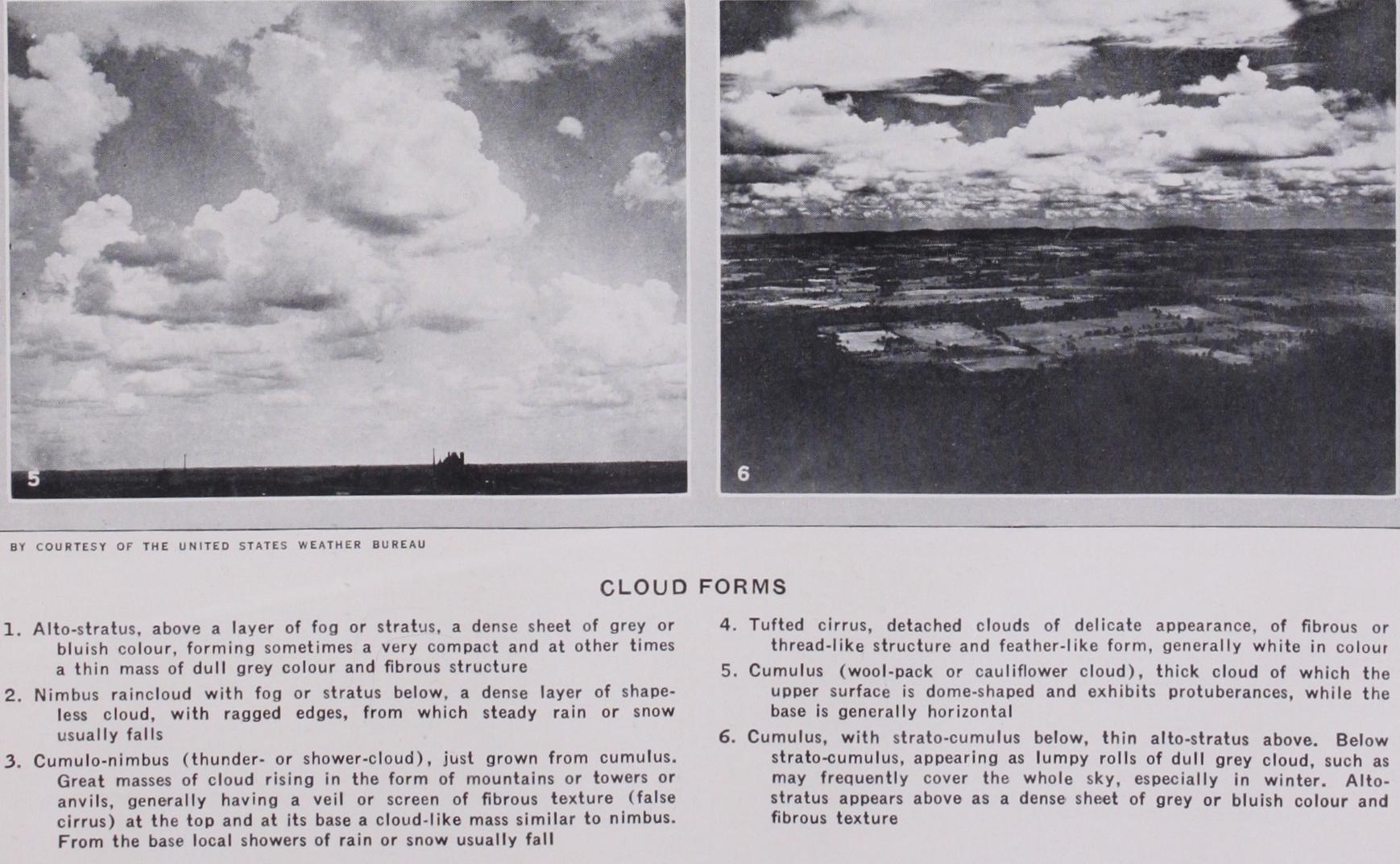
a term popularly applied to an exces sively heavy fall of rain, usually of brief duration, over a small area of the earth's surface. Most so-called cloud-bursts occur in connection with thunder-storms. In these storms there are violent uprushes of air, which at times prevent the condensing raindrops from falling to the ground. A large amount of water may thus accumulate at high levels, and if, for any reason, the upward currents are weakened the whole of this water falls at one time. Cloud-bursts are especially common in mountainous districts. This is probably because the rising air currents of a thunder storm are more or less broken up by the passage of the storm over a mountain. Of course, the effects of heavy rain are espe cially striking on mountain slopes because the falling water is con centrated in valleys and gulleys. Mountain cloud-bursts cause very sudden and destructive floods. The intensity of rainfall in the most severe cloud-bursts can only be conjectured. A rainfall of 2.47 in. in 3 min. was registered by an automatic rain-gauge at Porto Bello, Panama, on Nov. 29, 1911, and one of 1.02 in. in i min. by two automatic gauges, placed side by side, at Opid's camp, on the west front of the San Gabriel Range, Calif., on April 5, 1926. There have been many cases, however, in which the deep excavations made in the ground by the falling water of a cloud-burst appear to indicate a much greater intensity of rainfall than in the cases above noted.