COAST PROTECTION AND LAND RECLAMA TION. The boundaries between sea and land are perennially changing. In many sheltered bays and estuaries the sea is reced ing, while along other portions of the sea coast it is continuously encroaching. The same causes operate to produce both results: the rivers carry down with them detritus and sediment from the higher ground ; the sea, aided by wind and tide, is always eroding exposed portions of the seaboard; and even such lesser influences as rain and frost assist in disintegrating cliffs composed of softer strata.
The main objects of reclaiming land from the sea are : (a) to increase the area of ground available for cultivation; (b) to gain land of high potential value for some industrial purpose or for municipal expansion. Examples of the first are the fen-land reclamations, the embanking and reclaiming of Sunk Island in the river Humber, and the great Zuider Zee reclamation which was begun in 1920. The reclaiming of nearly 3ooac. of fore shore by the construction of a costly sea embankment at Hod barrow in Cumberland, for the purpose of mining iron-ore under the foreshore and sea bed, and many instances of reclamation of sites for dock works, such as that begun at Southampton in 1926, are examples of reclamation for industrial purposes. The reclaiming of the foreshore at Back Bay on the west side of the Colaba peninsula at Bombay, begun after the World War, is a notable undertaking connected with city expansion. The high cost of labour and materials compared with the value of agricul tural land in recent times has, particularly since the war, rendered works of reclamation, solely with the object of cultivation, in Great Britain at any rate, usually unremunerative.
In the intermediate stages of the process outlined above much may be done to promote the growth of accretion, or warping as it is termed, and to ensure the fertility of the reclaimed land. The deposit of warp is accelerated by anything which tends to reduce the flow and consequent scour of the ebb-tide over the foreshore : thus considerable advantage will accrue from placing rows of faggots or sods across the lines of flow. The light, fertiliz ing alluvium only deposits in shallow water at high tide and where there are no tidal currents. The final enclosure, therefore, in the case of land intended for cultivation, should not be effected until this deposit has taken place. A final and rapid deposit can sometimes be effected by making sluices in the banks : the turbid water is admitted near high tide, and retained until the whole of its silt has been deposited, the clear water being allowed to escape slowly towards low tide. Premature enclosure must be guarded against ; it is more difficult, the cost greater, the reclaimed land is less fertile and, being lower, less easy to drain.
The practice of reclaiming land in British estuaries is a very ancient one. The Romans effected reclamations in the Fen dis tricts, in Romney Marsh and near Winchelsea; the enclosing of Sunk Island in the Humber was begun in the 17th century, and now produces an annual revenue of something like £ro,000; large reclamations in the Dee estuary took place in the i8th century; and, in recent times, works have been carried out in the estuaries of the Ribble, Tees and other rivers. The bulk of the recent work has been with the object of industrial development. For instance, in the Tees estuary large areas of foreshore have been, and are being, reclaimed for factory sites and other industrial purposes by forming banks of iron-slag obtained from the iron works of the Middlesbrough district. Slag constitutes an excellent material for the construction of reclamation banks in localities where it can be obtained at a low cost near the site of the works. The deposit of alluvial material, during and after embanking, is not an important factor in reclamation for industrial purposes and where the levels of land have to be raised it is usual in such cases to effect this by the artificial deposit of filling material.
Sea-coast embankments should not generally be constructed farther down the foreshore than half-tide level, as the cost of construction and maintenance would increase out of all pro portion to the additional area obtained. It is, as a rule, more economical to reclaim a large area at one time, instead of en closing it gradually in sections, as the cost varies with the length of embankment ; it is, however, more difficult to effect the final closing of a bank, where a large area is thus reclaimed, on account of the greater volume of tidal water flowing in and out of the contracted opening. The final closing of a reclama tion embankment is best accomplished by leaving a fairly wide aperture, and by gradually raising a level bank across its entire length. The embankments in Holland are closed by sinking long fascine mattresses across the opening; these are weighted with clay and stone, and effectually withstand the scour through the gap; the two terminal slopes of the finished sections are similarly protected.
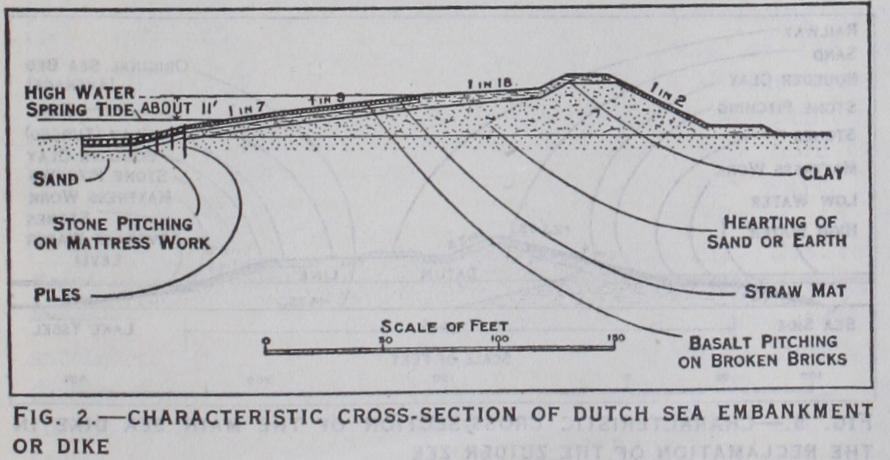
There are many examples of sea-coast reclamation : Romney marsh was enclosed long ago by the Dymchurch wall, where the method of protection adopted in late years more nearly resembles the Dutch system than any other work in Great Britain (fig. 1), and a large portion of Holland has been reclaimed from the sea by embankments (fig. 2) ; the reclamation bank for the Hod barrow iron-mines illustrates the use of puddled clay to prevent infiltration. The outer portion of this embankment for a Length of over 3,000f t. was protected on its sea face by concrete blocks, each weighing 25 tons, deposited "pell-mell" (fig. 3) . The sea embankment of the Back Bay reclamation at Bombay (q.v.) is an example of modern construction on a rocky foreshore. When completed the length of the wall will be 4 miles.
Breaches in Embankments.—The repair of a breach effected in a completed reclamation embankment is a more difficult task than that of closing the final gap during construction; this is owing to the channel or gully scoured out upon the opening of the breach. When a breach occurs which cannot be closed in a single tide, the formation of an over-deep gully may to some extent be prevented by enlarging the opening. Breaches in embankments have been closed by sinking barges across the gap, by piling and planking up, by lowering sliding panels between frames erected to receive them, and by making an inset wall or bank round the breach.
The gradual drying of reclaimed land lowers the surface some two or three feet ; the land therefore becomes more liable to inundation after reclamation than before. Accordingly, it is most important to prevent breaching of the bank by promptly repair ing any damage caused by storms; and if a breach should occur, it must be closed at the earliest possible opportunity.
Reclamation by Dredging.—Mention should be made of the method of reclamation by dredging material from the bed of the sea or a river and depositing it on shore or behind an embankment for the purpose of raising the level of existing land or converting foreshore or sea-bed into dry land. The method was first used on a large scale in Holland towards the end of the 19th century and has since been extensively em ployed in many parts of the world (see DREDGERS AND DREDGING). The material, whether sand, silt, clay or gravel, is dredged from the sea or river-bed by a bucket dredger or a suction dredger. If the former is employed the dredged material is usually delivered into barges and conveyed to a "pump-ashore" station, where ad mixture with water takes place, and a pump forces the mixture through a line of pipes on to the land to be reclaimed. If suction dredgers are used for gaining the material it can be pumped ashore direct through floating pipe lines, if the distance is not too great, or transported by barges from which it is pumped ashore by means of a fixed or floating reclamation pump. In some instances an intermediate pumping station in a long line of delivery pipes has been used to "boost" (i.e., to speed up or relay the flow through the pipes) the mixture of water and dredgings delivered to it from the main dredger.