
COASTGUARD, a force usually naval in character, main tained in some countries for the suppression of smuggling or af fording assistance to vessels in distress or wrecked and for other duties incidental to a seaboard, e.g., signalling, etc.
To cope with the intensive smuggling which followed on the conclusion of the Napoleonic wars a special British preventive service was formed, officered by half-pay naval lieutenants, to work in conjunction with the revenue cutters and riding officers to whom hitherto the duty of the protection of the revenue had been entrusted. Until 1831 the control of this service was vested in the customs, but in that year the service was reorganized and came, for purposes of administration, under the Admiralty, taking the name of Coastguard, but it was not until 1845 that it assumed a naval character. In 1856 the Coastguard Act was passed and the service transferred entirely to the control of the Admiralty. By the provisions of this act the Coastguard were, in time of war, to be used for the defence of the coast and as a reserve for the navy. The protection of the revenue remained, however, the pri mary function in time of peace.
From the establishment of the Coastguard—both prior to and since its transfer from the board of customs to the Admiralty— certain services connected with wrecks, casualties at sea, and life saving generally were undertaken gradually by the force.
The main work of the Coastguard in time of peace, therefore, was on behalf of government departments other than the Ad miralty, the board of trade and board of customs, the former being the government department responsible by Act of Parliament for the establishment and maintenance of rocket and other life-saving stations on the coast of Great Britain. The personnel were, how ever, trained regularly in their naval duties, at first by periodical cruises in Coastguard vessels stationed at various ports on the coast and subsequently by embarkation in the fleet during the an nual manoeuvres. A certain portion, however, were organized and trained as a signal section for the purpose of manning signal stations around the coast in the event of war. This system pre vailed at the outbreak of the World War.
On the conclusion of peace the Coastguard was reorganized, the personnel being composed of naval pensioners in place of active service ratings. The force, however, continued to be officered by officers on the active list and its duties remained substantially the same as in pre-war days.
In 1922 as the result of the recommendations of the Geddes Committee an inter-departmental committee was appointed to enquire what establishment was necessary for carrying out the civil duties discharged by the Coastguard, what arrangements should be made for a divisional responsibility and cost between the departments concerned and what economies consistent with the maintenance of the necessary national services could be ef fected. The committee reported in effect that the responsibility for revenue protection should be assumed by the board of cus toms and excise and that the responsibility for the other non naval services should be assumed by the board of trade. These recommendations were accepted by the Government and the serv ice was reorganized on the lines recommended as from April 1, 1923.
The Coastguard Act of 1856 was repealed by the Coastguard bill of 1925 whereby it was enacted that H.M. Coastguard shall consist of such numbers of officers and men as the board of trade may, with the consent of the Treasury, from time to time think fit, and shall be raised, maintained, equipped and employed as a coast watching force for the performance of the duties hitherto performed by the Coastguard on behalf of the board.
As a result the Coastguard is now, although very much reduced in numbers, primarily a life-saving service, to which end the organization is directed. The personnel is composed entirely of retired naval officers and pensioners from the royal navy.
In France, although there is no coastguard service in the sense of that maintained by Great Britain and the United States, a num ber of semaphore stations are established on the coast, manned by long-service men from the navy, called "Guetteurs Semaphorique." Their duties are primarily concerned with signalling, but the work is also of a life-saving character as a look-out is kept for vessels in danger or distress, while the personnel have charge of and assist to work the rocket life-saving apparatus, should there be one in the vicinity of the station. The service is under the control of the minister of marine, stations being under the command of the mari time prefect of the district.
BIBLIOGRAPHY.--The rise and early history of the Coastguard in Bibliography.--The rise and early history of the Coastguard in Great Britain are told in Smuggling Days and Smuggling Ways by the Hon. Henry N. Shaw, R.N. (1892) . Information of this nature can be found also in The King's Customs by Hatton and Holland. Later history must be traced in the Queen's (and King's) Regulations and Admiralty Instructions of successive years. The reports of the Inter Departmental Conference on the Coastguard held in 1907 (Cmd. 4,091) and of the Inter-Departmental Committee on the civil duties of the Coastguard held in 1922 (Cmd. 1,753) contain much useful information as to the history and the duties of the Coastguard. In the case of the United States full information as to the organization and duties of the Coastguard can be obtained from the annual reports issued by the Treasury on the United States Coastguard ; the report for 1921 especially contains much useful information concerning the history and development of the service. (H. J. M. R.) The United States' Coastguard was originally created by an act of Congress approved on Jan. 28, 1915, which combined therein the existing U.S. revenue cutter service and U.S. life saving service. The act expressly provides that the Coastguard "shall constitute a part of the military forces of the United States, and shall operate under the Treasury department in time of peace, and operate as a part of the navy, subject to the orders of the sec retary of the Navy, in time of war or when the President shall so direct." The Coastguard, through its antecedent, the revenue cutter service, is one of the oldest organizations under the Federal Gov ernment. After the Revolutionary War, the continental navy was disbanded. There was no sea force available for the protection of the coasts and the maritime interest of the newly constituted United States until the organization of the revenue cutter service by an act of the first Congress, approved by President Washington on Aug. 4, I790. The vessels of the revenue cutter service formed the only armed force afloat belonging to the young republic until the navy was organized a few years later. The revenue cutter service was from the first, and still is, charged with the protection of the customs, that is, with preventing smuggling from the sea.
The Coastguard has played a distinguished part in every war in which the United States has been engaged, with the exception only of the war with Tripoli. The records show that of the 22 prizes captured by the United States during the difficulties with France in 1798 and 1799 the Coastguard cutters captured 18, un aided, and assisted in the capture of two others. A Coastguard vessel made the first capture afloat in the War of 1812. The sup pression of the piracy which prevailed during the first quarter of the 19th century in the Gulf of Mexico was due chiefly to the Coastguard. The cutters waged a relentless war upon the pirates, pursued them to their every resort and rendezvous, and attacked and dispersed them wherever found. Vessels of the Coastguard service participated actively in the Seminole Indian War, in the Mexican War and in the Civil War. The cutter "Harriet Lane" was attached to the squadron of naval vessels that was sent to Paraguay in 1858. The Coastguard cutters fought alongside ves sels of the navy in the Spanish War. The cutter "Hudson" was actively engaged at the battle of Cardenas and the cutter "Mc Culloch" was with Admiral Dewey's fleet at the battle of Manila bay. When the United States entered the World War, the entire Coastguard, in accordance with law, passed into the naval estab lishment. Coastguard vessels fought submarines and performed escort and patrol duty in the European war zone, and officers and men served with distinction in practically every phase of naval activity. The sinking of the Coastguard cutter "Tampa," after she had safely escorted her convoy to an English port, by an enemy submarine, Sept. 26, 1918, when every soul on board, 115 in all, was lost, constituted, with the sole exception of the loss of the "Cyclops," the largest individual loss sustained by U.S. naval forces during the war.

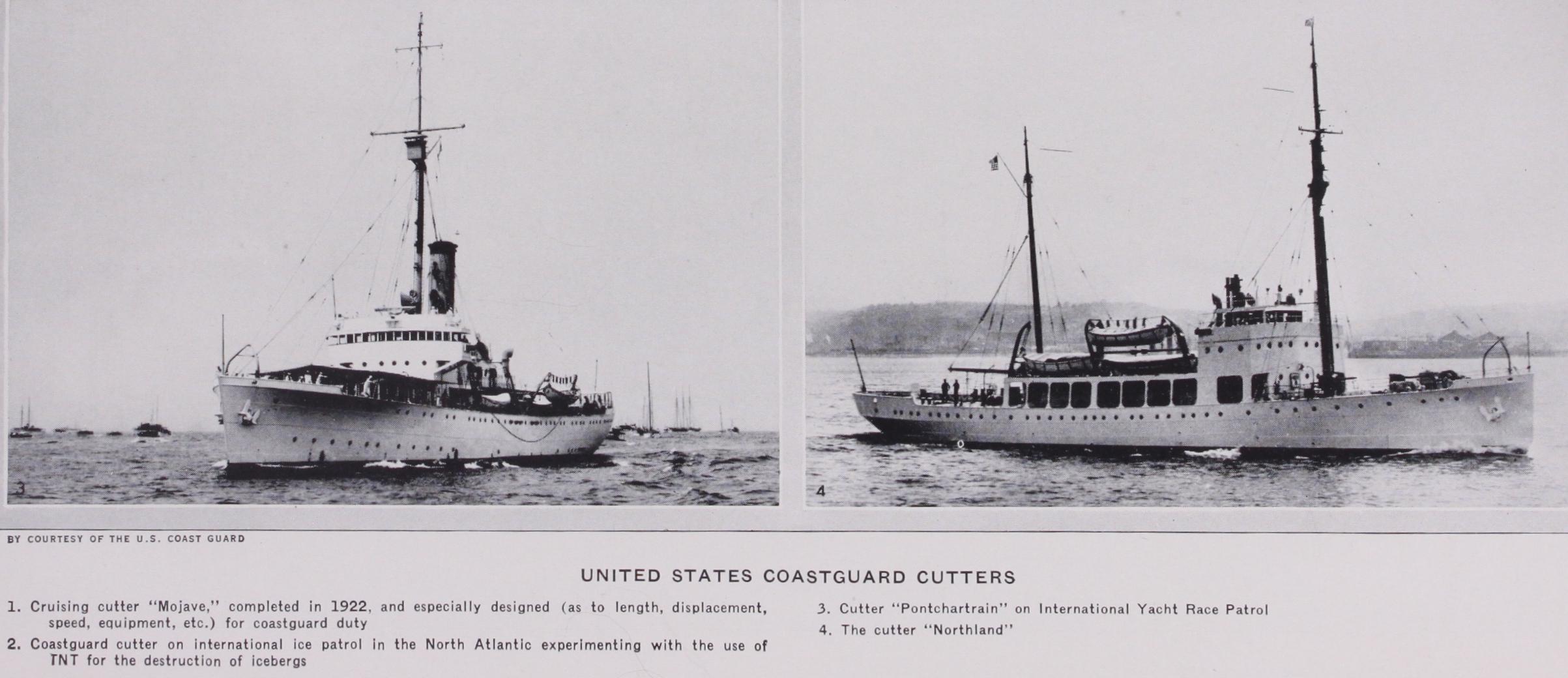

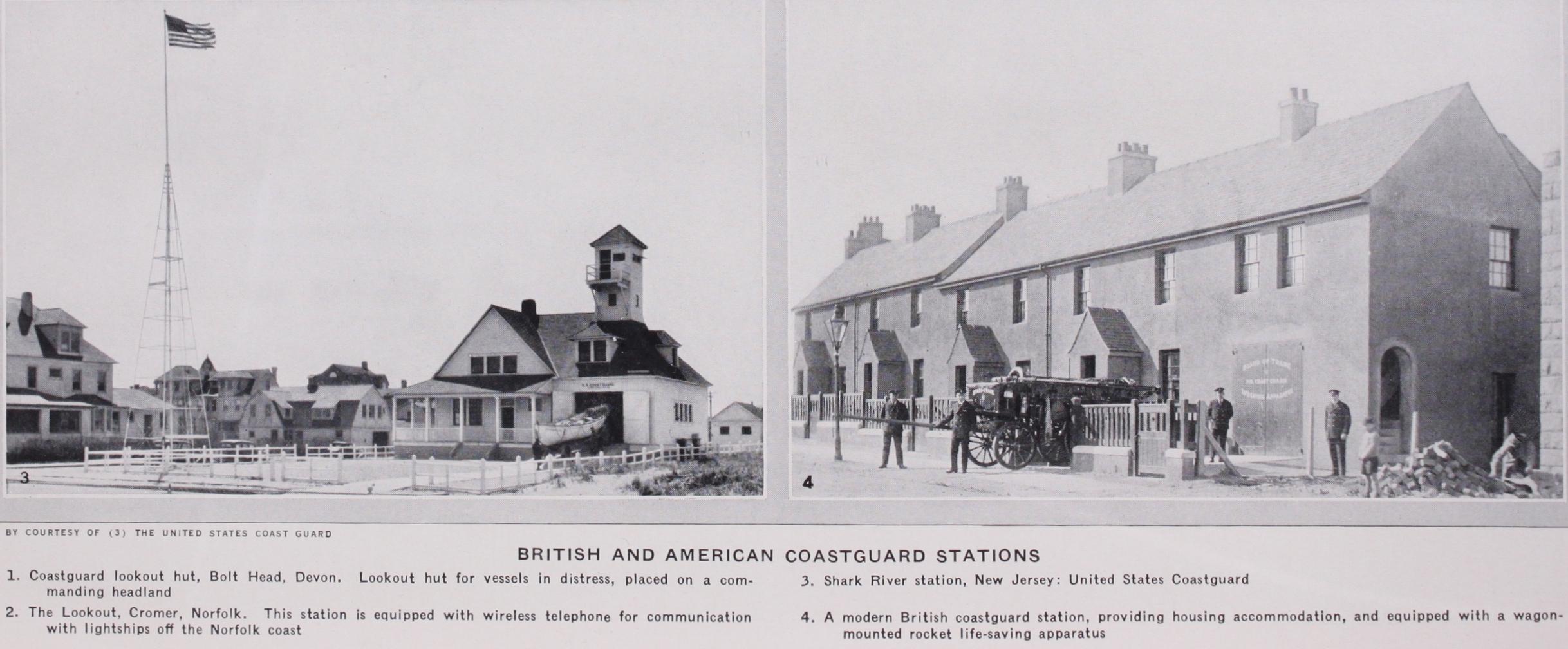
In time of peace the Coastguard maintains a constant readi ness for war and is prepared to pass into the naval establishment on 24 hours' notice. It is a real and valuable part of the national defence. In addition, it is charged with a large number of im portant peace-time duties, most of which are essentially humani tarian in their character. Its most important function, in time of peace, is that of saving life and property at sea. Its ships cruise actively along the coasts at all times, and particularly in the most dangerous weather, to render aid to vessels in trouble. In addition to the ships and supplementing their work in rescuing human life, a cordon of 277 Coastguard stations (formerly known as life saving stations) protects the shores.
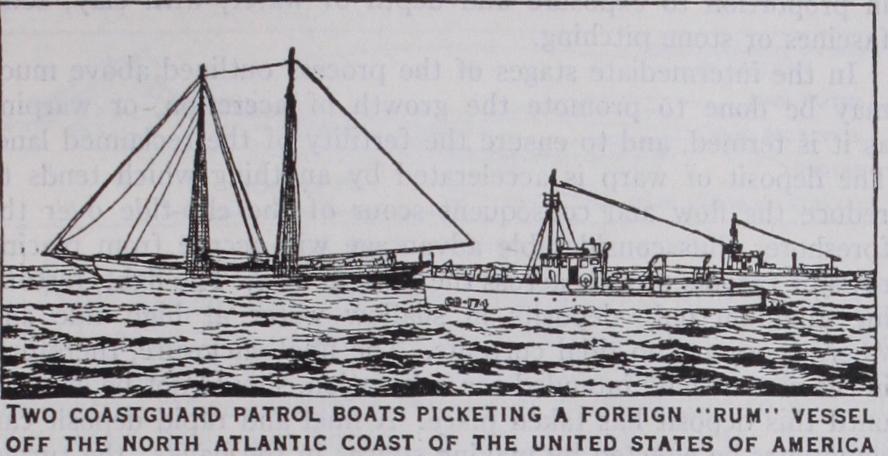
The Coastguard clears away derelicts and other floating obstruc tions to navigation that constitute a very real danger to ships at sea. It maintains the international ice patrol along the trans Atlantic steamer lanes, a service that was instituted following the sinking of the steamer "Titanic" April 14, 1912. Since the Coast guard took charge of this patrol there has not been a single life lost by collision with icebergs or ice-fields in the North Atlantic. The cutters protect the seal herds and other fisheries in Alaskan waters and visit the remote parts of the Alaskan coast, carrying medical aid and the benefits of law and civilization to the whites and natives in those far northern regions. The Coastguard enforces the regulations governing anchorage of vessels in navi gable waters; it aids in the enforcement of the navigation laws governing merchant vessels and motor boats ; it suppresses mu tinies on merchant vessels; it protects human life and maintains order at regattas and large marine parades. During the great Mis sissippi flood in the spring of 1927, the Coastguard service sent 674 officers and men and 128 vessels and boats into the inundated regions. It removed 43,853 persons from perilous positions to places of safety and saved 11,313 head of live stock. During the fiscal year ended June 3o, 1927, the number of lives saved or persons rescued from peril by the Coastguard was 3,313. The number of derelicts and other obstructions to navigation removed or destroyed was 136. The number of persons on board vessels assisted was 14,496. The value of vessels assisted, including their cargoes, was $37,801,357. The number of vessels boarded and their papers examined was 68,223.
On June 3o, 1927, the Coastguard fleet consisted of 33 cruising cutters, 25 destroyers, 37 harbour cutters and launches, 46 off shore patrol boats, 198 75-foot patrol boats, 7 other patrol boats and 112 small picket boats. The personnel consisted of 359 com missioned officers, 47 cadets, 22 chief warrant officers, 832 war rant officers and 9,924 enlisted men.
There are 277 Coastguard (live-saving) stations, of which 252 are in an active status. The equipment of Coastguard stations consists of the beach apparatus—line-projecting guns, hawsers, breeches-buoys, etc.—flag and pyrotechnic signals, life-cars and life-boats, surf-boats and other types of boats, all intended to res cue persons in peril at sea. The historic motto of the Coastguard is Semper Paratus ("Always Prepared"). (F. C. Bi).