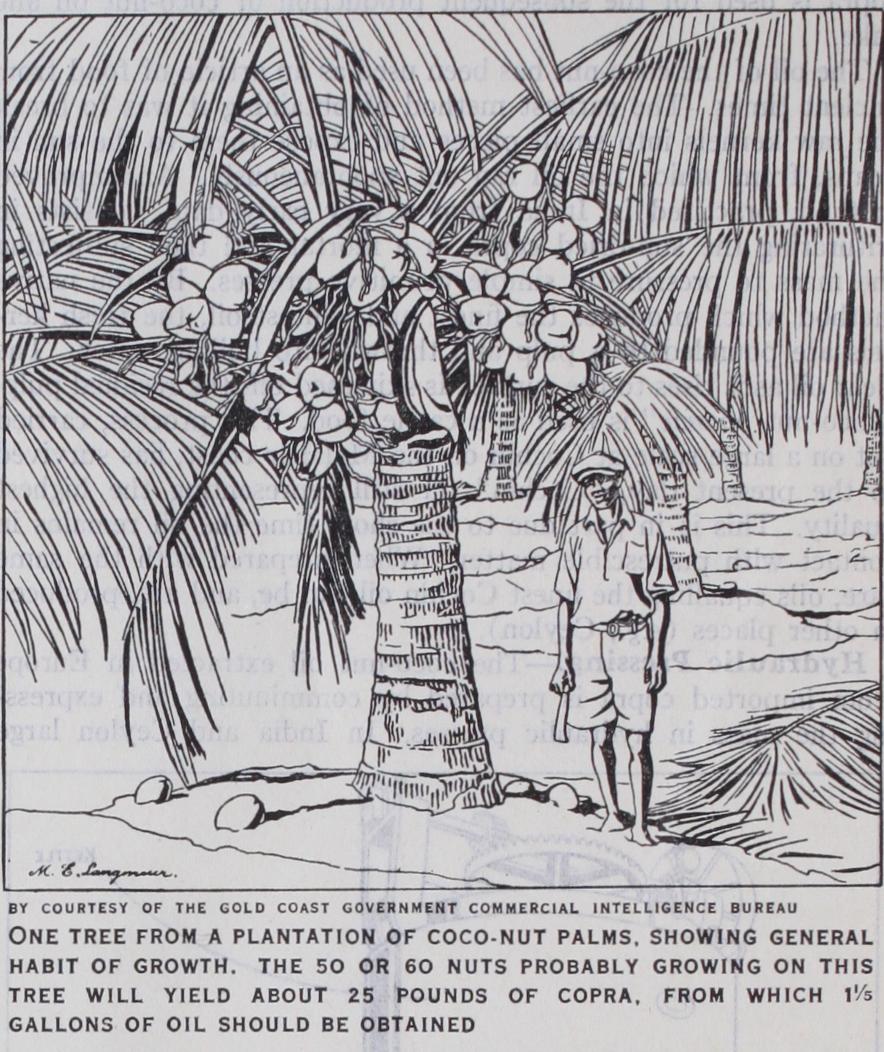
COCONUT PALM (Cocos nucifera), a beautiful and lofty palm-tree, growing to a height of 6o to iooft. with a cylindrical stem which attains a thickness of eft. The tree terminates in a crown of graceful waving pinnate leaves. The leaf, which may attain to loft. in length, consists of a strong mid-rib, whence numerous long acute leaflets spring, giving the whole the appear ance of a gigantic feather. The flowers are arranged in branching spikes 5 or 6f t. long, enclosed in a tough spathe, and the fruits mature in bunches of from io to 20. The fruits when mature are oblong, and triangular in cross section, measuring from i 2 to i8in. in length and 6 to Bin. in diameter. Each consists of a thick external husk or rind of a fibrous structure, within which is the ordinary coco-nut of commerce. The nut has a very hard, woody shell, enclosing the nucleus or kernel, the true seed, within which again is a milky liquid called coco-nut milk. The three well known marks on the shell correspond to the three original cavities of the ovary but only one cavity, that containing the "milk," remains in the native fruit. One of the marks, that leading to the single cavity, is soft and easily perforated ; beneath it lies the embryo. The palm is so widely disseminated throughout tropical countries that it is impossible to distinguish its original habitat. It flourishes on the coast of the East Indies, throughout the tropical islands of the Pacific, and in the West Indies and tropical America. It, however, attains its greatest luxuriance and vigour on the seashore, and it is most at home in the innumerable small islands of the Pacific seas, of the vegetation of which it is emi nently characteristic. Its wide distribution, and its existence in even the smallest coral islets of the Pacific, are due to the char acter of the fruit, which is eminently adapted for distribution by sea. The fibrous husk renders the fruit light and the leathery skin prevents water-logging. The seed will germinate readily on the seashore, the seedling growing out through the soft germ-pore on the upper end of the hard nut. The fruits dropping into the sea from trees growing on any shores would be carried by tides and currents to be cast up and to vegetate on distant coasts.
The coco-nut palm, being the most useful of its entire tribe to the natives of the regions in which it grows, and furnishing many valuable and important commercial products, is the subject of careful cultivation in many countries. On the Malabar and ant and refreshing drink. The juice drawn from the unexpanded flower spathes forms "toddy," which may be boiled down to sugar, or it is allowed to ferment and is distilled, when it yields a spirit which, in common with a like product from other sources, is known as "arrack." As in other palms, the young bud cut out of the top of the tree forms an esculent vegetable, "palm cab bage." The trunk yields a timber (known in European commerce as porcupine wood) which is used for building, furniture, firewood, etc.; the leaves are plaited into cajan fans and baskets, and used for thatching the roofs of houses; the shell of the nut is employed as a water-vessel; and the external husk or rind yields the coir fibre, with which are fabricated ropes, cordage, brushes, etc. The coco-nut palm also furnishes very important articles of external commerce, of which the principal is coco-nut oil. It is obtained by pressure or boiling from the kernels, which are first broken up into small pieces and dried in the sun, when they are known as copra. It is estimated that ',coo full-sized nuts will yield upwards of 500 lb. of copra, from which 25 gallons of oil should be ob tained. The oil is a white solid substance at ordinary temperatures, with a peculiar, rather disagreeable odour, from the volatile fatty acids it contains, and a mild taste. Under pressure it separates into a liquid and a solid portion, the latter, coco-stearin, being extensively used in the manufacture of candles. Coco-nut oil is chiefly used in manufacture of soap and margarine. Coir is also an important article of commerce, being in large demand for the manufacture of coarse brushes, door mats and woven coir-mat ting for lobbies and passages. (See MATTING.) A considerable quantity of fresh nuts is exported, chiefly from the West Indies.