
COD, the name given to the typical fish of the family Gadidae of the order Anacanthini, which includes fishes without spinous fin-rays, with no duct to the air-bladder, and with the pelvic fins anterior in position. The pelvic fins are often many-rayed, and the pelvic bones are not directly attached to the pectoral arch, these characters distinguishing the Anacanthini from certain Blennioid fishes of the order Percomorphi, with which they were formerly associated, and indicating their relationship to more primitive orders. The Anacanthini include two principal fam ilies, the Macruridae, which are deep-sea fishes without a caudal fin and with the long second dorsal and anal fins continued to the end of the tapering tail, and the Gadidae, in which the caudal fin is composed mainly of dorsal and anal fin-rays, the homo cercal fin being greatly reduced, an indication that the ancestral form may have been eel-shaped. The Gadidae are marine with the exception of the burbot (Lota iota), which is a freshwater fish. They are most abundant in northern seas, where there are several species of great economic importance, e.g., cod, haddock (q.v.), whiting (q.v.), ling (q.v.), and hake (q.v.). In warmer seas there are some deep-water forms of no great value, and the hake genus (Merluccius) is the only important one represented in both the north and south temperate zones. The flesh of all these fishes is more digestible than nutritious, being poor in fat.
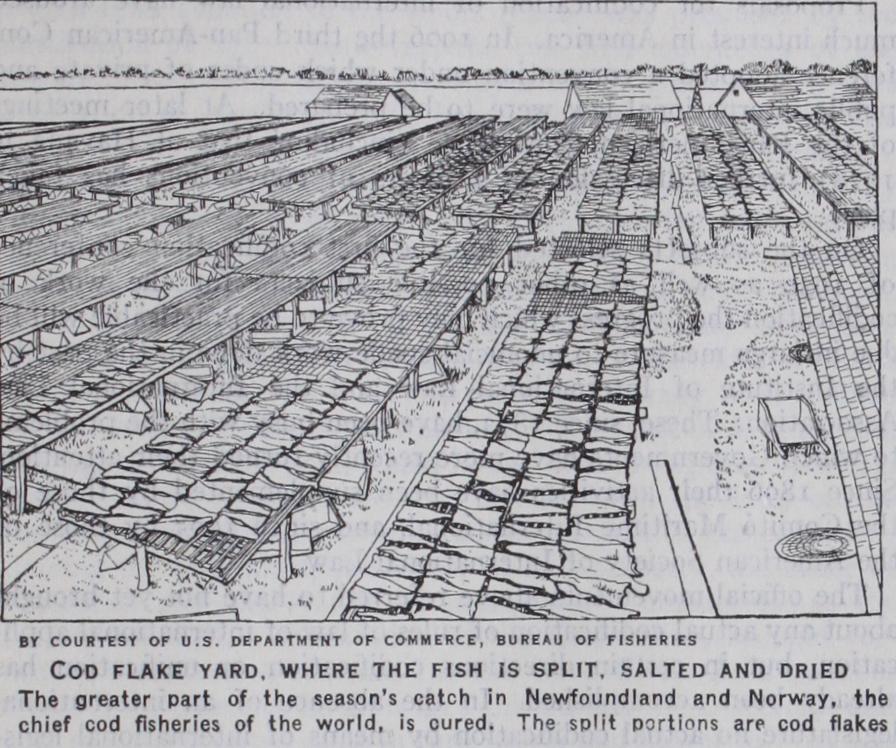
The cod (Gadus naorrlzua) in common with other fishes of the genus Gadus, has three dorsal and two anal fins; the upper jaw projects beyond the lower, and there is a barbel at the chin. The colour varies considerably, but is generally olive-green above with darker spots, and white below ; the lateral line is white and conspicuous. The cod is found in the north Atlantic and Baltic but not in the Mediterranean; it also occurs in the north Pacific. Generally it lives on the bottom at depths of io to I oo fathoms, and feeds on other fishes, such as herring and sand-eels, and also on squids, mussels, whelks, etc. The spawning season is from January to March ; the eggs are minute and are produced in enormous numbers, sometimes 1 o,000,000 from one female; they float in the water. The young fish attain a length of about two feet in four years; three feet is an average size, but some grow to more than five feet long and weigh over ioolb. The cod is the object of extensive fisheries by line and trawl on the New foundland banks, off Iceland and in the North Sea. The greater part of the catch is split, salted and dried ; the livers are used for the preparation of cod-liver oil, and the roes are sent to France to be used as groundbait in the sardine fishery; isinglass is made from the air-bladder. (C. T. R. ) C.O.D.: see CASH ON DELIVERY.