
COFFEE. This important and valuable article of food is the produce chiefly of Co$ea arabica, a Rubiaceous plant indigenous to Abyssinia, which, however, as cultivated originally, spread out wards from the southern parts of Arabia. The name is probably derived from the Arabic K'hawah, although by some it has been traced to Kaffa, a province in Abyssinia, in which the tree grows wild.
The genus Coffea, to which the common coffee tree belongs, contains about 25 species in the tropics of the Old World, mainly African. Besides being found wild in Abyssinia, the common coffee plant appears to be widely disseminated in Africa, occurring wild in the Mozambique district, on the shores of the Victoria Nyanza, and in Angola on the west coast. The coffee leaf disease in Ceylon brought into prominence a Liberian coffee (C. liberica), a native of the west coast of Africa, now extensively grown in several parts of the world. Other species of economic importance are Sierra Leone coffee (C. stenophylla) and Congo coffee (C. robusta), both of which have been introduced into and are culti vated on a small scale in various parts of the tropics. C. excelsa is another species of considerable promise.
The common Arabian coffee shrub is an evergreen plant, which under natural conditions grows to a height of from 18 to 20 ft., with oblong-ovate, acuminate, smooth and shining leaves, measur ing about 6in. in length by 2 tin. wide. Its flowers, which are pro duced in dense clusters in the axils of the leaves, have a five toothed calyx, a tubular five-parted corolla, five stamens and a single bifid style. The flowers are pure white in colour, with a rich fragrant odour, and the plants in blossom have a lovely and attractive appearance, but the bloom is very evanescent. The fruit is a fleshy berry, having the appearance and size of a small cherry, and as it ripens it assumes a dark red colour. Each fruit contains two seeds embedded in a yellowish pulp, and the seeds are enclosed in a thin membranous endocarp (the "parchment"). Between each seed and the parchment is a delicate covering called the "silver skin." The seeds which constitute the raw coffee "beans" of commerce are plano-convex in form, the flat surfaces which are laid against each other within the berry having a longitudinal furrow or groove.
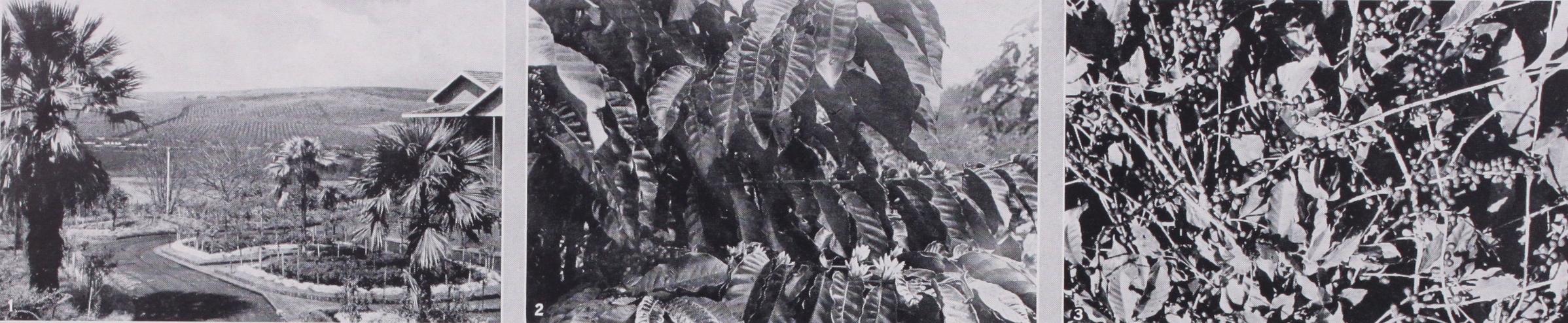
When only one seed is developed in a fruit it is not flattened on one side, but circular in cross section.
Such seeds form "pea-berry" cof f ee, The seeds are of a soft, semi translucent, bluish or greenish colour, hard and tough in texture.
The regions best adapted for the cultivation of coffee are well watered mountain slopes at an elevation ranging from i,000 to 4,0ooft. above sea-level, within the tropics, and possessing a mean annual temperature of about 65° to 7o° F.
The Liberian coffee plant (C.
liberica) has larger leaves, flow er:. and fruits, and is of a more robust and hardy constitution than Arabian coffee. The seeds yield a highly aromatic and well flavoured coffee (but by no means equal to Arabian), and the plant is very prolific and yields heavy crops. Liberian coffee grows, moreover, at low altitudes, and flourishes in many situations un suitable to the Arabian coffee.
It grows wild in great abun dance along the whole of the Guinea coast.
The appreciation of coffee as a beverage in Europe dates from the 17th century. "Coffee-houses" were soon instituted, the first being opened in Constantinople and Venice. In London coffee houses date from 1652, when one was opened in St. Michael's Alley, Cornhill. They soon became popular, and the role played by them in the social life of the 17th and 18th centuries is well known. In Europe, as in Arabia, coffee at first made its way into favour in the face of various adverse and even prohibitive restric tions. Thus at one time in Germany it was necessary to obtain a licence to roast coffee. In England Charles II. endeavoured to suppress coffee-houses on the ground that they were centres of political agitation.
Up to the close of the 17th century, the world's entire, although limited, supply of coffee was obtained from the province of Yemen in south Arabia, where the true celebrated Mocha or Mokka cof fee is still produced. At this time, however, plants were success fully introduced from Arabia to Java, where the cultivation was immediately taken up. The government of Java distributed plants to various places, including the botanic garden of Amsterdam. The Portuguese introduced coffee into Ceylon. From Amsterdam the Dutch sent the plant to Surinam in 1718, and in the same year Jamaica received it through its governor, Sir Nicholas Lawes, whence it spread generally through the tropics of the New World, which now produce by far the greater portion of the world's supply.
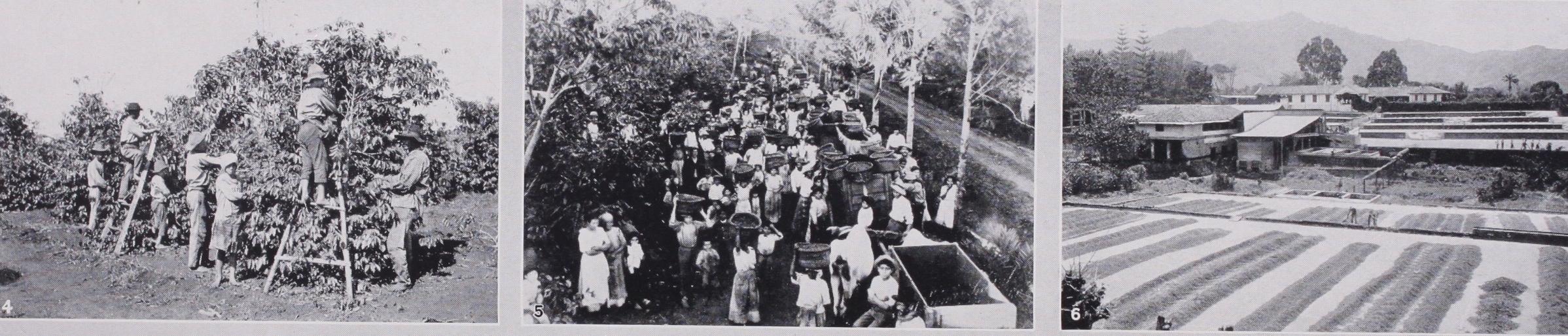
The plants begin to come into bearing in their second or third year, but on the average the fifth is the first year of considerable yield. There may be two, three, or even more "flushes" of blos som in one year, and flowers and fruits in all stages may thus be seen on one plant. The fruits are fully ripe about seven months after the flowers open; the ripe fruits are fleshy, and of a deep red colour, whence the name of "cherry." When mature the fruits are picked by hand, or allowed to fall of their own accord or by shaking the plant. The subsequent preparation may be ac cording to (I) the dry or (2) the wet method.
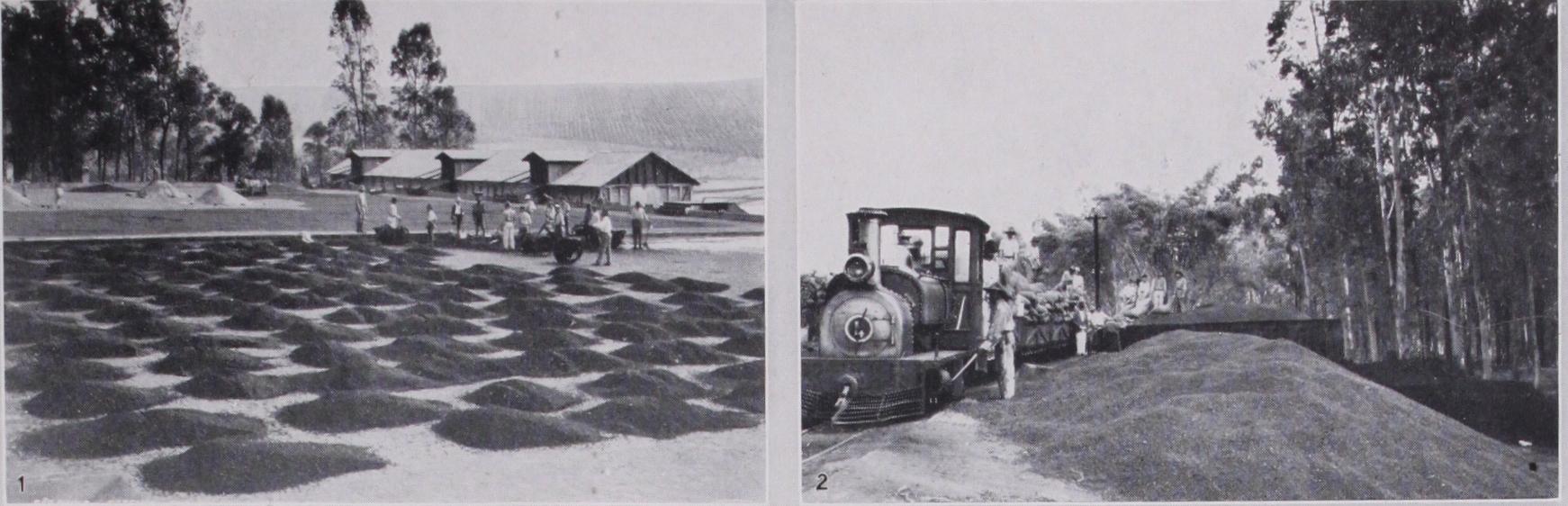
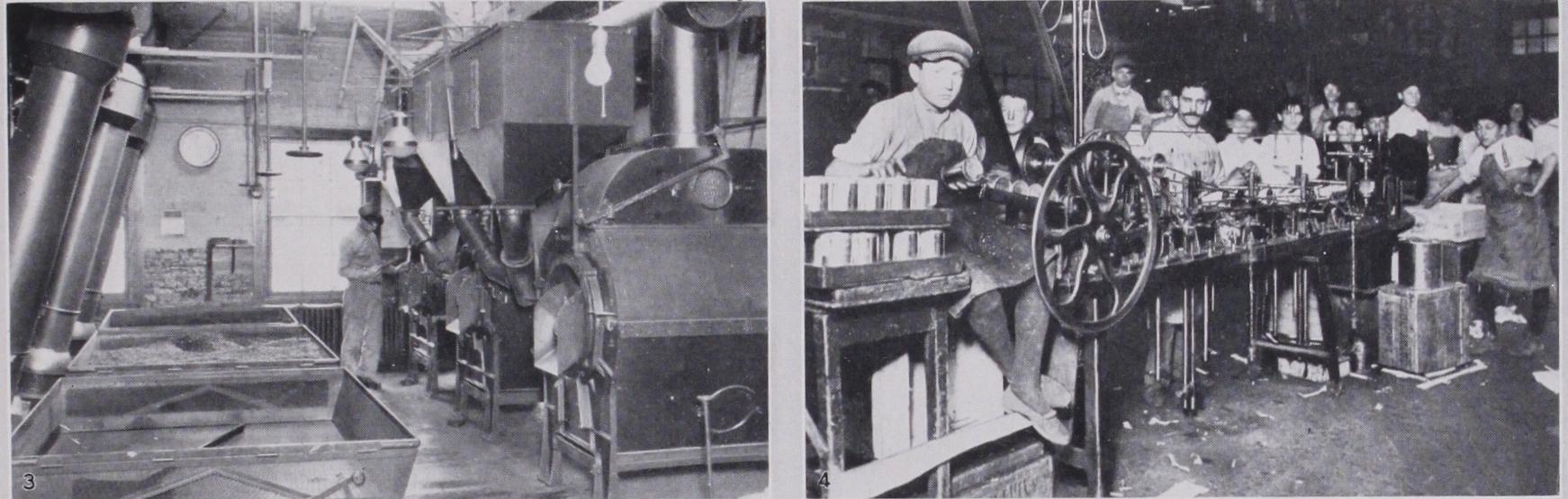
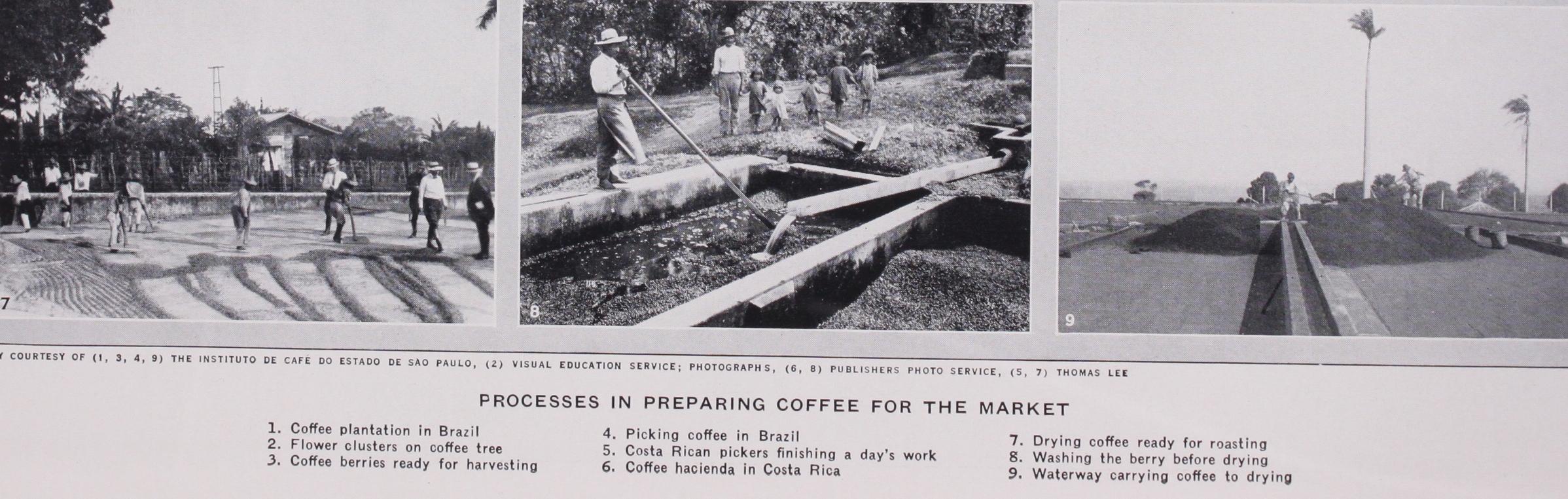
In the dry method the cherries are spread in a thin layer, often on a stone drying floor, or barbecue, and exposed to the sun. Pro tection is necessary against heavy dew or rain. The dried cherries can be stored for any length of time, and later the dried pulp and the parchment are removed, set ting free the two beans contained in each cherry. This primitive and simple method is employed in Arabia and other countries; in Brazil it has largely given place to the more modern method de scribed below.
In the wet, or as it is times called, West Indian method, the cherries are put in a tank of water. On large estates galvanized spouting is often ployed to convey the beans by the help of running water from the fields to the tank. The ture cherries sink, and are drawn off from the tank through pipes to the pulping machines. Here they are subjected to the action of a roughened der revolving closely against a curved iron plate. The fleshy portion is reduced to a pulp and the mixture of pulp and ated seeds (each still enclosed in its parchment) is carried away to a second tank of water and stirred. The light pulp is moved by a stream of water and the seeds allowed to settle. Slight fermentation and subsequent washings, accompanied by trampling with bare feet and stirring by rakes or special machinery, result in the parchment coverings being left quite clean. The beans are now dried on barbecues, in trays, etc., or by artificial heat if matic conditions render this necessary. Experiments in Porto Rico tend to show that if the weather is unfavourable during the crop period the pulped coffee can be allowed to remain moist and even to malt or sprout without injury to the final value of the product when dried later. The product is now in the state known as parchment coffee, and may be exported. Before use, how ever, the parchment must be removed. This may be done on the estate, at the port of shipment, or in the country where im ported. The coffee is thoroughly dried, the parchment broken by a roller, and removed by winnowing. Further rubbing and win nowing removes the silver skin, and the beans are left in the con dition of ordinary unroasted coffee. Grading into large, medium and small beans, to secure the uniformity desirable in roasting, is effected by the use of a cylindrical or other pattern sieve, along which the beans are made to travel, encountering first small, then medium, and finally large apertures or meshes. Damaged beans and foreign matter are removed by hand picking. An average yield of cleaned coffee is from z to 2 lb. per tree, but much greater crops are obtained on new rich lands, and under special conditions.
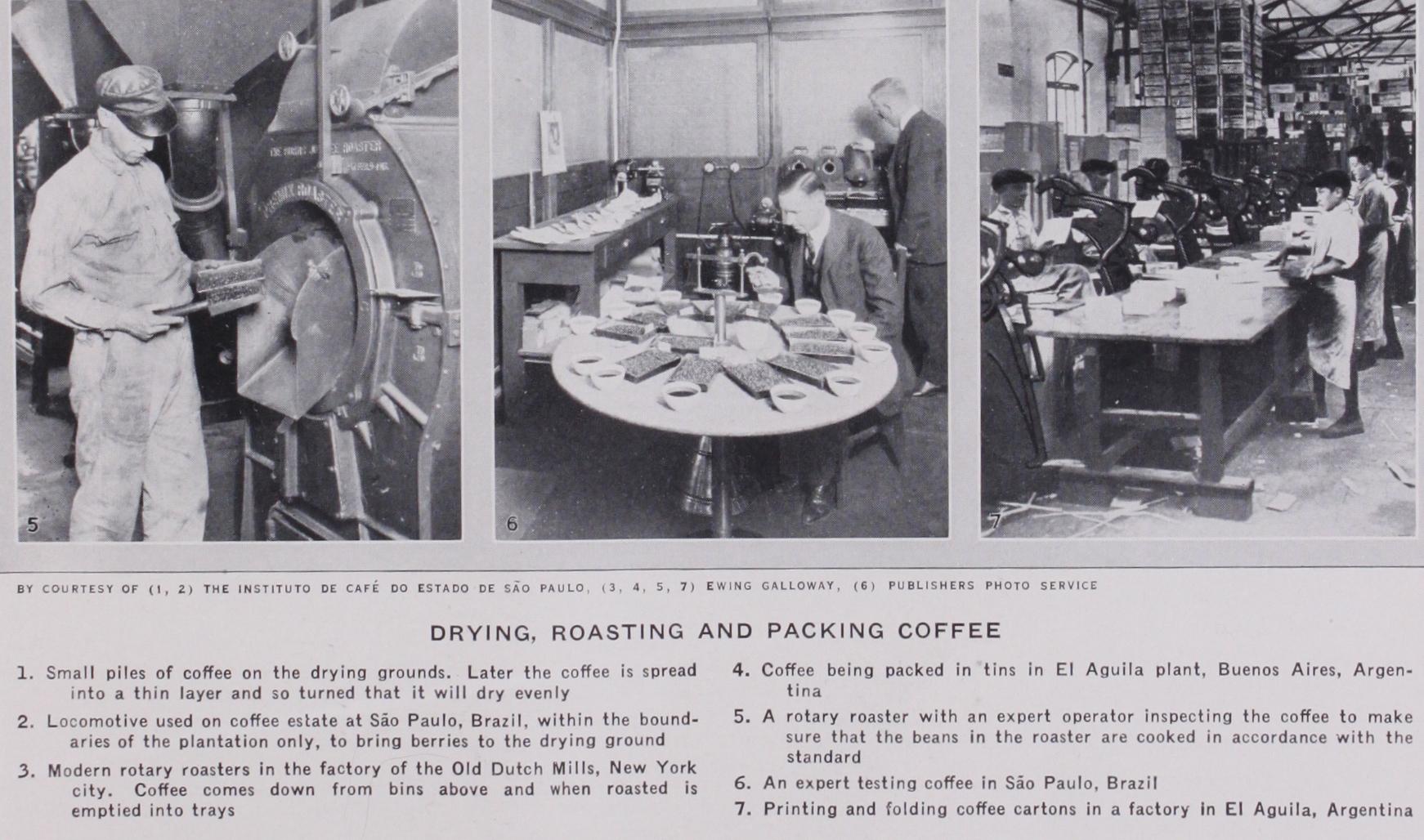
The physiological action of coffee mainly depends on the pres ence of the alkaloid caffeine, which occurs also in tea, Paraguay tea, and cola nuts, and is very similar to theobromine, the active principle in cocoa. The percentage of caffeine present varies in the different species of Coffea. In Arabian coffee it ranges from about 0.7 to 1.6%; in Liberian coffee from i•o to 1.5%. Sierra Leone coffee (C. stenophylla) contains from 1.52 to 1•70%; in C. excelsa 1.89% is recorded, and as much as 1.97% in C. canephora. Four species have been shown by M. G. Bertrand to contain no caffeine at all, but instead a considerable quantity of a bitter prin ciple. All these four species are found only in Madagascar or the neighbouring islands. Other coffees grown there contain caffeine as usual. Coffee, with the caffeine extracted, has also been pre pared for the market. The commercial value of coffee is deter mined by the amount of the aromatic oil, caffeone, which develops in it by the process of roasting. By prolonged keeping it is found that the richness of any seeds in this peculiar oil is increased, and with increased aroma the coffee also yields a blander and more mellow beverage. Stored coffee loses weight at first with great rapidity, as much as 8% having been found to dissipate in the first year of keeping, 5% in the second, and 2% in the third; but such loss of weight is more than compensated by improvement in quality and consequent enhancement of value.
The leaves of the coffee tree contain caffeine in larger propor tion than the seeds themselves, and their use as a substitute for tea has frequently been suggested. The leaves are actually so used in Sumatra, but being destitute of any attractive aroma such as is possessed by both tea and coffee, the infusion is not palatable. It is moreover, not practicable to obtain both seeds and leaves from the same plant, and as the commercial demand is for the seed alone, no consideration either of profit or of any dietetic or economic advantage is likely to lead to the growth of coffee trees on account of their leaves. (A. B. R. ; W. G. F.) Coffee Production.—The centre of production has shifted greatly since coffee first came into use in Europe. Arabia formerly supplied the world; later the West Indies and then Java took the lead, to be supplanted in turn by Brazil, whose output is of over whelming importance. Coffee is Brazil's main industry and main export .
The law of the State of Sao Paulo provides that the chairman and the vice-chairman of this body shall be its ministers of Finance and of Agriculture respectively, the three remaining members of the governing body being elected by the two associations of planters and the commercial association of Santos, subject to the approval of the president of the State. The powers of the institute include the regulation of the amount of coffee to be retained in the official warehouses through which all coffee produced in the interior must pass; io of these had been erected throughout the coffee-growing districts of Sao Paulo and one in the State of Rio, their total capacity being 11,500,000 bags per annum. Other powers of the institute extend to the amount of coffee to be ex ported, the making of agreements with other producing countries for the protection of coffee, the concluding of financial arrange ments, the levying of an export tax on coffee, and the establish ment of an agricultural loan bank. To obtain funds for the insti tute £4,000,000 of 71% bonds were issued in London and f 00o in Holland and Switzerland in Jan. 1926. Interest on this capital is to be raised by a transport tax of one gold milreis (2s. 3d.) levied on each bag of coffee grown in and transported through the State of Sao Paulo.
The effects of the "permanent defence of coffee" in the United States, Brazil's greatest customer, were higher prices and reduced consumption. In June and July 1925, a mission from the United States, consisting of three representatives of the trade in coffee, visited the institute and the producing centres in Brazil. After conference, the following measures were agreed: the daily regu lated entry into Santos of coffee for export in accordance with the crops and the needs of consumption; the maintenance of a stock in Santos of never less than 1,200,000 bags, to facilitate the buyers finding the qualities required; the constant attendance of American buyers on the Santos market ; full publication of sta tistics and of data relative to crops, stocks, etc. ; and the resump tion of coffee-propaganda in the United States. It was also ar ranged that similar conferences should be held in 1926 and annu ally thereafter. (See BRAZIL.) Other South American Producers.—Next in importance to Brazil as a coffee-growing country, Colombia showed signs of fol lowing her example. A law providing for the establishment of coffee bonded warehouses and the official classification of coffee, with the issue of negotiable bonds, was passed, but the declared policy of the Government was to help the industry without inter fering with prices. Venezuela, Ecuador, Peru, and to a much less degree Bolivia and Paraguay also produce coffee.
Annual consumption in the United States rose from I r lb. per capita before the World War to 12.4 lb. in 1923 : in 1925 it had fallen to '14)9 lb. About two thirds of the imports in 1925 came from Brazil and the greater part of the remainder from Colombia.
(C. L. T. B.)