
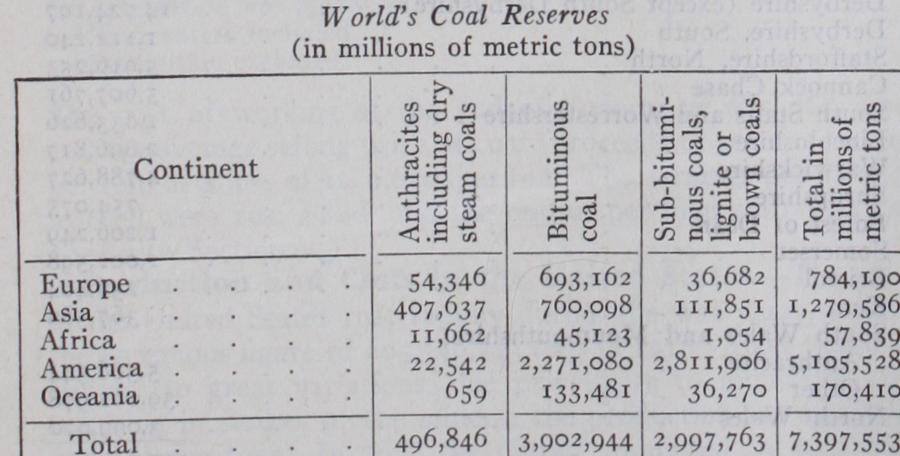
CONSUMPTION AND PRODUCTION COSTS The International Geological congress which met in Toronto, Canada, in the year 1913, made an estimate of the world's re sources of coal, for which purpose they took 'ft. as the minimum workable thickness of seams, down to a depth of 4,000ft. from the surface, and aft. at depths of from 4,00o-6,000f t.-6,000f t. being regarded by the Congress as the limit in respect of workable depth. The figures of the available resources which are given in millions of metric tons (a metric ton= a,ao4.6 lb.), are, in respect of continents as follows :— The great depth at which coal mining is carried on (4,000ft. below the surface in Belgium) is surpassed by the still greater depth in the mining of mineral deposits (6,726ft. in the St.
John del Rey mine in Brazil). The working of coal at great depths is, however, more difficult than the extraction of ore from a metalliferous vein at like depth, for whereas in the latter case the plane of the deposit is, as it were, usually on edge reaching to the surface, in the former case it is, usually, more or less flat, the whole of the coal being derived from, approximately, the same depth, and it is very doubtful whether it will ever prove com mercially possible to produce coal from a depth greater than 5,00o feet.
On the question of supply, it is not so much the duration of the world's ultimate resources of coal that matters, but how long will the better and more cheaply-got coals last. European coun tries are rapidly exhausting their supplies of readily available coals, and, if the present relative rates of exhaustion are continued, the period of their complete exhaustion will arrive long before that of Asia and the New World.
The most important of all classes of coal is that which is termed "bituminous," for not only does it provide the gas, coking, house and manufacturing, but many of the steam coals also. It is, too, from this class of coal that we obtain our coal derivatives, e.g., tar, pitch, sulphate of ammonia, paraffin hydrocarbons, benzene, toluene, dyes and some medicines. Curiously enough, the term "bituminous" was founded on a misapprehension but is a con venient one of which the use is almost a necessity from its having an almost universal currency among coal miners. Nothing anal ogous to bitumen exists in coals.
In view of the importance of the bituminous coals, it is for tunate that nearly 4,000,000,000,00o tons, or more than half of the world's coal reserves, are bituminous coal.
The relative importance of the great coal-producing countries in point of coal production is illustrated diagrammatically in fig. 3. In regard to Great Britain, the average figures are taken and not those for the year 1926, as it was the year of the great national lock-out in the coal mining industry. In the case of the other countries named the figures are for the year 1926. In respect of Germany, the brown coal has been converted into terms of bituminous coal by dividing the output of brown coal by three.
In fig. 4 is shown diagrammatically the "curve" of annual output from the three greatest coal-producing nations of the world and the world's output since the years 1910 to the year 1926 inclusive.
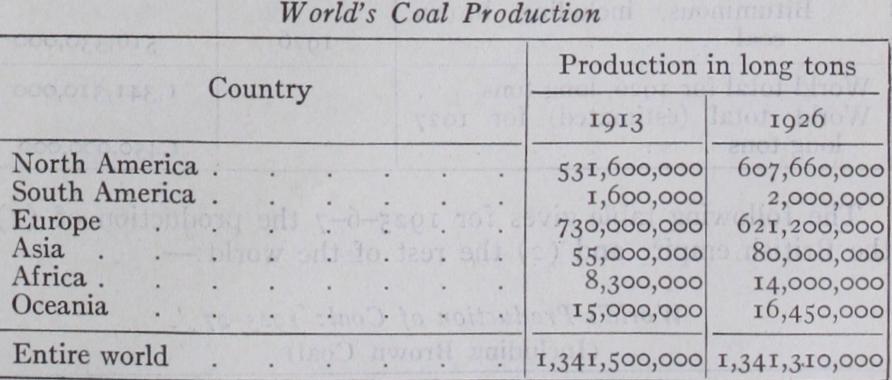
It will be seen from the curves, that, in spite of the great impetus which has been given in the last few years to the substitu tion of oil for coal, the hydro-electric gen eration of power and the introduction of economy in the use of fuel, the world's production of coal was never greater than in 1926. (The great drop in production in respect of Great Britain was due to the national lockout in the coal mining in dustry.) A noticeable feature in the dia gram is the upward grade in Germany's coal production; al though she lost some of her coalfields, she has so developed her brown coal resources and increased the output from the remaining fields of true coal as to produce the remarkable result shown in this diagram. However, the brown coal on the curve of aggregate production has not been converted into terms of true coal. Coal is widely distributed throughout Germany, the principal field is that of the lower Rhine and Westphalia which centres in the industrial region of the basin of the Ruhr, a right hand tributary of the Rhine. In Saxony, Zwickau and Lugan are other important mining centres.
Production and Costs in Great Britain.—The following figure (fig. 5) shows in diagrammatic form the rapid increase in production in Great Britain during the last Ioo years, a produc tion necessitated by and conducive to a very great extension in industry, and to an increase of population from 11,090,120 in 1811, to 40,980,311 in 1911, the output of coal being estimated by the 1871 royal commission on coal supplies to have been 10,080,300 tons, or less than the production for one fortnight at the present time.
The production from the various British coalfields stated by counties was as follows for the year 19251:— In the United States coal is classified as "soft" coal (bitumi nous) and "hard" coal or anthracite. Great variation exists in quality in the different States and even in the same district, e.g., in Central Pennsylvania there are seams of semi-smokeless coals of high steaming quality; gas coals, coking coals, and in the west, coals of high volatile content which are sold as steam coals. So great, too, is the variation in the working conditions that, as in In 1913 Great Britain contributed 21.7% of the world's entire output of coal, and in the year there were 1,110,884 persons employed in about 3,00o coal mines, which were worked as about 1,5oo separate undertakings. The coal properties, or royalties, as they are called in the industry, were vested in about 4,000 owners. Various estimates of the amount of capital invested in the coal mining industry have been attempted, that by Sir Josiah Stamp, £135,000,000, based on the output of five years preceding the war, being perhaps nearest the mark. It is agreed that of all the industries that contributed to the successful issue for the Allies of the World War, the coal industry was perhaps the most important.
The estimated cost of production and of profit to the coal owners in Great Britain arising from the sale of the coal prior to the war may be taken to have averaged as follows : s. d.
Wages . . . . . . . . . . . 5 6 Stores and pit wood . . . . . . . . . 1 oGeneral expenses, inclusive of everything, except preciation and interest . 1 3 Total 7 9 Profit . . . . . . . . . 2 5 The average royalty rent payable to the owners of the coal averaged about 6d. per ton of coal raised.
Since the year 1923 the general tendency has been for coal in Great Britain to approach what for want of a better term may be called an economic basis of price (although it has not yet fallen to a pre-war level) . This has been rendered possible by the de creased cost of production.
This is indicated by the following figures:— FIG. 4.-CURVE OF ANNUAL OUTPUT OF COAL FOR THE WORLD AND THE Fig. 4.-CURVE OF ANNUAL OUTPUT OF COAL FOR THE WORLD AND THE THREE GREATEST COAL-PRODUCING COUNTRIES the case of Great Britain, the problem of making an equitable wage scale to suit the varying conditions is extremely difficult. The output per man shift in the bituminous mines is just under 4 tons (year 1922 3.82 tons, year 3.99 tons) and in the anthracite mines just under 2 tons (1923 1.97 tons and tons).
It is doubtful whether there are available positive figures of the cost of working all classes of coal in the United States calculated over the whole annual production, but it was possible to compare the returns for 1922 with those for 1916 in respect of 217 colliery owners in 31 fields and 11 States. From these concerns there were produced in the aggregate 66,000,000 tons in 1916 and 52,000,000 tons (of 2,000lb. per ton) in 1922, that is to say, 131% and 121% respectively of the total coal output of the United States. The working costs and sale prices per ton were as follows :— *The subvention operated over the last two quarters of 1925.
tOn the first of May, 1926, the production of coal was suspended. The figures given in the tables are up to the end of April, during which period the subvention was operative.
**Subvention included.
$Subvention excluded.
The cost of working at the end of June 1927 was 16s. o.7od., and the average selling price of coal (proceeds of sales) 15s. o.o5d. per ton, or a loss of is. 0.65d. per ton. The earnings per man shift worked were 1os. 2.84d. and the output per man shift 20.47 cwt. (See also Section V.) Production and Costs in the United States.—The output in the United States rose rapidly during the war years, attaining the enormous figure of 605,546,343 tons in 1918. After that it was subject to great variations, due principally to industrial unrest resulting in strikes of the miners; the production for 1925 being 522,474,999 tons. In 1926 the output amounted to 591,721,00o long tons, a number of colliers being on strike. But the produc tive capacity of the United States coal mines is far beyond the actual output.
The cost of coal to a consumer in America according to one qualified authority (H. F. Hopkiss, "Economics in Coal Mining in the United States of America," Eng. Soc., W. Pa. 132-141; Dixon 141) is made up as follows:— Per cent.
Purchase of coal, opening up mine, mining machinery, housing 8 Mine supplies . 3 Labour . . . . . . . . . . 24 Insurance and Taxes Operators' profit 3 Railway Transport . . . . . . . . . . 36 Retailing . 25 I00 That is to say, 61% of the cost is absorbed in transport and re tailing.
In America as in Great Britain, one of the great outstanding problems awaiting solution is that of distribution.
Taking the whole of Germany and comparing pre-war and post war results, the following figures show the relative outputs exclusive of brown coal:— (a) Information not available.
(b) These figures refer to the United Kingdom.
(c) From 1912, inclusive, figures are based upon numbers of insured workers.
(d) Excluding Saar district.
The output per man per shift at the present time (year 1927) has been as follows:—Quarter ending in March, 20.66 cut; quarter ending in June, 20.47 cut; quarter ending in Sept., 19.0 cut.
The figures representing annual average quantity of coal raised per person employed have been obtained by dividing the annual output by the number of persons employed.
For comparative purposes as between countries, these figures are vitiated by the fact that the same number of days and hours may not have been worked in each country in respect of any given year; nor are the natural conditions with which the miner has to contend the same in each country. For instance, the condi tions prevailing in the United States are perhaps the best in the world; on the average the seams are thick, with good roofs, and lying at shallow depths from the surface. In respect of the black coal of Germany, the conditions are somewhat more difficult than in Great Britain. Making the fairest comparison, namely, that of output per shift, calculated over all persons employed, that for Great Britain is at present about i 7.85cwt. as against 19.5cwt. for the whole of the Ruhr coalfield. In the Ruhr field the rise in pro duction per man per shift has been on the up grade. The output per shift in Germany of Lignite is very considerable, much of it being quarried "open-cast." In Great Britain the hours of work of the underground miner were in 1925 7hr., exclusive of winding time, say, on the average 7hr. 37min., but since then the length of the working shift has been extended at some collieries to 8hr. and at others to 71 hours. In Germany (Ruhr) they are 8hr. inclusive of one winding time, so on the basis of the same length of winding time as in Great Britain the average time below ground is 8 hours. In France the working time is 8hr. inclusive of both winding times, so that miners actually work less time than in Great Britain. In the United States the time is 8hr. exclusive of both winding times, but as in the majority of the mines the inlet is by way of adit or day-drift, the actual time below ground is probably on the average more than 8hr., though, from the report of the recent United States coal commission, the miners would appear to go into the mines and come out pretty well as they like.