
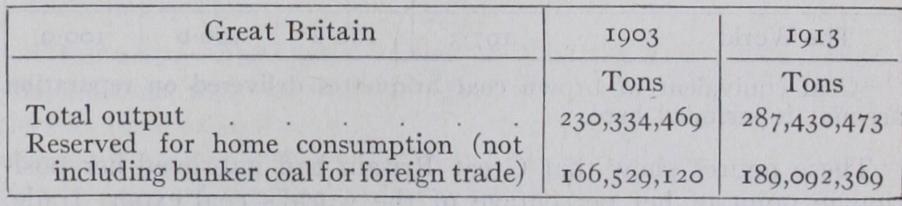
COAL : ITS SALE, DISTRIBUTION AND EXPORT An attempt was made by the British Coal Mining Organization committee in the year 1915 to arrive at some close approximation of the proportional distribution of the coal output of the United Kingdom, and in doing so they made a comparison as between the year 1903 and 1913, the object aimed at being to determine how the available supply could be distributed to meet the national requirements in the best possible way during the World War. The comparison was as follows :— The balances were absorbed by export and bunkers.
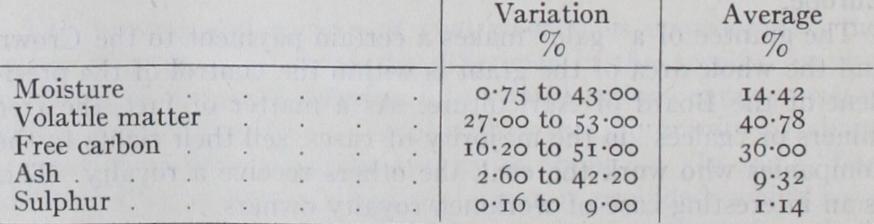
The average pit-head value of a ton of coal in 1913, all kinds included, was about Ios. 2d. Of the home consumption it was esti mated that at least 8o,000,000 tons were absorbed in the produc tion of power, inclusive of railways. The following table shows approximately the uses to which the coal was put :— The figures given for 1913, which are largely in the nature of an estimate only, will be fairly applicable at the present time.
Although coal has been exported from Great Britain for six centuries, it was in an insignificant quantity until the 18th century, and the first accurate return of coal shipped is in 1791, when the total amount of coal shipped from British ports totalled tons, the coal emanating chiefly from the great northern coalfield. By 1850, the exports of coal from Great Britain amounted to II.000,000 tons; in 1890, 29,000,000; in 1900, 000,000 tons; and in 1913, 73,000,00o tons; or, adding the quan tity supplied as bunkers to vessels engaged in the foreign trade, the coal equivalent of the coke, and the patent fuel (briquettes) exported, more than 98,000,00o tons, or 34% of the total output, was shipped.
Great Britain still retains the advantage of owning the higher quality and greatest variety of coal as compared with any other country. Her collieries are in the great majority of cases closer to the sea than is common in other countries, and cheap freights are still available ; but the production of coal in other coal-own ing countries has increased enormously, and not only are their demands in respect of imported coal less than formerly, but in some cases they have become rival competitors for the available export markets.
In fig. 26 the extent of the exports of coal from the United Kingdom is shown diagrammatically in comparison with the ex ports from Germany and the United States, 1910 to 1926.
The table below shows the export trade in coal of the three great coal producing countries in 1913 and 1924, compiled from the coal tables (1924) issued by the British Mines Department.
World's Coal Export Trade (in millions of long tons) , including coal shipped as bunkers by vessels engaged in overseas trade, and also coal equivalents of brown coal, coke and briquettes.
*Coal equivalent_ of brown coal briquettes delivered on reparation account is included here.
These figures show that Great Britain had improved her posi tion in point of her percentage of the world's coal export trade, but inasmuch as the total amount of coal exported from all coun tries had declined, the weight of coal exported by Great Britain had also declined. The year 1925 showed a further decline of nearly Ii,000,000 tons in respect of British coal exports, and, as the figures show, the exports for 1926 were very seriously affected by the lock-out, which caused the exports, including bunker coal shipped in vessels engaged in overseas trade, to be only 28,184,165 tons. Since the end of the last century, the competition of foreign coal has confined all increase in demand for British coal to markets situated, as was pointed out by the late Lord Rhondda, "within a portion of the globe limited by the Suez Canal on the east, by a line drawn from Cape Horn to the Cape of Good Hope on the south, and by a line from Cape Farewell to, say, Trinidad on the west." In 1873 one-fifth of the coal exported from Britain was shipped to regions beyond Europe and the Mediterranean; in 1913 the proportion was only one-eighth.
Taking the whole of the British Coal exports as Ioo, and divid ing the world's markets into nine groups, the proportions of coal The table shows there has not been much variation as between the pre-war and post-war years.
The decrease in the export of British coals of late years is due to a variety of reasons, in addition to the reason already named, viz., the increased productivity of other nations. The high price of coal during the World War and for some time thereafter directed the attention of users of fuel to other sources of heat and power, e.g., peat, oil, the generation of electricity hydro-electrically, and also intensified the practice of the more economical use of fuel. With falling prices, however, these restrictive influences will be mini mized. There has been, too, on the part of some countries, a de sire to erect barriers against the importation of coal; thus, the Soviet Government restricted imports to reduce payments abroad, and forced the use of native coal in north-west Russia, even though an extensive subsidy was necessary to secure this. The French Government also recently (1928) imposed restrictions as to im portation of coal.
The average selling price of coal per long ton at the pit's mouth in Great Britain over the period 1905-1926 and the price of coal exported from Great Britain for the same years was as follows:— It will be observed from the above table that, while the home prices did not soar unduly during the war period of control, export prices reached very high figures. The former was due to the Price of Coal (Limitation) Act then operative. (See Section XI.) Sale and Distribution of British Coal.—There are 1,400 separate colliery undertakings in Great Britain, owning 2,500 mines, all engaged in the disconnected disposal of their produce through the selling agencies attached to, or disconnected from, their concern. Thus in the great northern coalfield it is usual for the coal to be sold to merchants and others through an agent or "fitter" as he is locally termed, who is an official of the colliery company. In other cases the general manager of the colliery, the managing director or the colliery owner acts as the salesman, and in others outside agents perform this function. One great object being to keep the colliery at work, long-term rather than short term contracts are sought, the period varying from two or three to six months, or even a year ; six and twelve month periods, how ever, are the more common in the case of large contracts. When prices are very high or very low, the tendency is towards short contracts.
Coal in Britain is seldom if ever sold on an analytical or calorific basis, but under one of the very many commercial names which may or may not—the latter is generally the case—have any ref erence to the seam from which it is derived. Thus "Wallsend," which originally was the coal from the High Main Seam at Wallsend Colliery on the Tyne, is now merely a name for certain high class house-fire coals. Similarly D.C.B.s (an abbreviation of Davisons, Cowper, Bothal, well known Northumbrian col lieries), Derbyshire Brights, Derbyshire Hards, Best South York shire Hards, Best Admiralty Smokeless, etc., have no reference to the seam of derivation, but in the trade itself do represent a certain standard of quality, and certain of the many trade names have a world-wide reputation for excellence as steam, gas, coking or domestic coals.
Few collieries engaged in the British home trade sell direct to customers, but the coal is sold at pit mouth prices to the coal merchants, who bear the cost of transportation to the distribut ing centre, or the wholesale merchant, sometimes termed a "fac tor," may dispose of his supplies to smaller merchants, and so on. The public is often at a loss to understand why there should be so great a difference between the price of the coal at the pit's mouth and that which they have to pay delivered into their cellars, even when the extent of the railway charges are known. The differ ence is accounted for by the many hands through which the coal has to pass from pit to cellar. The crying economic need of the day would appear to be simplicity in distribution. Coal for export also, is, to a large extent, sold through the medium of merchants, the latter undertaking the risk of transport and distribution.
In the matter of sale and distribution of coal, the machinery in the United States does not differ materially from that in Great Britain. Some 5o% of the coal is marketed by the producing companies, but even they do not as a rule sell directly to the ultimate consumer. There are, according to Mr. E. T. Devine (Coal, by E. T. Devine), 1,5oo wholesale dealers in coal, 40,000 retailers (i.e., one to every 600-700 families), and 8,000–io,000 producers.
The anthracite contained within a small area of a single State, viz., Eastern Pennsylvania, has a highly concentrated ownership, 90% of the reserves being owned by the ten railway companies. The capital value of the anthracite industry is estimated at about $990,000,000. The vastness of the bituminous or "soft" coal in dustry is indicated by the fact that the coal areas under operation are contained in about 30 of the States, and in 192o, a year of strong demand for coal, there were 12,122 corporations, partner ships and individuals operating 14,766 coal mines.
The production of "soft" coal is on the increase, and this over production is one of the great troubles with which the United States has to contend ; mines being equipped and manned to pro duce twice their present output, it is not surprising that in 1923 only 179 days were worked on the average. With this capacity for over-production the necessity of the United States to find markets for her coal outside her own border is obvious, and it is interesting in this connection to compare the average export value (f.o.b.) in Great Britain and the United States of coal exported to South America—the coal market most available to the United States— together with average freights during two "spot" months, July and August, in 1925:— Germany.—The German exports of coal for 1925 rose to 13, 500,000 tons, and for 1926 to 28,774,07o tons. Taking the fron tiers as they existed in 1925, the consumption in 1913 was 156, 000,000 tons, which is not far short of the British home consump tion in 1913 of 589,000,000 tons, and points to the increased in dustrial activity of Germany. The chief consumption of lignite was in the generation of electrical energy. In 1913 lignite was the source of 23% of the power generated in Germany, and in 1922 of 41.2% ; the generation of electric power more than trebled in the 1 o-year period 1913-22, amounting in the latter year to 7,200,000,000 kw. hours. Increased saving in fuel consumption in large power plants and increased use of lignite in the generation of power have liberated a greater quantity of high class "black" coal for export, which competes with British coal in European and other markets.
In Germany the colliery owners must by law sell through syndicates arranged according to districts. A severe penalty is imposed on any owner selling coal outside the syndicate of the district in which his colliery is situated. The syndicates, which are not worked in order to make profit, determine the output of each colliery and fix the selling price of the coal, all coal being divided into classes, e.g., gas coal, coking coal, steam coal, etc. There is one price only for any given class, except in respect of coals grading from steam into anthracite, intermediate or "dry" steam coals; in these "border line" cases there may be more than one price.
All of these syndicates are combined into the Reichskohlenver band over which is a coal council composed of representatives of the coal owners, workmen and consumers' associations, termed the Reichskohlenrat, which has conferred upon it, by Government, power to make laws and regulations for the control of the coal mining industry, subject, however, to a power of veto vested in the Minister of Economics (Reichswirtschaf tsmninister). There are at least 10o members of the Kohlenrat, 25 of whom are appointed by the management, 25 by the miners and ten by the Reichstag, and the rest—of whom not more than one-third may be officials— by the president of the Reich.
More coal is now being produced in the world than in the past, and more economy is being practised in its use ; that is to say, it is being put to better use than previously by improved methods of burning for steam raising and the generation of electricity, by the more extensive use of gas for heating, cooking and for driving internal combustion engines, by the use of powdered fuel, and by other means of obtaining a higher percentage of the available heat value of the fuel. But as Prof. Jevons states, "It is wholly a confusion of ideas to suppose that the economical use of fuel is equivalent to a diminished consumption. The very contrary is the truth." Speaking generally, it is probable that the economy does lead to increased consumption, but it is doubtful whether it does so to the extent of the economy effected.