
CLAY, HENRY American statesman and orator, was born in Hanover county, Va., on April 12, and died in Washington on June 29, 1852. His public life covered nearly half a century, and his name and fame rest entirely upon his own merits. He achieved his success despite serious obstacles. He was tall, rawboned and awkward ; his early instruction was scant ; but he read books, talked well, studied law under George Wythe, the teacher of Jefferson and Marshall, and so, after his admission to the bar at Richmond, Va., in 1797 and his removal next year to Lexington, Ky., he quickly acquired a reputation and a lucrative income from his law practice.
Thereafter, until the end of life, and in a field where he met, as either friend or foe, John Quincy Adams, Gallatin, Madison, Monroe, Webster, Jackson, Calhoun, Randolph and Benton, his political activity was wellnigh ceaseless. At the age of 22 (1799) he was elected to a constitutional convention in Kentucky; at 26, to the Kentucky legislature; at 29, while yet under the age limit of the U.S. Constitution, he was appointed to an unexpired term (1806-7) in the U.S. Senate, where, contrary to custom, he at once plunged into business as though he had been there all his life. He again served in the Kentucky legislature (1808-9), was chosen speaker of its lower house, and achieved distinction by preventing an intense and widespread anti-British feeling from excluding the common law from the Kentucky code. A year later he was elected to another unexpired term in the U.S. Senate, serving in 1810-11. At 34 (181 1) he was elected to the U.S. House of Representatives and chosen speaker on the day of his entrance. During the 14 years following his first election, he was re-elected five times to the House and to the speakership; retiring for one term (1821-23) to resume his law practice and retrieve his fortunes. He thus served as speaker in 1811-14, in 1815-2o and in 1823-25. Once he was unanimously elected by his constituents, and once nearly defeated for having at the previous session voted to increase congressional salaries. From 1825 to 1829 he served as secretary of State in President John Quincy Adams's cabinet, and in 1831 he was elected to the U.S. Senate, where he served until 1842, and again from 1849 until his death. Between 1824 and 1848 he was a strong presidential candidate in nearly every campaign.
One of the chief sources of Clay's immediate popularity when first elected to the House in 181 r, was his championship of the War of 1812 with Great Britain, which his influence, more than that of any other man, precipitated. While not, perhaps, an alto gether advantageous or necessary war, it won the youthful nation the respect of European nations, and a greater independence of them than she had hitherto known. Clay was sent to Ghent as one of the peace commissioners, and signed the treaty, though reluctantly, for he was disappointed in the silence concerning the questions of impressment of American sailors, the fisheries, and the navigation of the Mississippi.
After the war Clay and Calhoun became the foremost cham pions of the Democratic Republican Party in Congress. Clay refused appointments as minister to Russia and to England, as well as the secretaryship of war under both Madison and Monroe that he might devote his attention to his congressional programme, the three most important features of which were the inauguration of internal improvements, the establishment of a national bank, and the levying of a tariff high enough to build up industries needed in time of war. As a protectionist Clay in 1824 again advocated high duties to relieve the prevailing distress, which he pictured in a brilliant and effective speech. In spite of the opposition of Webster, Calhoun and other prominent statesmen, Clay succeeded in enacting a tariff so high that the people of the Southern States denounced it as a "tariff of abominations." When it overswelled the revenue in 1832 he favoured reducing the rates on all articles not competing with American products, but the new measure reduced the revenue so little and provoked such serious threats of nullification and secession in South Carolina, that to prevent bloodshed and to forestall a free trade measure from the next Congress, Clay brought forward in 1833 a compro mise measure for the gradual reduction of the tariff to a 20% ad valorem basis extending over a period of nine years. It lost Clay the support of ardent protectionists but was hailed with favour by the people at large.
Clay's interest in internal improvements resulted naturally from his interest in western expansion and development. He supported the Federal financing or aiding of roads, canals and other schemes of transportation which would bind the east and west together. For a time he argued for the return to individual States of the receipts from all public lands sold within its borders.
This plan, together with many of his special projects, failed, but the general impetus of his c atory and argument was not lost.
Clay also interested himself passionately in the struggle of the South American nations for their independence. He made re sounding speeches in the House in favour of the "eighteen millions of people struggling to burst their chains." He advocated an alliance in the two Americas to counterbalance the Holy Alliance of Europe and work against its designs. He was among the first to recommend recognition of the new nations by the United States, and consequently is still remembered with affection by them. Similarly, in 1824, he made an impassioned speech in favour of Greek independence and supported Webster's resolution for sending an agent or commissioner to that country.
But of all causes and questions, Clay's career was connected most intimately with that of slavery. When only 2 2 Clay had vainly urged an emancipation clause for the new constitution of Kentucky and never ceased to regret its failure. In 1820 he con gratulated the new South American republics on having abolished slavery, pointing out that in this important point of progress they were in advance of the United States. The same year, however, threats of the Southern States to destroy the Union led him to advocate the "Missouri Compromise," which, while keeping slavery out of all of the rest of the territory included in the "Louisiana Purchase" north of Missouri's southern boundary, permitted it in that State. When the slave power became more aggressive in and of ter the year 1831, Clay defended the right of petition for the abolition of slavery in the District of Columbia, and opposed Calhoun's bill forbidding the use of the mails to "abolition" newspapers and documents. Though he favoured the freedom of the mails and press as regards slavery, he disliked the abolitionists and, because of their insistent, uncompromising de mands, held them largely responsible for the hatred and strife which menaced the Union. Clay was lukewarm toward recognizing the independence of Texas lest it should aid the increase of slave territory. Yet he was so anxious to set himself right with the South that he prepared an elaborate speech for the purpose which re ceived pro-slavery approval. His attitude resulted, as he himself declared, in the abolitionists denouncing him as slave-holder, and the slave-holder as an abolitionist. Such straddling undoubtedly was a prime factor in his loss of the presidency, which he always held in view. In 1844, for instance, while a candidate for the presidency, he announced himself against the annexation of Texas, but on other grounds than slavery. By not pronouncing definitely on the real issue he lost supporters from men of both pro-slavery and anti-slavery sentiments instead of winning them as he had hoped. His compromising spirit upon the question promised to bear fruit, however, when in the crisis of 185o he was able to bring about the series of measures known collectively as the "Compro mise of 1850." The situation was acute, the South was on the point of secession, statesmen were frantic, every way of alleviating the deadlock seemed to have failed. Clay, who had retired from the Senate several years before, was now an old and physically frail man, but had himself re-elected to that body where he could put forth and defend his measures. His speech was one of the ablest of his career. Webster in a notable speech seconded the measures as a last resort. Calhoun still bitterly opposed. A dead lock resulted because of the opposition of President Taylor to the plan, and was only removed upon the latter's death, where upon Fillmore, friendly to the compromise, succeeded to his place. The compromise admitted California as a free State, organized Utah and New Mexico as territories without reference to slavery, and enacted a more efficient fugitive slave law. It was a noble climax to Clay's great career, but it did not, as he hoped, perrria nently save the Union from bloodshed. Its success was in the fact that it postponed the Civil War until the North had the immense growing power of the West as its ally. Clay did not live to see its failure, but died in 1852 at the height of his fame and pop ularity.
In one respect, however, Clay's whole political career had been a bitter disappointment, at least to the man himself. The nation never rewarded him with the highest office in its power to bestow, and which he so deeply coveted. This was in spite of the fact that for a generation he was the acknowledged leader of his party. One reason was that during the whole period sectional feeling was so strong that no leader of any one section could be elected. Peace had to be secured by choosing lesser men as compromise candidates. Another reason was Clay's own compro mising nature which always won him enemies in both camps. His name was used comparatively early in connection with the presidency. He had hoped to be offered the office of secretary of State under Monroe in 1817, for at that time this official was re garded as next in line for the succession. Clay was greatly disap pointed and pursued a policy of obstruction to the administration until the events culminating in the Missouri Compromise again led him to co-operate with Monroe. In 1824 Clay was a candidate with W. H. Crawford, Andrew Jackson and John Quincy Adams for the presidency. Choice between the two highest, Jackson and Adams, went to the House where Clay controlled the deciding vote. Though Jackson represented the West and its interests, to choose him would have meant the denial of all chances for him self in the following campaign, for the country would not be likely to choose two western leaders in succession. Tempera mentally Clay was also opposed to Adams, but after a long con ference he gave out that he would support the latter. Soon after wards he accepted an appointment as secretary of State, under Adams, and Jackson's supporters immediately charged a corrupt bargain between the two. Historians generally feel that Clay sincerely favoured Adams, but ever after Clay was kept busy explaining and denying the allegation of a bargain. It made Jackson his bitter enemy for life. John Randolph of Virginia pressed the accusation until Clay hotly consented to a duel to defend his honour. Neither was hurt. Clay's action so alienated his western supporters that it also must be ascribed as one of the reasons why he never achieved the presidency. In fact when he finished his term as secretary of State he had to go home "to mend his fences" in order to ensure his re-election to Congress. It proved the most difficult and most important campaign of his life, for, had he failed, it would have meant the eclipse of his political career.
By his enemies Clay's compromises were of ten ascribed to timidity or to hedging for political purposes. They can just as truly be represented as the acts of a man of great human under standing and sympathies, anxious to enter into the point of view of others. There is every indication that they represent a philo sophical attitude toward life. "All legislation, all government, all society is founded upon the principle of mutual concession, polite ness, comity, courtesy . . . I bow to you today because you bow to me." Such were his words and sentiments. The compromises represent his greatest political achievements. As "the great pacif icator" he occupies a place in the memory of his countrymen.
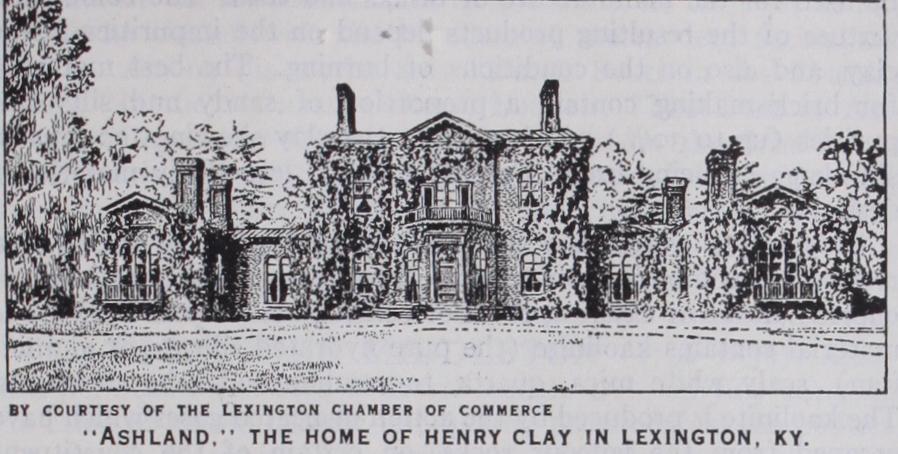
When not in Washington Clay's home was on his estate at Ashland, Kentucky. He took a great interest in its practical man agement and especially devoted himself to the breeding of beauti ful Kentucky horses. He was an excellent rider. Though Clay repeatedly denounced slavery as an evil, tradition and habit allowed him to keep slaves on his own plantation. He treated them con siderately and they were devoted to him. When very young Clay married Lucretia Hart, a cousin of Thomas Hart Benton. Five sons and six daughters were born to them. But misfortune seemed to hang over the family. All of the daughters died before the father. One son was killed in the Mexican War, and another became insane after an accident. Clay's acquaintances and friends were selected from all classes and occupations. His popularity with the people was immense, and he believed in them. Yet like many democratic leaders, notably his great western rival, Andrew Jackson, Clay was of ten arbitrary, autocratic and possessed of an irrepressible desire to rule. His imagination frequently ran away with his understanding while his imperious temper and ardent combativeness hurried him into disadvantageous positions. Great crowds always met him wherever he was to speak because of his matchless voice and fascinating personality. In public he was of magnificent bearing, possessing the true oratorical tempera ment, the nervous exaltation that makes the orator feel and appear a superior being, transfusing his thought, passion and will into the mind and heart of the listener. In private he was an excellent conversationalist, possessing a fund of pleasant humour. His never-failing courtesy, his agreeable manners and a noble and generous heart for all who needed protection against the powerful or the lawless endeared him to hosts of friends.