
MEGACHIROPTERA The first of these suborders of bats comprises the fruit-eating species, which are generally of large size, with the crowns of the cheek-teeth smooth and marked with a longitudinal groove. The bony palate is continued behind the last molar, narrowing slowly backwards; there are three phalanges in the index finger, the third phalange being terminated generally by a claw; the sides of the ear form a ring at the base; the tail when present, is inferior to (not contained in) the interfemoral membrane ; the pyloric extremity of the stomach is generally much elongated ; and the spigelian lobe of the liver is ill-defined or absent, while the caudate is well-developed. This group is limited to the tropical and sub-tropical parts of the eastern hemisphere.
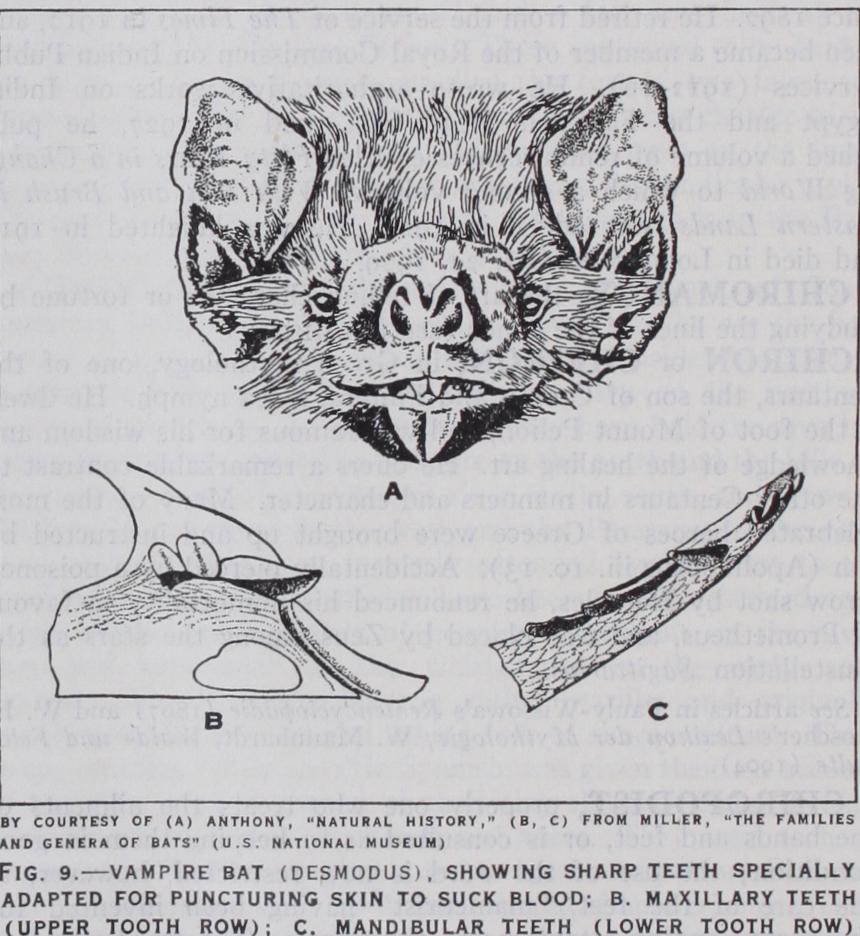
All the members of this suborder are included in the single family Pteropodidae—which is subdivided into two subfamilies, (I) the Pteropodinae containing a large number of genera and the typical members of the family; and (2) the Macroglossinae, containing seven genera. The subfamily Pteropodinae is further divided into three sections, (a) the rousettine section, containing the typical fruit bats of the genus Tteropus, (b) the epomophorine section containing only African genera, and (c) the cynopterine containing I I genera from Africa and Asia. The subfamily Pteropodinae is distinguished from the Macroglossinae by the incisors being normal and the tongue not highly extensile. Mem bers of this group range over the tropical and subtropical parts of the Old World, extending as far east as the Carolines and Samoa, but not to New Zealand. Commencing with the rousettine section, the nine genera may be classified in three subsections, (a) the rousettine branch, containing three genera, Rousettus, Eidolon and Boneia, characterized by the presence of a tail, and usually by having the third metacarpal slightly longer than the fourth and fifth; (b) the pteropine branch, containing four genera, Pteropus, Acerodon, Pteralopex, Styloctenium, in which the tail is absent and the fifth metacarpal usually longer than the third and fourth; and (c) the Dobsonian branch containing two genera, Dobsonia and Harpyionycteris, in which the tail is present or absent, and the third metacarpal usually distinctly the longest. The rousettine branch or subsection (about 20 species) is found throughout the whole area inhabited by the Megachiroptera, except Polynesia. The Pteropine branch (over ioo species and subspecies) covers the same area, including Polynesia, and exclud ing Africa and the eastern Mediterranean countries. The Dob sonian branch (13 species) is found in Austro-Malaya.
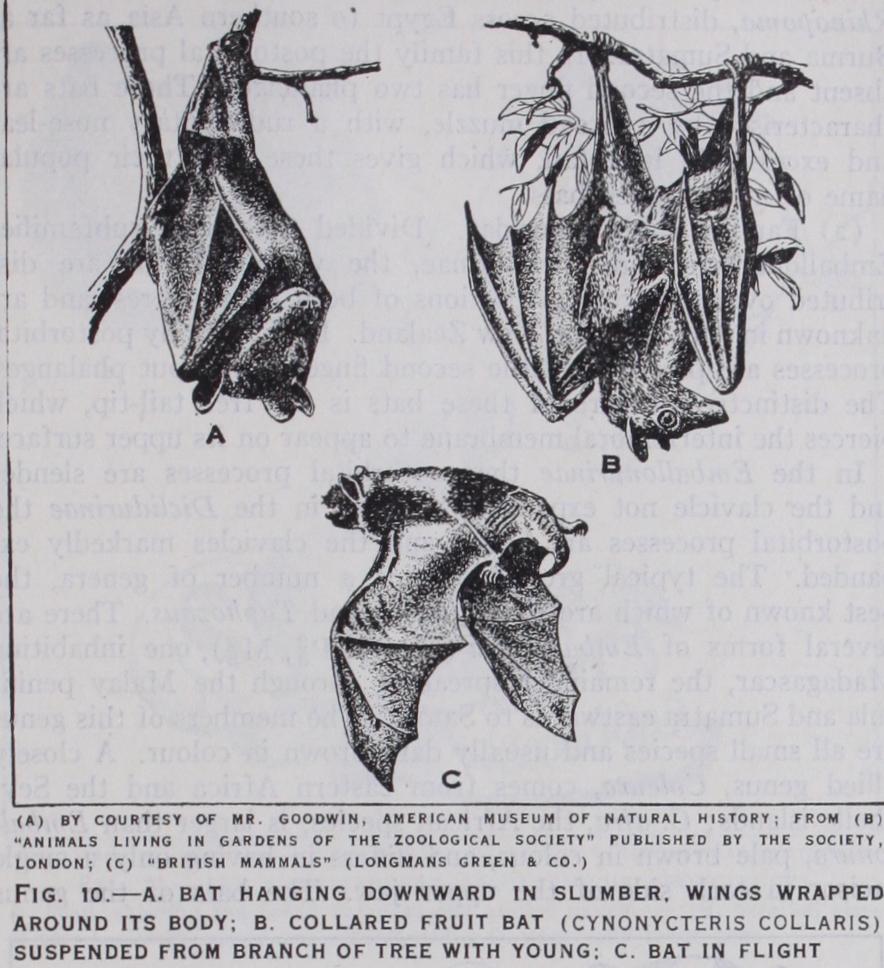
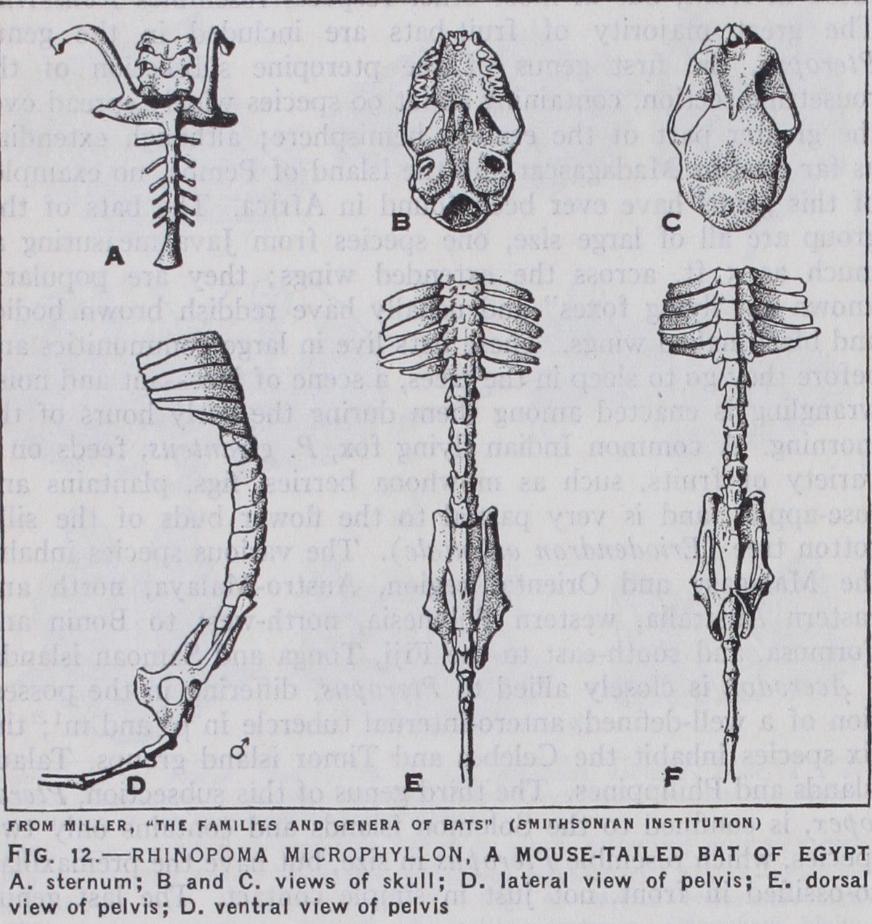
Commencing with the rousettine branch or subsection, the bats of the genus Eidolon are found only in Africa, Madagascar and southern Arabia. The African species, E. helvurn, is found over a large part of Africa, extending from the Sudan to Namaqua land; it is a highly coloured bat, the fur of the body being a mixture of straw yellow and brownish. The genus Rosettus is also found in Africa, but extends eastwards as far as the Solomon islands. The skull is much the same as that of Eidolon but there is no bony auditory meatus, and the premaxillae are joined together in front, not separate as in Eidolon. In addition to fruit, some of these bats eat many insects ; so great is the damage done to fruit crops that special measures have to be taken to protect the fruit from bats. Rousettus is divided into three sub genera, the typical one containing eight or nine species, widely distributed throughout the greater part of the distributional area of the genus ; and Stenonycteris and Lissonycteris both confined to the Ethiopian region. The two latter contain but a single species each, R. (S) lanosus from east central Africa, and R. (L) angolensis from west and central Africa. The genus Boneia also contains only a single species, B. bidens, from north Celebes; it agrees with Eidolon in having the premaxillae sepa rated in front, but in most other respects resembles Rousettus. The great majority of fruit-bats are included in the genus Pteropus, the first genus of the pteropine subsection of the rousettine section, containing about go species widely spread over the greater part of the eastern hemisphere ; although extending as far west as Madagascar and the island of Pemba, no examples of this genus have ever been found in Africa. The bats of this group are all of large size, one species from Java measuring as much as 5 ft. across the extended wings; they are popularly known as "flying foxes" and usually have reddish brown bodies and black naked wings. These bats live in large communities and before they go to sleep in the trees, a scene of incessant and noisy wrangling is enacted among them during the early hours of the morning. A common Indian flying fox, P. giganteus, feeds on a variety of fruits, such as mowhooa berries, figs, plantains and rose-apples, and is very partial to the flower buds of the silk cotton tree (Eriodendron orientale). The various species inhabit the Malagasy and Oriental region, Austro-Malaya, north and eastern Australia, western Polynesia, north-west to Bonin and Formosa, and south-east to the Fiji, Tonga and Samoan islands.
Acerodon is closely allied to Pteropus, differing in the posses sion of a well-defined, antero-internal tubercle in and m'; the six species inhabit the Celebes and Timor island groups, Talaut islands and Philippines. The third genus of this subsection, Ptera lopex, is confined to the Solomon islands and contains only two species, which resemble Pteropus in size, but have the premaxillae co-ossified in front, not just in simple contact. The last genus of this branch is Styloctenium, in which the first lower incisor is missing and the cheek teeth are g, not as in the rest of the group. The single species, S. wallacei, occurs only in the Celebes. The genus Dobsonia contains i 2 species distributed over the Austro-Malayan subregion (Celebes, Flores, Timor, the Moluccas, New Guinea, Solomon islands, but not extending to Australia). Harpyionycteris, which contains but a single species (known only from one specimen), hails from the Philippines.
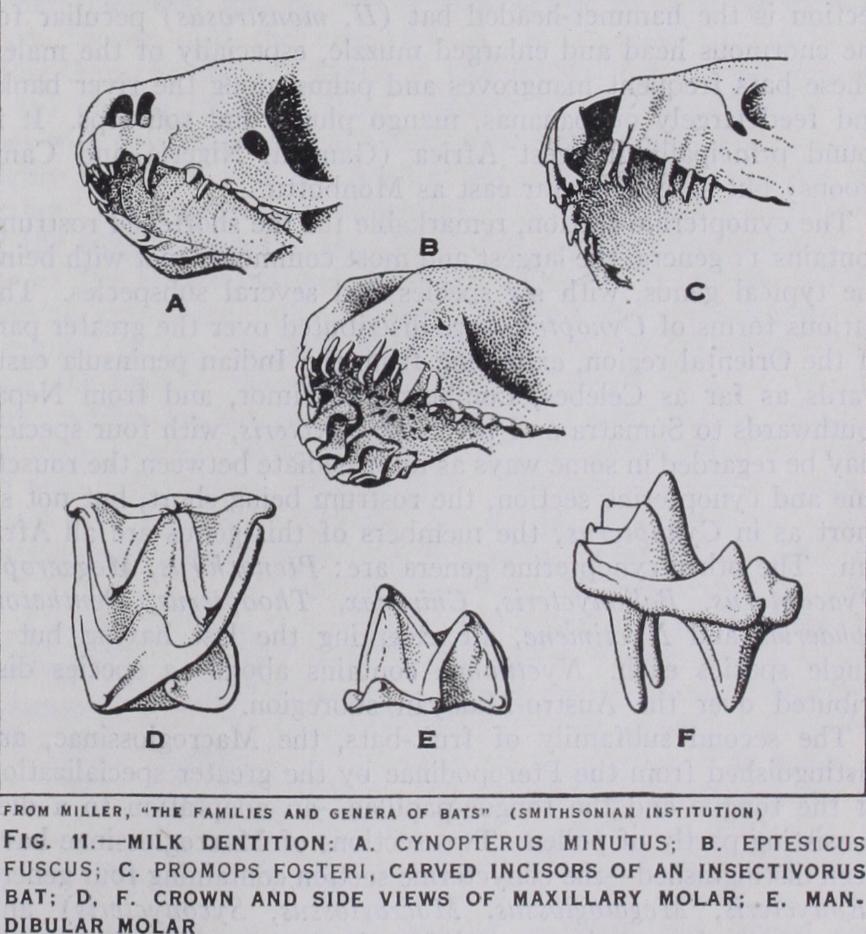
The epomophorine section may be divided into three branches (I) the Epomops branch, with a long rostrum and broad palate, containing three genera Plerotes (I species), Epomops (3 species), and Hipsignathus (I species) ; (2) Nanonycterine branch, with a short rostrum, containing three genera Nanonycteris, Scotonycteris and Casinycteris, each with a single species; and (3) the Epomoph orus branch, with a variable rostrum and modified palate ridges, containing two genera Epornophorus (about 8 species) and Micropteropus (I species). The best known member of this section is the hammer-headed bat (H. monstrosus) peculiar for the enormous head and enlarged muzzle, especially of the males. These bats frequent mangroves and palms along the river banks and feed largely on bananas, mango plums and soursops. It is found principally in west Africa (Gambia, Nigeria and Cam croons) but spreads as far east as Monbuttu.
The cynopterine section, remarkable for the shortened rostrum, contains I I genera, the largest and most commonly met with being the typical genus, with six species and several subspecies. The various forms of Cynopterus are distributed over the greater part of the Oriental region, extending from the Indian peninsula east wards as far as Celebes, Lombok and Timor, and from Nepal southwards to Sumatra and Java. Myonycteris, with four species, may be regarded in some ways as intermediate between the rouset tine and cynopterine section, the rostrum being short, but not so short as in Cynopterus; the members of this genus are all Afri can. The other cynopterine genera are : Ptenochirus, Megaerops, Dyacopterus, Balionycteris, Chironax, Thoopterus, Penthetor, Sphaerias and Nyctimene, all excepting the last having but a single species each. Nyctimene contains about I2 species dis tributed over the Austro-Malayan subregion.
The second subfamily of fruit-bats, the Macroglossinae, are distinguished from the Pteropodinae by the greater specialization of the tongue and the tongue-papillae—an adaptation to a diet consisting partly of pollen. Two sections of Macroglossinae have been distinguished—the eonycterine section containing four genera (Eonyeteris, Megaloglossus, Macroglossus, Syconycteris) and the notopterine section containing three genera (Melonycteris, Nesonycteris and Notopteris). One genus, Notopteris, is remark able for the length of its tail, being the only living fruit-bat in which the tail has remained long.