
MICROCHIROPTERA The second and larger suborder, the Microchiroptera, includes all the insectivorous species, most of which are of relatively small size. Their teeth are usually of insectivorous type, the crowns being surmounted by sharp cusps. The ear-margin does not form a complete ring as in the fruit-bats, and the angular process of the mandible is well-developed. The index finger never terminates in a claw, and the trochiter and trochin are large. As the suborder contains upwards of 600 different forms it will only be possible to give an outline of the various families, with special mention of some of the more important types.
The various genera may be grouped together into 16 families : (I) Family Rhinopomidae. Represented by a single genus Rhinopoma, distributed across Egypt to southern Asia as far as Burma and Sumatra. In this family the postorbital processes are absent and the second finger has two phalanges. These bats are characterised by a broad muzzle, with a rudimentary nose-leaf and excessively long tail, which gives these bats their popular name of mouse-tailed bats.
(2) Family Emballonuridae. Divided into two subfamilies Emballonurinae and Diclidurinae, the various forms are dis tributed over the tropical portions of both hemispheres, and are unknown in Australia and New Zealand. In this family postorbital processes are present and the second finger is without phalanges. The distinctive feature of these bats is the free tail-tip, which pierces the interfemoral membrane to appear on its upper surface.
In the Emballonurinae the postorbital processes are slender and the clavicle not expanded, whereas in the Diclidurinae the postorbital processes are broad and the clavicles markedly ex panded. The typical group contains a number of genera, the best known of which are Emballonura and Taphozous. There are several forms of Emballonura (I4, P , M4), one inhabiting Madagascar, the remainder spreading through the Malay penin sula and Sumatra eastwards to Samoa. The members of this genus are all small species and usually dark brown in colour. A closely allied genus, Coleura, comes from eastern Africa and the Sey chelle islands; C. a f ra, the African species, is larger than Embal lonura, pale brown in colour, and differs in having only a single incisor in each side of the upper jaw. The bats of the genus Taphozous are usually of considerable size, and have the frontal region of the skull concave; there are only two pairs of lower incisors, the dental formula being Imo, C i , Pi, M4. They are known as tomb-bats, and many of them have a glandular sac (fig. 8) between the angles of the lower jaw, more developed in males than in females. The Indian tomb-bat (T. melano pogon) is one of the best known of these bats ; it is a fair sized species and drab brown in colour, with the pale hair-bases showing through. T. longimanus, from Tenasserim, is either bright orange brown or dark drab-brown, and in T. mauritianus, from Africa, the general colour is pale buff overlaid with a wavy pattern of silver and black. Saccolaimus is an allied genus occurring in Africa, Asia and Australia ; S. peli, from central Africa, is one of the largest of this group, the head and body measuring about 125 mm. in length. S. affinis, from the East Indies, has a brownish coat speckled with whitish, and the entire under parts are white, as are also the wing membranes. The Australian S. flaviventris is a very handsome species, being velvety black above and pure white below. Rhynchonycteris and Saccopteryx are closely related to the typical genus, the former being small, greyish coloured bats, and the latter small, or medium sized, species, with two whitish stripes extending from the shoulders to the hind-quarters. These latter species are found only in tropical and subtropical America. Cormura, Peropteryx, Peronymus, Centronycteris and Myrop teryx are other American genera belonging to this group.
The subfamily Diclidurinae is confined to tropical America and contains but a single genus, Diclidurus, with a dental formula of I C+, P*, M*; the three species are all white or whitish coloured bats.
(3) Family Noctilionidae. Probably allied to the Rhinopom idae and Emballonuridae as is indicated by the large trochin and small trochiter with its slight articulation with the scapula ; teeth I. , C+, P4-, M4. The family is confined to tropical America, north as far as southern Mexico and Cuba. Two genera may be distinguished, (a) Noctilio, characterized by its excessively long legs, large feet, strongly wrinkled lips, and long, pointed ears; (b) Dirias, resembling Noctilio but with shorter legs and feet. N. leporinus is brownish above with a white median stripe, ex tending from neck to tail, and the underneath parts are bright orange ; measurements :—head and body 95 mm. ; tail 24 mm.; hindfoot 27 mm. The members of the Noctilionidae are essen tially fish-eating bats.
(4) Family Nycteridae. At one time the bats of this group were included in the Megadarmidae (see below) ; they are recog nizable by their long tails entirely enclosed in membrane and large ears with simple tragus, and deep frontal groove with leaf like outgrowth. The single genus (Nycteris) is chiefly African, but is also represented in the Malay peninsula, Java, Timor, etc. The dental formula is C+, P , M4. N. Luteola, which is pale tobacco-brown above and white below, exhibits the following dimensions : head and body 6o mm. ; tail 55 mm. ; hindfoot 11 mm. ; ear 32 mm.
(5) The family Megadermidae contains a large number of spe cies, grouped in five genera, and includes some of the most bril liantly coloured members of the whole order. Closely allied to the preceding family, these bats are distinguished by their long, pointed nose-leaves, short tails, large ears with bifid tragi, and absence of upper incisors. They range over tropical Africa, southern Asia, the Philippines and Australia. Of the five genera two (Mega derma and Lyroderma) have the dental formula I, Ci, Pte, M4; in the other three genera (Macroderma, Lavia and Cardioderma), there is only a single upper premolar on each side, the formula being I , C-f, Pte, M- . Megaderma spasma, from India, has large, rounded ears, and is of a greenish soot-colour; the head and body measure 70-75 mm. Macroderma contains but a single species, M. gigas, from Australia ; it is a very large bat with a body measurement of 125-13o mm., and ears about 5o mm. in length. Megaderma and Lyroderma are Asiatic, and Lavia and Cardioderma are African. Lavia frons from tropical Africa (the only known habitat of the genus) is about the same size as the typical Megaderma (head and body 75 mm., ears 42 mm.). The fur is bright greenish-grey in colour and the wings, in the living state, yellowish.
(6) Family Rhinolophidae. Toes (except hallux) with three phalanges each, premaxillae free from each other and from the maxillary bone; tragus absent. Dental formula II-, Cam, M4. This family which inhabits the tropical and temperate parts of the Old World, contains the single genus Rhinolophus (the well known horse-shoe bats), the members of which are remarkable for their large and complicated nose-leaves and large ears. They vary considerably in size, in some species such as the lesser horse shoe (R. hipposideros) the head and body measure only 5o mm. in length ; in others, like the greater horse-shoe (R. f errum-equi num) the head and body are from 65-75 mm. ; in this latter species the fur is a pale grey snuff-brown in colour. In other species such as R. rouxi of India and R. lobatus of Africa, the colour of the fur is sometimes bright orange all over, sometimes dull greyish brown. R. perniger, from Tenasserim, is one of the largest and richest coloured species; the general colour in this bat is deep sepia brown, and the nose-leaf and ears conspicuously large. More than zoo different forms of Rhinolopleus are now recognized.
(7) Family Hipposideridae. Similar to the preceding but the toes with two phalanges each, the pelvic and pectoral girdles more highly modified, and the lumbar vertebrae tending to fuse to gether. Eight genera are recognised and range over a large area of the tropical parts of the Old World, extending northwards as far as the Himalayas and Morocco. The typical genus, Hippo sideros, containing over 4o forms, presents the following dental formula : C+, M4. Some of these bats are of considerable size, the body measurement of H. gigas being as much as 125 mm. ; while the ears attain a length of 35 mm. ; others, like the common African species, H. caffer, are quite small (head and body 48 mm., tail 32 mm., ear 14 mm.) . The former species is some times very brilliantly coloured, the fur of the body being a rich chestnut-orange tint, with a dark chestnut V-shaped marking on the hind-quarters; at other times the coat is greyish with a sooty-brown marking. H.
caffer is also either orange-buff or sooty brown in colour, and a species from cen tral Africa, H. cyclops, presents a beautiful silvery-grey speckled effect. The genus is widely spread over the tropical parts of the Old World eastwards to Australia. A very beautifully coloured bat belonging to this family is Ansellia tridens, a small species which is sometimes brilliant chestnut red, above and below; it is found in north-eastern Africa (Sudan) and adjacent parts of Asia. Anthops, with a single species, A. ornatus, is a closely allied genus from the Solomon islands, distinguished by its short tail. The other genera of the family are Coelops (Bengal and Java), Cloeotis (East Africa), Rhinonycteris (Australia) and Triaenops (Africa, Madagascar and Asia), which contain only a single or a few species each.
(8) Family Phyllostomidae. Bats of this group are character ized by the presence of three bony phalanges in the third finger, entire premaxillae, and well-developed molars. They are dis tributed over the warmer parts of America, northwards towards the southern United States and the Bahamas. The family has been subdivided into seven subfamilies, one of which, Chilonycteriae, is distinguished from the other six by the absence of a nose-leaf, and having the trochiter not articulating with the scapula. This subfamily contains three genera, Chilonycteris, Pteronotus and Morrnoops, which include about 20 forms (dental formula I 2 i Ci, P*, M4) . The subfamily Phyllostominae contains about 14 genera of American leaf-nosed bats with normal teeth. Four of these genera, Tonatia, Anthorina, Mirnon and Chrotopterus, have only one lower incisor on each side ; the first of these genera has three lower premolars on each side, the others have only two.
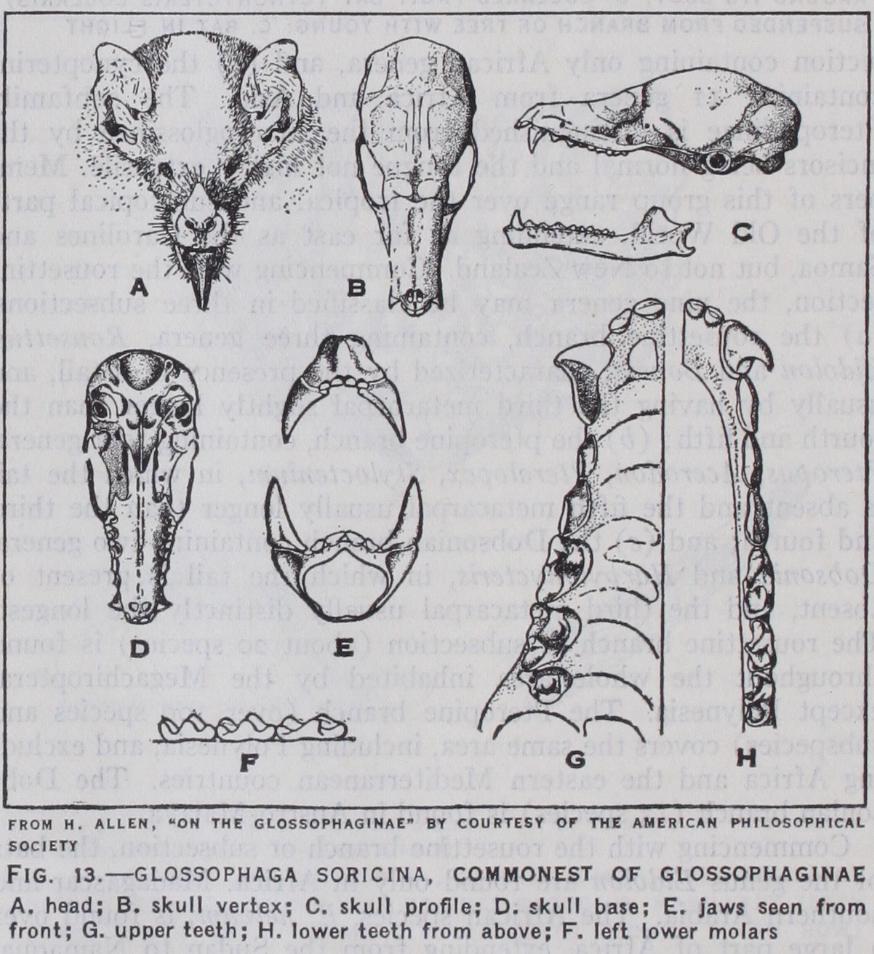
The remaining genera, including such well-known names as Phyl lostomus and Vampyrus, have two lower incisors on each side. Phyllostomus, which is a fairly large genus containing a dozen forms, has the following dental formula : Imo, C+, P-, M4. The species are all large and heavily built, the nose-leaf is well devel oped, and the ears small and separate. P. hastatus, a well-known species, measures 112 mm. from head to base of tail, the latter being 23 mm. in length, and the ear 3o mm. The colour of the hair is dark reddish brown or black. A smaller species P. lati folium, presents the following dimensions :—head and body 76 mm. ; tail 12 mm. ; ear 28 mm. Clirotopterus, which contains but a single species, C. auritus, hails from tropical America as far north as southern Mexico; this bat is a medium sized species (head and body 107 mm.) and sooty grey in colour. Vampyrus, also represented by a single species (V. spectrum), has the teeth arranged as follows:-4, Pte, M4; this bat is large in size and reddish or dark brown in colour. It is not a blood-sucking bat, the name being due to mistaken identity. The remaining five subfamilies have abnormal molars with the cusps and commis sures much reduced; Glossophaginae (about nine or ten genera) from the warmer parts of America, West Indies and Cuba; Hemi derminae (two genera of American and West Indian species) ; Sturnirianae, containing the one species Sturnina spectrum from tropical America. The males of this bat have modified tufts of deep red hair in front of each shoulder; Stenoderminae (contain ing 19 or 20 genera) from America; these bats have highly abnormal teeth. One of the best known genera is Artibeus, characterized by the presence of white lines running from the nose to the ears above the eyes, and a white crescentic marking under each ear. These bats vary in size considerably, some species (A. lituratus etc.) measuring 105 mm. in length (head and body) while others do not exceed 5o mm. (A. cinereus). A closely allied genus, Uroderma, has similar head markings but, in addition, has a white stripe extending from the shoulders to the hind-quarters. In Vampyrops and Vampyrodes these markings are still more sharply defined. The last subfamily of this group is the Phyl lonycterinae, containing three genera from the West Indies.
(9) Family Desmodontidae. This family is composed of the well-known blood-sucking vampire bats. Their teeth are specially adapted for cutting rather than crushing ; the whole anatomy of these bats being specially modified for obtaining a diet of blood. They are found only in the warmer parts of America, as far north as southern Mexico. Dental formulae 11--, C i , Pte, M i (Desmodus and Diaemus) ; Imo, Ci, Pi-, M2 (Diphylla). The bats of the genus Diaemus are of striking appearance, the body being brown in colour and the wings black with white margins. The best-known and most specialised genus of the family is Desmodus; it seems probable that these bats are unable to take any other food than blood. See VAMPIRE.
(io) Family Natalidae. A group of small bats from America as far north as Mexico. Dental formula : I4, C+, P4, M*.
(1 I) Family Furipteridae. A South American family, allied to Natalidae, with a dental formula of 14, Ci, P-, M4.
(12) Family Thyropteridae, closely related to the Natalidae, distinguished by the form of the sternum, separate lumbar verte brae and the presence of a pedicillate sucking disc on the thumb and sole. The single genus (Thyroptera) is confined to tropical America.
(13) Family Myzopodidae. This family is based on a single species (M. aurita) from Madagascar.
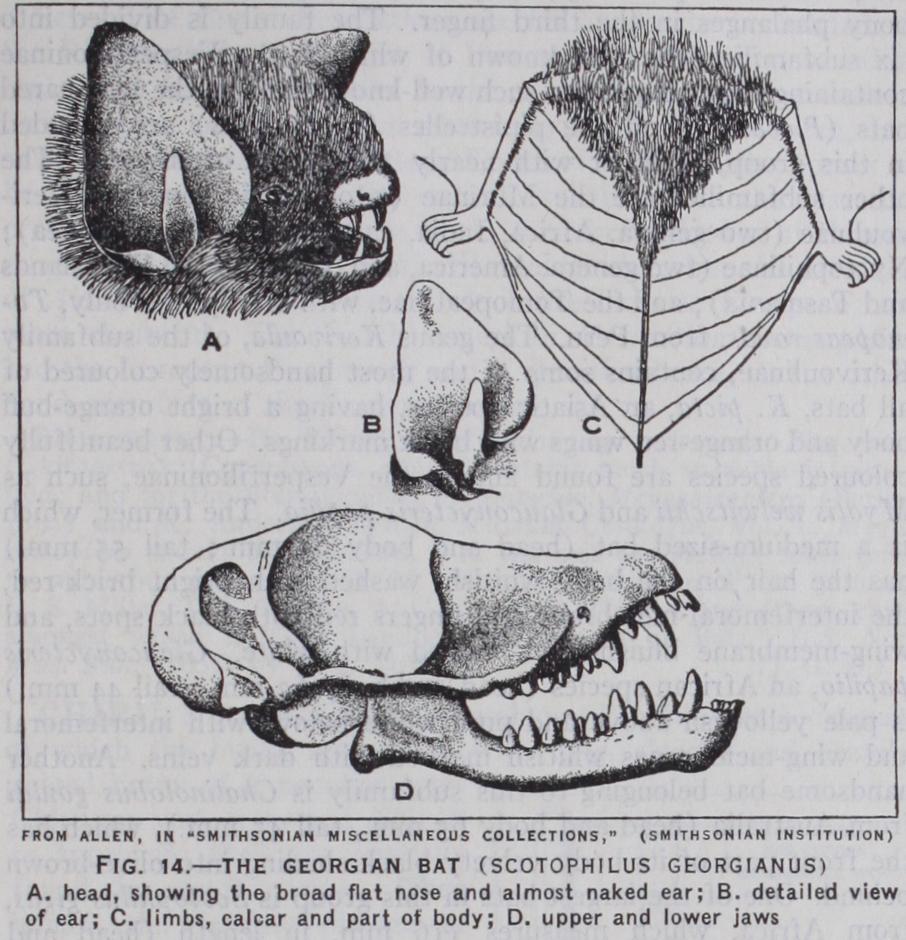
(14) Family Vespertilionidae. The members of this almost uni versally distributed group are distinguished by their simple muz zles, well-developed tragi, long tails, and presence of only two bony phalanges in the third finger. The family is divided into six subfamilies, the best known of which is the Vespertilioninae containing over 3o genera; such well-known bats as the long-eared bats (Plecotus) and the pipistrelles (Pipistrellus) are included in this group, together with nearly 1 oo forms of Myotis. The other subfamilies are the Murinae (two Asiatic genera) ; Keri voulinae (two genera, Africa, India, eastwards to New Guinea) ; Nyctophilinae (two genera, America, and Timor to the Fiji islands and Tasmania) ; and the Tomopeatinae, with one species only, To mopeas raves, from Peru. The genus Kerivoula, of the subfamily Kerivoulinae, contains some of the most handsomely coloured of all bats, K. pieta, an Asiatic species, having a bright orange-buff body and orange-red wings with black markings. Other beautifully coloured species are found among the Vespertilioninae, such as Myotis welwitscliii and Glauconycteris papilio. The former, which is a medium-sized bat (head and body 65 mm. ; tail S5 mm.) has the hair on the body whitish, washed with bright brick-red, the interfemoral membrane and fingers red with black spots, and wing-membrane bluish-black veined with white. Glauconycteris papilio, an African species (head and body 62 mm.; tail 44 mm.) is pale yellowish above and pure white below, with interfemoral and wing-membranes whitish marked with dark veins. Another handsome bat belonging to this subfamily is Chalinolobus gouldi from Australia (head and body 65 mm., tail 45 mm.), which has the front part of its body velvety black shading into olive-brown behind. One of the largest bats in this group is Scotophilus gigas, from Africa, which measures 116 mm. in length (head and body) and has a tail from 65-70 mm.
long. A closely allied species, S. nigrita, is rather a highly coloured animal, being yellow-brown above and bright golden yellow below, the body colouration con trasting vividly with the black wings.
Scotomanes ornatus, another member of the Vespertilioninae, is bright orange-buff in colour, with a pure white stripe extend ing down the back.
(I 5) The family Mystacopidae was founded on a single New Zealand bat, Mystacops tuberculatus, related to Myotis and Molossus.
(i6) The family Molossidae is common to the warmer parts of both the New and Old World ; in these bats the double ulation of the shoulder-joint is perfected, and the wing-membrane markedly reduced in size. There are 13 or 14 genera; rneles, from the Malay peninsula and East Indies, is one of the most interesting era, containing but a single species, C. quatus; it is a very large, ugly bat (head and body 135 mm. ; tail 45 mm. ; hindfoot 3o mm.) . The upper surface of the body appears quite naked and the wing membrane is greatly reduced in size. In Eumops the ears are very large; some of the species are a fair size (head and body 16o-90 mm. in length) and very dark in colour. Molossus is closely allied ; these bats are a small size (head and body about 6o mm.) and in some the body is speckled, owing to the light hair-bases showing through the dark tips. The genus Tadarida now accommodates the Nyctinomus-like bats of India and Africa ; the free-tailed bats of South America and Australia alone being considered as true Nyctinornus. One of the most handsome species of this group is Otomops wroughtoni, from India, a dark chocolate-coloured bat with a light collar-like marking just in front of the shoulders; this bat is of fair size:— head and body 88 mm. ; tail 4o mm. ; ear 33 mm. The genus Chaerephon (Africa, Asia and Australia) contains mostly small sized bats, one of them, C. limbatus, having pure white wings. Xiphonycteris, Eomops, Platymops, Molossops, Mormopterus, and Promops are other genera belonging to this group.