PREVENTION : THE RECORD OF CASUALTIES The subject of health and safety in the mines of Great Britain is governed by the Coal Mines Act of 1911 and the regulations made thereunder, administered through the Mines Department of the Board of Trade. For the purpose of inspection, the country is divided into eight divisions, each under a divisional inspector of mines, with a staff of both senior and junior inspectors under him, as well as several sub-inspectors of mines, a sub-inspector of quarries, and an inspector of horses. Over the whole inspectorate is the chief inspector with a deputy-chief and an electrical in spector of mines.
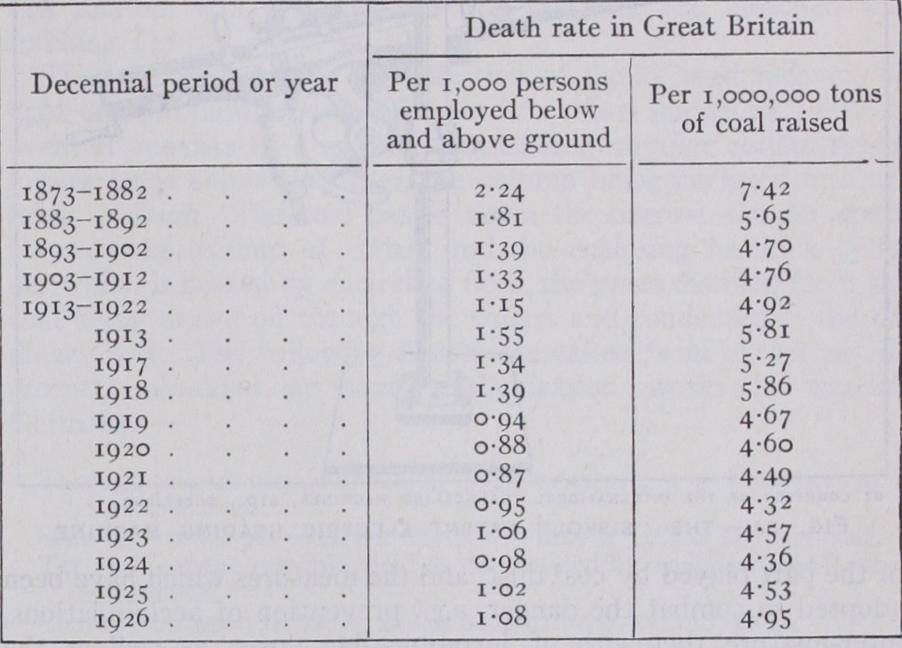
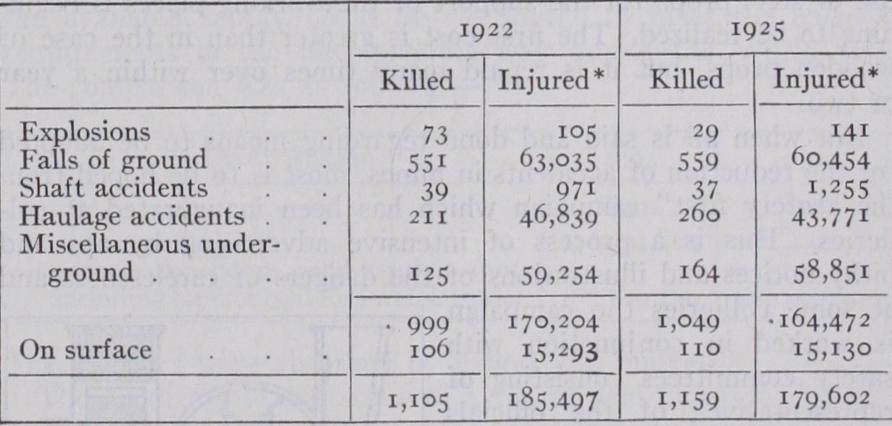
While there has been steady progress in the prevention of fatal accidents in mines in Great Britain during the last 5o to 6o years, coal mining is unfortunately a dangerous occupation, the number of fatal accidents averaging over 1,000 per annum in Britain. Thus: For the purpose of the official returns made in Great Britain accidents are divisible under six heads, namely : (I) explosions of fire-damp and coal dust, (2) falls of ground, (3) shaft acci dents, (4) underground haulage accidents, (5) miscellaneous underground, and (6) those occurring on the surface. The num ber of fatalities coming under the first division varies greatly, owing to the length of the periods separating great colliery dis asters; the accidents under the other heads are not subject to the same variations. The chief cause of fatalities in mines, a class of accident not so spectacular as colliery explosions, but imposing a heavy and persistent toll on the lives of the miners, is that due to falls of ground. Thus, taking the years 1922 and 1925, the figures are as follows:— *That is accidents disabling the persons injured for more than three days.
Falls of ground account for 50-55% of the accidents at mines, and haulage, i.e., accidents due to the moving tubs and ropes underground, accounts for from 20-25% ; so that three quarters of the accidents at coal mines in Great Britain are due to these two causes. Regarding the former, the chief inspector of mines of Great Britain comments in his annual report for the year 5926 as follows : "Falls of roof and side continue to account for more than half of the fatal accidents in mines. Innumerable pages have been written on this subject and innumerable suggestions made, but the progress made towards a lessening of the number can only be described as disappointing and disheartening." Avoidable Accidents.—To what extent accidents in mines are avoidable or otherwise is a moot point. In a report written a few years ago by the then chief inspector of mines, it was stated that all accidents had been classified to show whether they were avoidable or not, and so far as falls of ground were concerned about 72% were pronounced to be unavoidable, while as regards other accidents the percentage was 45.6.
Accidents from explosions are decreasing owing to our acquire ment, during the last quarter of a century, of a greater knowledge of the part played by coal dust, and the measures which have been adopted to combat the danger, e.g., prevention of accumulations, inter-mixture therewith of incombustible dusts, as well as the development of safety devices in connection with shot-firing, safety lamps, and in the application of electricity (see Section V.).
The question of support is now resolving itself into one of ma terials rather than of methods. Falls of ground on haulage roads might be reduced by the erection of steel arches to a larger ex tent than at present for the support of such roads. The chief in spector of mines in his annual report for the year 1926 stated: "In the South Wales Coalfield, where probably the greatest difficulties are experienced in keeping roads and faces open, steel arches for the support of roadways have been used for many years, and at present some of the collieries have over tom. of roads so supported." Likewise, the benefits resulting from the use of steel props for the support of the working places is begin ning to be realized. The first cost is greater than in the case of wooden props, but it is repaid many times over within a year or two.
But when all is said and done regarding means to be adopted for the reduction of accidents in mines, most is to be hoped from the "safety first" campaign which has been inaugurated at col lieries. This is a process of intensive advertising by apt and pithy notices and illustrations of the dangers of carelessness and at some collieries the campaign is worked in conjunction with safety committees consisting of representatives of the officials and workmen, which are func tioning admirably.
Coal miners are, on the whole, a strong and healthy body of men. The ailments to which they are most prone are chiefly nystagmus, neurasthenia, and, in the case of the older miners, respiratory diseases, such as bron chitis. Nevertheless, in spite of their dangerous occupation and liability to accidents, statistics show that miners live longer and enjoy better health than most men. -(See also p. 198, Report of royal commission on the coal industry, 1925.) In point of lowness of death rate from accidents in coal mines, Belgium stands best of all the great coal producing countries of the world, while the United States of America occupies the worst position. But between Great Britain, Belgium and France there is very little difference. The mean annual death rate from acci dents per 1,000 persons employed at coal mines in the principal coal producing countries of the world for the periods 1903-12, 1913-1922, 1923-1925, was as follows:— The higher rate obtaining in the United States of America is explained in the authoritative summary, by the staff of the United States coal commission appointed in 1922 as follows: "The higher accident rate per 1,000 employees and lower rate per ton of coal, obtaining in the United States, is due to the favourable natural conditions here for mining coal, the larger use of machinery, the high speed at which the industry works, and the venturesome spirit of the men in this and other American industries." As stated in The case of Bituminous Coal by W. H. Hamilton and Helen R. Wright (1925) "The high death rate is not due entirely to the natural hazards of the trade, which man is powerless to prevent. The Bureau of Mines estimates very conservatively that at least half of the annual deaths could be prevented." (See also United States Bureau of Mines, "Coal Mine Fatalities in the United States and Europe," by W. W. Adams, April 1924.)