
TEMPERATE ZONES The designation "temperate" is appropriate for the middle latitudes of the southern hemisphere and of the oceans and western coasts in the northern hemisphere, but not for the con tinental interiors and eastern coasts of Asia and North America, for which Koppen's term "boreal" is better. The temperate zones as a whole are however characterized by the extreme changeableness of their weather, resulting from the frequent passage of barometric depressions.
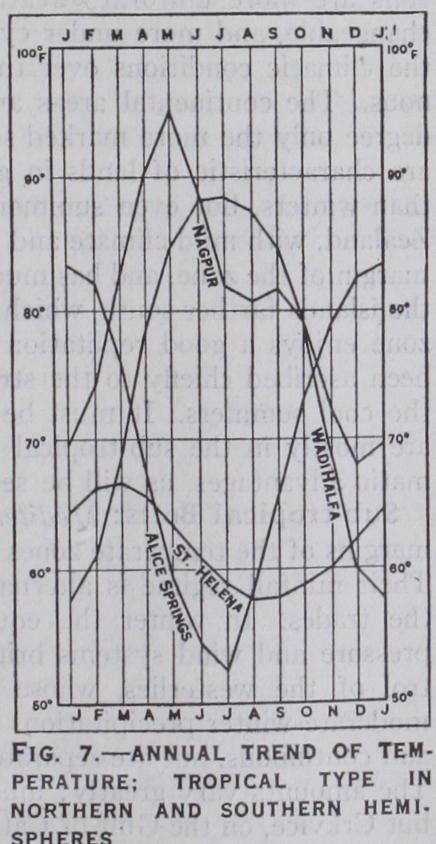
The north-east Atlantic and north-western Europe are about 35° too warm for their latitude in January, while north-eastern Siberia is 3o° too cold. The lands north of Hudson bay are 25° too cold, and the waters of the Alaskan bay 20° too warm. In July, and in the southern hemisphere, anomalies are small. The diurnal variability of temperature is greater in the north tem perate zone than elsewhere and the same month may differ greatly in its character in different years. The annual temperature curve has one maximum and one minimum. In the continental type the times of maximum and minimum are about one month behind the solstices. In the marine type the retardation may amount to nearly two months. Coasts and islands have a tendency to a cool spring and warm autumn; continents, to similar temperatures in both spring and autumn.
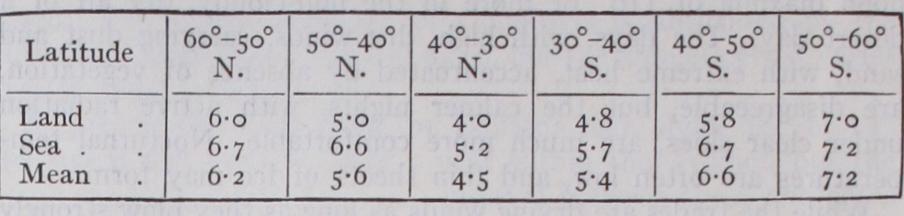
The distribution of cloudiness resembles that of humidity, rang ing from one-tenth in the interior deserts to nine-tenths in the oceanic storm areas. The averages for different latitudes are as follows : Seasons in the temperate zones are classified according to tem perature, not, as in the Tropics, by rainfall. The four seasons are important characteristics, especially of the middle latitudes of the north temperate zone. Towards the equatorial margins of the zones the difference in temperature between summer and winter becomes smaller, and the transition seasons weaken and even disappear. At the polar margins the change from winter to sum mer, and vice versa, is so sudden that there also the transition seasons disappear. These seasonal changes are of the greatest importance in the life of man. The monotonous heat of the Tropics and the continued cold of the polar zones are both de pressing. The seasonal changes of the temperate zones stimulate man to activity and encourage higher civilization.
Sub-tropical belts of winter rains and dry summers are mainly limited to western coasts of continents, and to the islands off these coasts in latitudes between about 28° and The sub tropical belt is exceptionally wide in the Old World, and reaches far inland there, embracing countries bordering on the Mediter ranean in southern Europe and northern Africa, and then extend ing eastward across the Dalmatian coast and the southern part of the Balkan peninsula into Syria, Mesopotamia, Arabia, north of the tropic, Persia and adjacent lands. This distribution has led to the use of the name "Mediterranean climate." Owing to great irregularity of topography and outline, the Mediterranean prov ince embraces many varieties of climate, but the dominant char acteristics are the mild temperatures, except on the heights, and the winter rains.
On the western coasts of the two Americas the sub-tropical belt of winter rains is clearly seen in California and in north Chile, on the west of the coast mountains. Between the region which has rain throughout the year from the stormy westerlies, and the dis tricts which are permanently arid under the trades, there is an indefinite belt over which rains fall in winter. In south Africa, which is controlled by high pressure areas of the south Atlantic and south Indian oceans, the south-western coastal belt has winter rains, decreasing to the north while the east coast and adjoining interior have summer rains, from the south-east trade. Southern Australia is climatically similar to south Africa. In summer the trades give rainfall on the eastern coast decreasing inland. In winter the westerlies give moderate rains, chiefly on the south western coast. Sub-tropical climates follow the tropical high pressure belts across the oceans, but do not retain their distinctive character far inland from the west coasts of the continents (except in the Mediterranean), nor on the east coasts. On the latter, sum mer monsoons and the occurrence of general summer rains interfere, as in east Asia and in Florida.
Strictly, winter rains are typical of the coasts and islands of this belt. The more continental areas have a tendency to spring and autumn rains. The rainy and dry seasons are most marked at the equatorward margins of the belt. With increasing latitude, the rain is more evenly distributed through the year, the summer becoming more and more rainy until, in the continental interiors of the higher latitudes, summer becomes the season of maximum rainfall. The monthly distribution of rainfall in two sub-tropical regions is shown in the accompanying curves for Malta and for Perth (Western Australia) (fig. 8). In Alexandria the dry season lasts nearly eight months ; in Palestine from six to seven months ; in Greece about four months. The winter rains which migrate equatorward are separated by the Sahara from the equatorial rains which migrate poleward. Large variations in annual rain fall may be expected towards the equatorial margins of sub tropical belts.
The main features of the sub-tropical rains east of the Atlantic are repeated on the Pacific coasts of the two Americas. In North America the rainfall decreases from Alaska, Washington and northern Oregon southwards to lower California, and the length of the summer dry season in creases. At San Diego, six months (May–October) have each less than 5% of the annual precipitation, and four of these have r %. The southern extremity of Chile, from about latitude 38° S. southward, has heavy rainfall throughout the year from the westerlies, with a winter maxi mum. Northern Chile is persis tently dry. Between these two there are winter rains and dry summers. Neither Africa nor Aus tralia extends far enough south to show the different members of this system well. New Zealand is almost wholly in the prevailing westerly belt. Northern India is unique in having summer mon soon rains and also winter rains, the latter from weak cyclonic storms which correspond with sub-tropical winter rains.
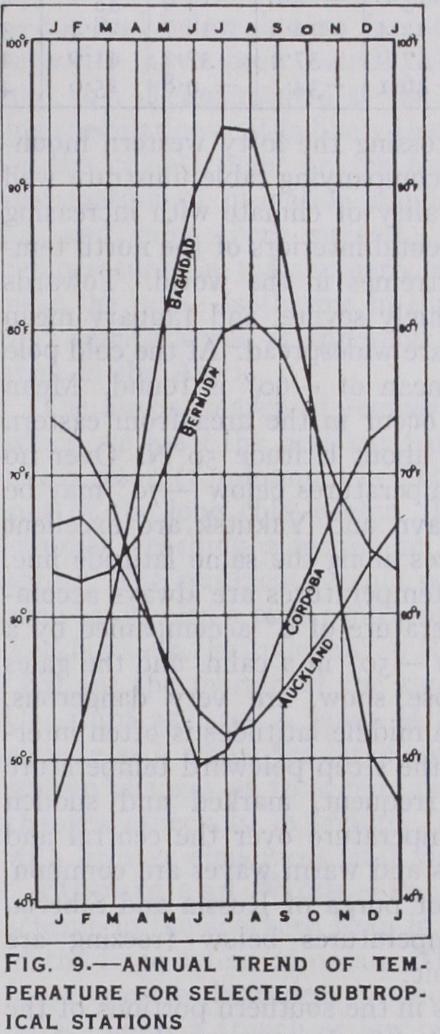
From the position of the sub-tropical belts to leeward of the oceans, and at the equatorial margins of the temperate zones, it follows that their temperatures are not extreme. Further, the protection afforded by mountain ranges, as by the Alps in Europe and the Sierra Nevada in the United States, is an important factor in keeping out extremes of winter cold. The annual march and ranges of temperature depend upon position with reference to continental or marine influences (fig. 9). The Mediterranean basin is particularly favoured in winter, not only in the protection against cold afforded by the mountains, but also in the high perature of the sea itself. The southern Alpine valleys and the Riviera are well situated, having good protection and a southern exposure. The coldest month ally has a mean temperature well above 3 2 ° . Mean minimum peratures of about, and what below, freezing occur in the northern portion of the trict, and in the more nental localities such as northern Spain and the Balkans minima a good deal lower have been served. Somewhat similar ditions obtain in the sub-tropical district of North America. Under the control of passing cyclonic storm areas, hot or cold winds, which often owe some of their special characteristics to the topography, bring into the tropical belts, from higher or lower latitudes, unseasonably high or low temperatures. These winds have been given special names (mistral, sirocco, bora, etc.) . Cloudiness is moderate in winter but very small in summer. The winter rains do not bring ously overcast skies, and a mer month with a mean cloudiness of one tenth is not exceptional in the drier parts of the sub-tropics.
With prevailing fair skies, even temperatures and moderate rainfall, the sub-tropical belts possess many climatic advantages which fit them for health resorts. The long list of well-known resorts on the Mediterranean coast, and the shorter list for California, bear witness to this fact.
Continental Interiors.—The equable climate of western coasts changes, gradually or suddenly, into the more extreme climates of the interiors. In Europe, where no high mountain ranges inter vene, the transition is gradual, and broad stretches benefit by the tempering influences of the Atlantic. In North America the change is abrupt and comes on crossing the lofty western moun tain barrier. The figures in the accompanying table illustrate well the gradually increasing continentality of climate with increasing distance inland in Eurasia. Continental interiors of the north tem perate zone have the greatest extremes in the world. Towards the arctic circle winters are extremely severe, and January mean temperatures of --1o° and — 20° are widespread. At the cold pole of north-east Siberia a January mean of —6o° is found. Mean minimum temperatures of —40° occur in the area from eastern Russia, over Siberia and down to about latitude 50°N. Over no small part of Siberia minimum temperatures below — 70° may be looked for every winter. Thorshavn and Yakutsk are excellent examples of temperature differences along the same latitude line. Fortunately in Siberia the lowest temperatures are always accom panied by calm weather. A temperature of o° accompanied by a strong wind is harder to bear than —50° in a calm, and the gales (buran, purga), which carry loose snow, are very dangerous. North American winter weather in middle latitudes is often inter rupted by cyclones, which, under the steep poleward temperature gradient then prevailing, cause frequent, marked and sudden changes in wind direction and temperature over the central and eastern United States. Cold waves and warm waves are common, and blizzards resemble the buran or purga of Russia and Siberia. With cold northerly winds, temperatures below freezing are carried far south towards the tropic.
The January mean temperatures in the southern portions of the continental interiors average about 50°. In summer the northern continental interiors are warm, with July means of 60° and there abouts. These temperatures are not much higher than those on the west coasts, but as the northern interior winters are much colder than those on the coasts, the interior ranges are very large. Mean maximum temperatures of 86° occur beyond the Arctic circle in north-eastern Siberia, and beyond latitude 60° in North America. In spite of the extreme winter cold, agriculture extends remarkably far north in these regions, because of warm, though short summers, with favourable rainfall distribution. Summer heat is sufficient to thaw the upper surface of the frozen ground, and vegetation prospers for its short season; great stretches of flat surface become swamps. The southern interiors have torrid heat in summer, temperatures of over 90° being recorded in the south western United States and in southern Asia. The diurnal ranges of temperature are very large, often exceeding 40°, and mean maxima exceed IIo°.
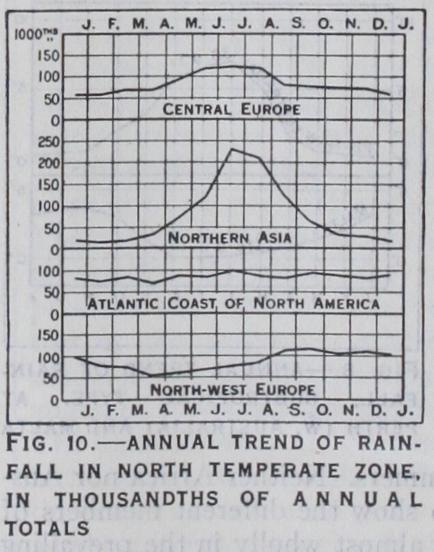
The winter maximum of rainfall and cloud on the west coasts becomes a summer maximum in the interiors. The change is grad ual in Europe, as is the change in temperature, but more sud den in North America. The rainfall curves for central Europe and for northern Asia illustrate these continental summer rains (see fig.io). The summer maximum becomes more marked with increasing continental character of the climate. There is also a well-marked decrease in the amount of rainfall inland. In western Europe rainfall averages loin. to 3oin., with much larger amounts (reaching i 2oin. and even more) on bold west coasts, as in the British Isles and Scandinavia, where moist Atlantic winds are deflected upwards, and also locally on_ mountain ranges, as on the Alps. There are small rainfalls (below 2oin.) in eastern Scandi navia and on the Iberian peninsula. Eastern Europe has generally less than 2oin., western Siberia about i sin., and eastern Siberia about loin. In the southern part of the great overgrown continent of Asia an extended region of steppes and deserts, too far from the sea to receive sufficient precipitation, shut in, furthermore, by mountains, controlled in summer by drying northerly winds, receives less than loin. a year, and in places less than Sin.
The North American interior because of its small area has more favourable rainfall conditions than Asia. The heavy rain falls on the western slopes of the Pacific coast mountains corre spond, in a general way, with those on the western coast of Europe. The coast mountains cause a much more rapid decrease of rain fall inland than in Europe and a considerable south-western inte rior region has deficient rainfall (less than coin.). The eastern part of the continent is freely open to the Atlantic and the Gulf of Mexico, so moist cyclonic winds have access, and rainfalls of over loin. are found everywhere east of the i ooth meridian. These conditions are much more favourable than those in eastern Asia. The greater part of the interior of North America has the usual warm-season rains. In the interior basin, between the Rocky and Sierra Nevada mountains, the higher plateaux and mountains receive much more rain (largely from thunderstorms) than the desert lowlands. Forests grow on the higher elevations, while irri gation is necessary for agriculture below. In southern South America the narrow Pacific slope has heavy rainfall (over 8oin.) ; east of the Andes the plains are dry (mostly less than coin.). The southern part of the continent is very narrow, and is open to the east as well as more open to the west owing to decreasing height of the mountains. Hence the rainfall increases somewhat to the south with passing cyclones. Tasmania and New Zealand have most rain on their western slopes.
East Coasts.—Prevailing winds carry the interior continental climates off over the eastern coasts of the temperate zone lands and even on to the adjacent oceans. The east coasts therefore have continental climates, with modifications resulting from the presence of the oceans to leeward, and have little in common with the west coasts. On west coasts of north temperate lands isotherms are far apart. On east coasts they crowd together. The east coasts share with the interiors large annual and cyclonic ranges of perature. A glance at isothermal maps of the world will show at once how favoured, because of its position to leeward of the warm North Atlantic waters, is western Europe as compared with eastern North America. A similar trast, less marked, is seen in ern Asia and western North America. In eastern Asia coast mountains give some shelter from extreme cold of the interior, but in North America, with no such barrier, severe cold winds sweep across the Atlantic coast States, even far to the south. Owing to prevailing offshore winds, oceans to leeward have relatively little effect.
The rainfall increases from the interiors towards the east coasts. In North America the distribution through the year is very form, with some tendency to a summer maximum, as in the interior (N. A. fig.io). In eastern Asia winters are relatively dry and clear, under the influence of the cold offshore monsoon, and summers are warm and rainy. Rainfalls of 4oin. are found on the east coasts of Korea, Kamchatka and Japan, while in North America, which is more open, they reach farther inland. Japan, although occupying an insular position, has a modified continental rather than a marine climate. The winter monsoon after crossing the water, gives abundant rain and snow on the western coast, while the winter is relatively dry in the lee of the mountains, on the east. Japan has smaller temperature ranges than the mainland.
Mountain Climates.—If the altitude is sufficient, decreased temperature gives mountains a polar climate, with the difference that summers are relatively cool while winters are mild owing to inversions of temperature in anticyclonic weather. Hence annual ranges are smaller than over lowlands. At such times of inver sion mountain-tops often appear as local areas of higher tempera ture in a general region of colder air over valleys and lowlands. Increased intensity of insolation aloft is important for certain mountain resorts in winter (e.g., Davos and Meran). Of Meran it has been well said that from December to March the nights are winter, but the days are mild spring. The diurnal ascending air currents of summer usually give mountains their maximum cloudiness and highest relative humidity in the warmer months, while winter is the drier and clearer season.