THE TORRID ZONE Climate and Weather.—Climatic features here are simple and uniform. Periodic phenomena, depending upon the daily and annual march of the sun, are dominant ; non-periodic weather changes are wholly subordinate. In special regions only, and at special seasons, is the regular sequence interrupted by an occa sional tropical cyclone. These cyclones are comparatively infre quent and generally bring very heavy rains ; the devastation one may produce often affects the economic conditions for many years.
Mean temperature is very high, and very uniform over the whole zone, with little variation during the year. The mean annual isotherm of 68° F. is a rational limit at the polar margins of the zone, and the mean annual isotherm of 8o° F. encloses the greater portion of the land areas, as well as much of the inter-tropical oceans. The warmest latitude circle for the year is not the equator, but latitude 1 o° N. The highest mean annual temperatures, shown by the isotherm of 85 ° F., are in Central Africa, in India, the north of Australia and Central America, but, with the exception of the first, these areas are small. The temperatures average highest where there is little rain. In June, July and August there are large districts in the south of Asia and north of Africa with temperatures over 9o° F.
Over nearly all the zone mean annual range of temperature is less than io° F., and over much of it, especially on the oceans, less than 5° F. Even near the margins of the zone the ranges are less than 25° F., as at Calcutta, Hongkong, Rio de Janeiro and Khartoum. Mean daily range is usually larger than mean annual; "night is the winter of the Tropics." Over parts of the Pacific and Indian oceans from Arabia to the Caroline islands and from Zanzibar to New Guinea, as well as on the Guiana coast, minimum temperatures do not normally fall below 68° F. Towards the margins of the zone, however, the minima on the continents fall to or even below 3 2 ° F. Maxima of over i 20° F. occur over the deserts of northern Africa and a reading of 136° F. at Azizia in Tunis is the highest known shade temperature. A district where the mean maxima exceed 1 13 ° F. extends from the western Sahara to north-western India, and over Central Australia. Near the Equator the maxima are not so high; and inter-tropical oceans show remarkably small variations in tem perature.
In a true inter-tropical climate the seasons depend not on temperature, but on rainfall and the prevailing winds. Life is regulated in some cases almost wholly by rainfall. Although the rain is characteristically associated with a vertical sun, that season is not necessarily the hottest. Towards the margins of the zone, with increasing annual ranges of temperature, seasons in the extra-tropical sense gradually appear. The associa tion of uniformly high heat and humidity at most low-level places near the Equator is very enervating, and energetic physical or mental activity is difficult or impossible for white men. The absence of a bracing cold winter is a great drawback and the uniformity of conditions makes one sensitive to slight changes of temperature. The drier interior regions are more healthy, and the most energetic natives are the desert dwellers.
Pressure is lowest near the equator, in the belt of doldrums. Here the pressure gradients are small, and calms, variable winds and heavy rain and thunder storms prevail. This region is one of the rainiest in the world, averaging about 'coin., and the sky is generally cloudy; it includes the dense forests of the Amazon and equatorial Africa. The dol drums extend from the Equator to about 1o° N., but do not in clude any part of the southern hemisphere ; on either side are the belts of trade winds, the north-east trade from about 1 o° to 3o° N. and the south-east trade from about o° to 25° S. The trades are extremely regular and stable and except where they strike windward coasts or high mountains they bring fine bracing weather. Over oceans the skies show small detached clouds (trade cumulus) but over the western and central parts of the conti nents the trade wind latitudes are desert—the Sahara and Arabia, Kalahari and the desert of Australia. The boundaries between the trade winds and the doldrums move north and south following the sun, giving a "winter" dry season and a "summer" rainy season, which near the equator is divided into two by a minor dry season shortly of ter the summer solstice. Monsoons occur on many of the tropical lands, the best known being those of southern and eastern Asia. In the northern summer the south-west mon soon, warm and moist, blows over the latitudes from about 10° N. to and beyond the northern tropic, between Africa and the Philippines, giving rains over India, the East Indian archipelago and the eastern coasts of China. In winter, the north-east mon soon, the normal cold-season outflow from Asia, combined with the north-east trade, and generally cool and dry, covers the same district, coming from as far north as lat. 3o° N. Crossing the Equator, these winds reach northern Australia and the western islands of the South Pacific as a north-west rainy monsoon, while this region in the opposite season has the normal south-east trade. Other monsoons are found in the Gulf of Guinea and in equa torial Africa. Wherever they occur they control the seasonal changes.
The regular occurrence and cool, clean air of the sea breeze make many districts habitable for white settlers. On not a few coasts the sea breeze is a true prevailing wind. The location of dwellings is often determined by exposure of a site to the sea breeze.
Local thunderstorms are frequent, have a marked diurnal periodicity, find their best opportunity in the equatorial belt of weak pressure gradients and high temperature, and are commonly associated with the rainy season, being most common at the be ginning and end of the regular rains. In many places intense thunderstorms occur daily throughout the rainy season.
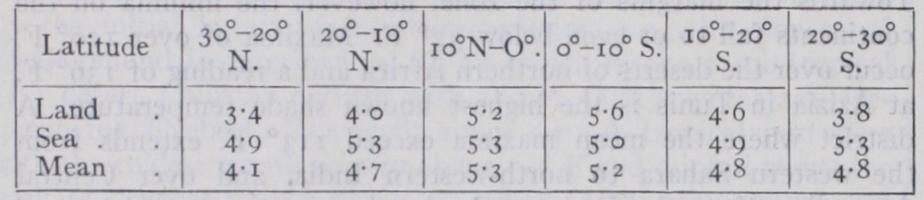
The average cloudiness of the tropics does not differ greatly from that in temperate regions. The mean, in tenths of sky covered, is shown by the following table:— Both wholly clear and wholly overcast days are rare in the Tropics; the sky is more usually about half clouded.