
COLUMBIA UNIVERSITY, one of the oldest and most important of the higher institutions of learning in the United States, situated for the most part on Morningside Heights, New York city. It embraces Columbia college, founded as King's col lege in 1754; a school of medicine (the College of Physicians and Surgeons) founded 1767, removed in 1928 to a site on the Hudson above 165th Street where, in conjunction with the Presbyterian hospital and allied institutions, it forms the nucleus of a great medical centre; school of law (1858) ; school of engineering, or ganized as school of mines in 1863 ; school of architecture (1881) ; graduate facilities of political science (188o), philosophy (1890) and pure science (1892) ; school of journalism (1912) ; school of business (1916) ; school of dental and oral surgery (1916) ; school of library service (1926). Closely affiliated to it and incor porated in its educational system are the College of Pharmacy (1829), in West 68th Street; Teachers college, founded in 1886, as the New York College for the Training of Teachers, and essen tially a part of the university since 1895 ; Barnard college (for women) founded in 1889, and essentially a part of the university since 19oo; Bard (formerly St. Stephen's college), Annandale-on Hudson (for men) founded in 1860, and essentially a part of the university since 1928, New York Post-Graduate Medical School, founded in 1882 and essentially a part of the university since 1931. Reciprocal relations also exist between the university and Union Theological Seminary, thus practically adding to the university a theological faculty.
In co-operation with the Ministry of Education in Porto Rico the university in 1924 assumed responsibility for educational and scientific work of the school of tropical medicine on the island of Porto Rico. Three research institutes are connected with the uni versity, the Institute of Educational Research, the Institute of Cancer Research and the De Lamar Institute of Public Health. Courses in university extension are open to men and women who can give only a portion of their time to study, but who desire to pursue subjects included in a liberal education. These courses, as such, do not lead to degrees. Under university extension there is also an Institute of Arts and Sciences which conducts a series of lectures and recitals of a popular nature. Women are admitted by all faculties of the university with the exception of that of engineering. Since 1900 a summer session has been held for six weeks. Teachers and others, under the direction of the Teachers college, are afforded an opportunity to pursue courses in absentia and so meet some of the requirements for an academic degree or a teacher's diploma.
In 1936 there were in Columbia university in all departments 3,190 instructors and administrative officers, and in the 12 months ending June 30, 33,495 students were enrolled. Of these, roughly one-third were registered in the 1935 summer session; more than one-third in the degree-granting schools and faculties during the academic year 1935-1936. In addition to the resident students there were 676 non-resident students in home study and 1,986 non-resident students in extra-mural and special courses. The numerous university publications include works embodying the results of original research published by Columbia University Press; "Studies" published in the form of a series by each of several departments; various periodicals edited by some members of the faculty, such as The Romanic Review, The Germanic Re view, The Political Science Quarterly, etc. and several papers or periodicals, published by the students, among which are the Columbia Spectator, a daily paper, the Columbia Law Review and the Columbia Jester.
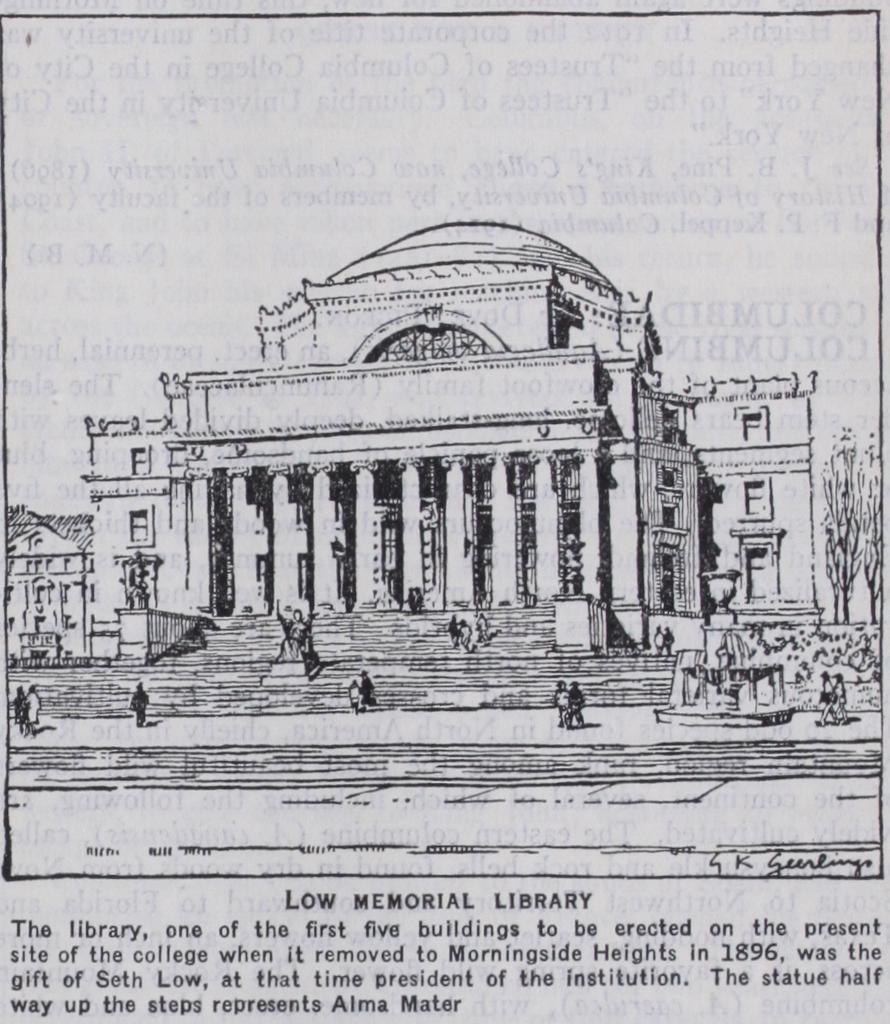
With one exception the 69 buildings of the university on Morn ingside Heights have been erected since 1896. They include be sides the several department buildings and laboratories, two li brary buildings, a university hall (with gymnasium), Earl Hall (for social purposes), St. Paul's chapel (dedicated in 1907), Presi dent's house, Faculty house, faculty residential halls, residence halls for men and for women, and four centres of foreign inter ests, the Maison Francaise, the Casa Italiana, the Deutsches Haus, and the Casa de las Espanas. The library contains about 1,520,00o volumes exclusive of duplicates and unbound pamphlets.
The highest authority in the government of the institution is vested in a board of 24 trustees, vacancies in which are filled by co-optation ; but the immediate educational interests are directed largely by the members of the university council, which is com posed of the president of the university, the dean and elected rep resentatives from the faculty of each school. The alumni of the university have been given a definite part in the government of the institution by an agreement under which six of the 24 trustees are elected on alumni nomination. The productive endowment of the university, including the endowments of Teachers college, Barnard college, College of Pharmacy, Bard College, and New York Post-Graduate Medical School had a book value in 1936 of $85,749,434, which, added to the property occupied for educa tional purposes, made a total capital holding of $144,336,580. The tuition fees to the students in the several schools range from $400 to $545. The total budget appropriations for the maintenance of the work of the whole educational system of the university for the year 1936-1937 were The charter granted by the Crown in 1754, for the establish ment of King's college, was so free from narrow sectarianism as to name ministers of five different denominations for ex-officio governors, and provide that the governors should not "exclude any person of any religious denomination whatever from equal liberty and advantage of education or from any of the degrees, Iiberties, privileges, benefits or immunities of the said college on account of his particular tenents in matters of religion." The purpose of the institution as set forth by its first president, Dr. Samuel Johnson (1696-1772) was about as broad as that now realized.
In 1756 the erection of the first building was begun at the lower end of Manhattan island, near the Hudson, and the institu tion prospered from the beginning. From 1776 to 1784, during the Revolutionary War, the exercises of the college were sus pended and the library and apparatus were stored in the New York city hall. In 1784 the name was changed to Columbia col lege, and an act of the legislature was passed for creating a State university, of which Columbia was to be the basis. But the plan was not a success, and three years later, in 1787, the act was re pealed and the administration of Columbia was entrusted to a board of trustees of which the present board is a successor. In 1857 there was an extensive reorganization by which the scope of the institution was much enlarged, and at the same time it was re moved to a new site on Madison Avenue between 49th and 5oth Streets.
From 18go to 1895 much reorganization and centralization in its administration was effected. In 1896 the name of Columbia uni versity was adopted, and in the autumn of 1897 the old site and buildings were again abandoned for new, this time on Morning side Heights. In 1912 the corporate title of the university was changed from the "Trustees of Columbia College in the City of New York" to the "Trustees of Columbia University in the City of New York." See J. B. Pine, King's College, now Columbia University (1896) ; A History of Columbia University, by members of the faculty (1904) and F. P. Keppel, Columbia (1 g 14) .
(N. M. B.)