
COMBUSTION. This term implies the process of burning and in the popular mind is generally associated with the produc tion of flame (q.v.). So far as terrestrial conditions are con cerned, it is due to the combination of a combustible substance with oxygen and the consequent evolution of heat. The condition of flame is due to the oxidation of gases or vapours at a very rapid rate so that high temperatures are attained, the molecules con cerned thereby becoming highly radiant. Scientifically, the term has a broader meaning and is extended to other oxidations. At atmospheric temperature oxidation of a combustible material generally occurs, if at all, only very slowly, and usually with little outward manifestation. When, however, the temperature is raised, as for example by the application of some external source of heat, the process becomes greatly accelerated, and if the "ignition point" be reached, heat will be developed at a rate greater than that at which it can be dissipated and flame will ensue. Thus, when a lighted match is applied to coal-gas issuing from a jet, the temperature is so raised that self-propellant combination is estab lished between the gas and the oxygen of the air with which it intermingles, flame then appears and is maintained at the jet. Similarly, when coal is heaped on a fire, its volatile constituents liberated by heat mix with the surrounding air and after ignition give rise to flame; the residual coke, consisting largely of carbon, becomes incandescent, its primary oxidation proceeding without flame.
The explanation of the nature of fire or flame was sought in very early times. At first fire was thought to be an element, but as far back as the fourth century B.C. it was demonstrated that air plays an important part in the phenomenon. During the middle ages, however, the notion of an "element of fire" universally pre vailed until Francis Bacon classed it among his "phantoms of the market place" as one of those "fictions which spring from vain and false theories" (Novum Organum). The first important experimental study of combustion commenced with the Oxford School of Chemistry about i 66o under the leadership of Robert Boyle. With the assistance of his pupil Robert Hooke, he had contrived his "Machina Boyleana," a forerunner of the modern air-pump, and by its aid proved that neither charcoal nor sulphur burns when strongly heated in vessels exhausted of air, although each inflames as soon as air is readmitted. Having found that a mixture of either substance with nitre catches fire even when heated in a vacuum, Boyle concluded that combustion depends upon the action of something common to both air and nitre. He concluded further that, in the calcination of metals a ponderable "fire-stuff" is taken up, thus accounting for the gain in weight already observed by the French physician, Jean Rey, in 163o. Robert Hooke said (picrographia, 1665) ". . . that shining transient body which we call Flame, is nothing else but a mixture of Air, and volatil sulphureous parts of dissoluble or combustible bodies, which are acting upon each other whilst they ascend. . . ." It was, however, John Mayow, another of Boyle's pupils, who in his Tractatus Quinque Medico-Physici (1674) expounded views nearest to those held to-day. In common with Hooke, Mayow regarded heat and light as originating in the motions of particles. By making the now familiar experiment of burning a candle or other substance in a bell jar of air enclosed over water, he ob served that the air is diminished in bulk by combustion and that when the flame expires the residual air is inactive and will not support combustion. Also he observed that the respiration of animals in an enclosed space had the same effect, and concluded that respiration and combustion were analogous processes. He therefore postulated the existence of two kinds of particles: (a) inflammable particles which exist in all combustible sub stances, and (b) nitro-aerial particles which, originating in the sun, become linked to normal aerial particles (which per se are inert) in the upper atmosphere. These particles (a and b) are mutually so hostile that when suitably brought together they enter into sharp conflict, whereby they are thrown into violent motion the outcome of which is the appearance of fire. Such a view differs from that propounded by A. L. Lavoisier a century later and now held, in that (i.) it did not recognize that common air is a mixture of two physically similar but chemically distinct gases, and (ii.) it regarded combustion only as the interplay and not as the actual combining of two opposite kinds of particles. But for his early death in 1679 Mayow might have discovered the gas now called oxygen.
At the beginning of the i 8th century, another view of combus tion known as the "phlogiston" theory, originally propounded by J. J. Becker (1635-1681), was developed and promulgated by G. E. Stahl, and soon became universally accepted. According to this theory, all combustible bodies contain at least two "prin ciples"--one of "combustibility" called phlogiston (from the Greek IOros, burnt) which escapes during combustion, and the other of "incombustibility" which remains behind as the ash. More easily combustible substances, e.g., charcoal, were supposed to consist so largely of phlogiston that after its escape during combustion little or no visible residue remains. The inherent defect of the theory was that it did not account for the fact that the products of combustion are invariably heavier than the original substance. This was overcome by ascribing to phlogiston a nega tive weight. The phlogiston theory dominated chemistry during the greater part of the i8th century but it did not long survive the discovery of oxygen by K. W. Scheele and by J. Priestley; for Lavoisier was able to prove that this gas is really the active constituent of air, and in 1783, after Henry Cavendish's dis covery of the composition of water, he correctly interpreted its compound nature as an oxide of hydrogen. In his Reflections sur le Plzlogistique he denied the existence of phlogiston and pro pounded his new oxygen theory of combustion. His main con tentions were, (i) inflammable substances will burn only in oxygen or where oxygen is present; (2) oxygen is consumed in combustion and, uniting with the substance burnt, causes an increase in weight and a corresponding decrease in the weight of the air used.
Lastly, it should be mentioned that combustion is not neces sarily controlled by simple thermal factors but may be profoundly influenced by the electrically charged condition (degree of ioniza tion) of the reactants. Such is probably the case in the ignition of explosive mixtures by electric discharges and also in catalytic combustion.
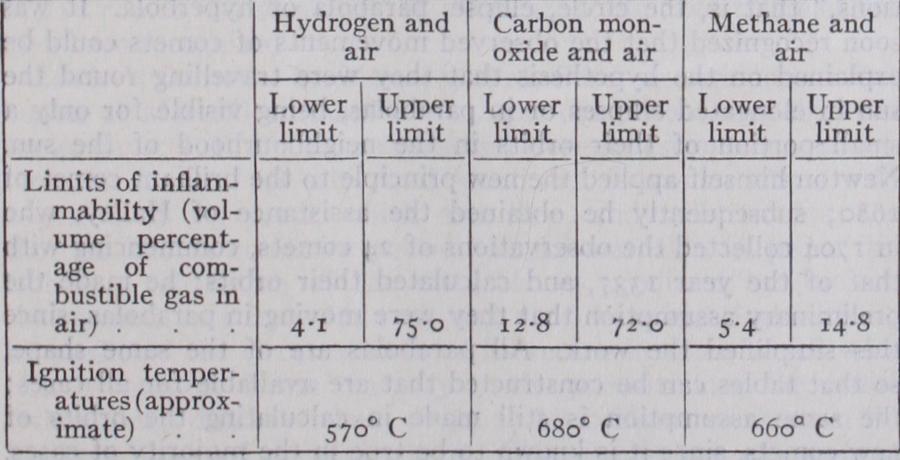
In order that a gaseous mixture may be explosive it is necessary that the percentage of the particular combustible present should lie between certain limits. Also, in order to initiate flame the mix ture must be raised locally at least to its ignition temperature. In neither case are these conditions constant, but they are dependent on the temperature and pressure of the mixture and also on its environment. Usually, however, they can be reasonably well de fined; thus at atmospheric temperature and pressure the following figures have been found: It should also be borne in mind that in certain cases the elec trically charged state of the gases may play an important role in the initiation of flame.
(For heats of combustion, see THERMOCHEMISTRY.) See W. A. Bone and D. T. A. Townend, Flame and Combustion in Gases (I 92 7) ; R. T. Haslam and R. P. Russell, Fuels and their Combustion (1926). (D. T. A. T.)