COMMERCE. In the widest sense the term commerce covers the exchange of commodities and all the arrangements necessary for effecting such exchange ; but in general usage it is more or less strictly confined to exchanges conducted on a large scale, particularly between distant places. The desire to make an exchange of goods will arise when one area possesses by nature something which another does not, or when it has acquired by skill a relative advantage in the making of particular articles. The extent to which commerce will develop in such circumstances will depend on a number of factors. If the means of transport are primitive the volume of long-distance trade will necessarily be small and the goods which enter into it must be able to bear high costs. If the trade route is dangerous and the trader has no prospect that his enterprise will receive proper protection the heavy risks may seriously discourage him. If methods have not been elaborated for computing, recording and paying debts he has no firm basis for his operations. If the goods have to pass political boundaries and the countries concerned burden it with tolls or taxes the trade will tend to be restricted. The history of the evolution of commerce, therefore, mainly consists of an ac count of how the tendency towards making exchanges has been limited by defective means of transport, by the perils of the route, by the lack of appropriate mechanism for carrying on trade, and by regulations adopted in the interests of particular States.
Long-distance trading presented great difficulties in the ancient world. It seems first to have developed along desert routes which had the advantage that comparatively large groups could travel together in caravans and defend themselves against marauders. Oases could be established as ports of call and entrepots. In this way trade sprang up be tween the civilizations of the Tigris-Euphrates valley and of Egypt. A very large caravan would be required to convey a hundred tons and its progress would be slow. It follows that the goods which entered this trade had to have a high value in pro portion to their bulk. They would include such things as oriental spices, drugs and dyes as well as fine textile fabrics and a variety of metal ornaments. But necessaries (for which there was a large and constant demand) would obviously not appear. This caravan trade retained its essential characteristics for centuries. In the course of time the caravan trade became subordinate to sea routes. The first people to make this development of the over land commerce were the Phoenicians. From their bases on the Syrian coast they carried goods by sea to Cyprus and Rhodes and step by step found their way to the western Mediterranean and beyond. The original cities of Tyre and Sidon and the colo nies they founded, of which Carthage became the chief, were true commercial centres. Articles wrought in metal, glass ware and textiles were exchanged for tin, copper and silver in the West. The Phoenicians were pioneers in the craft of ship construction, and the wealth which they amassed demonstrated the fact that a long-distance sea trade could be very profitable. Their merchants appear to have made their exchanges on the basis of goods f or goods; it remained for their rivals and successors, the Greeks, to spread the use of coned money. Athens, in particular, intro duced and maintained an excellent silver currency which won general acceptance because it was not allowed to depreciate. She exported olive oil, figs, honey, pottery and small quantities of metal and textile goods. Her trade with the Black sea is an early example of dependence for essential food supplies on regular communication by sea. The fortified harbour at the Peiraeeus also attracted a considerable volume of entrepot trade, it being used by the merchants of Asia Minor and Syria in their dealings with the rest of Greece and countries to the West. Greek com mercial enterprise was offered new opportunities when the con quests of Alexander opened the way into the heart of Asia. The consequent stimulus to long-distance trade was reflected in the growth of Antioch and Alexandria as great commercial cities.
In the earlier phases of its history Rome took little interest in commerce. In its origins an agricultural community, it long clung to its traditions. But the series of events which led to the destruction of Carthage (146 p.c.) and the assertion of Roman supremacy over Greece neces sarily opened up the possibilities of commercial development. When Augustus put an end to civil dissensions and inaugurated a period of peace these possibilities were fully explored. The main current of trade continued in the direction determined by the Greeks. To Antioch came the chief caravan routes from the East. The commodities thus secured were shipped from its port, Se leucia, to all parts of the Mediterranean. They were the typical articles of this trade—spices, drugs, silks, etc.—and catered for the demands of the wealthier classes. The commerce of Alexan dria, however, was of a twofold nature. Oriental luxury goods from Arabia and India reached Egypt by way of the Red sea. Augustus took steps to protect this trade by forcing the Arabs and Ethiopians to desist from piracy and he also had the navi gable canals repaired. A sea-captain, named Hippalus, is said to have observed the periodicity of the monsoons about the middle of the 1st century of our era, thus making a direct voyage to India possible and eliminating the need of calling at Arabian ports. There is, indeed, much testimony to the extent of this commerce in the first two centuries. Pliny complains that the demand for Eastern luxuries was so great that it had caused a drain of silver from the West to pay for them. This is partly confirmed by the fact that large quantities of coins of the early Roman emperors have been found in southern India. But there was another side to the trade of Alexandria. The importation of corn from Egypt was essential for the sustenance of the growing population of Rome. Some 20 million bushels were imported annually, part of it being produced on the emperor's domains in Egypt, but most being exacted as tribute from the province. Elaborate precautions were taken to safeguard the supply. Severe penalties were promulgated under Augustus against anyone who delayed the sailing of a corn-ship. The port at Ostia, where the corn was unloaded, was improved by Claudius. Trajari instituted regular sailings and provided granaries for storage. State super vision was necessary not only because the trade was vital to the existence of Rome but because of its very nature. There was no true exchange of goods between Rome and Egypt. Even at its zenith Rome was singularly unproductive; it never had the means of paying for its imports. Little is known of the organization of commerce, as, for instance, of the respective functions of mer chants and shippers ; but it is obvious that the corn trade was not one in which private enterprise could find a place. The trader was no doubt discouraged in other ways. Ships which were not part of a convoy were in danger of being attacked by pirates. Weather conditions in the Mediterranean made winter sailing perilous. With favourable winds the voyage between Alexandria and Rome could be accomplished in eight or nine days. When winds were contrary recourse had to be had to coasting from point to point and weeks could easily be consumed. A vivid ac count of such a voyage is given in the 27th chapter of Acts, the "ship of Alexandria" and her cargo of wheat being lost. It is not surprising, theref ore, that the activities of the private merchant continued to centre in the provinces of the eastern Mediterranean. Some of them found means of extending their trade to the West as the Roman empire promoted the growth of cities where a de mand for luxury goods arose. But that commerce had its roots in the East is proved by the fact that in most cases the merchant discovered in the West turns out to be a Greek, a Syrian or a Jew.
When the Roman empire in the West collapsed under the successive blows of the barbarian inva sions the volume of this trade was greatly reduced. Commerce was virtually confined to the eastern Mediterranean where Con stantinople enjoyed pre-eminence as the capital of the east Roman or Byzantine empire. Antioch had been sacked by the Persians in 54o and was captured by the Saracens in 637. The rising tide of Mohammedanism swept over Egypt, and Alexandria itself capitulated in 641. Constantinople, however, did not fall into the hands of a Mohammedan conqueror until the 15th century. She attracted to herself the commerce between Asia and Europe. From the fall of Rome in the Sth century to the age of the Cru sades she was the great entrepot of long-distance trade. Unlike Rome, Constantinople and the other cities of the Byzantine em pire established a reputation for their manufactures. High quality textile goods, leather work, armour, engraved and enamelled metal articles of exquisite workmanship, carved ivories, mosaics and porcelain were among the exports. Corn, wax, furs, amber, salt fish, unwrought metals and raw wool were secured in exchange from the less advanced peoples whom she did so much to civilize. Merchants had the advantage of good money—the bezant, a gold piece which was generally acceptable. The principles of banking and the use of credit notes were known. Loans could be raised at a moderate rate of interest. Shipping was assisted by the develop ment of insurance. It is true that from the reign of Justinian (528-565) there was a tendency to adopt a commercial policy in the fiscal interests of the empire. There were heavy duties on the import and export of certain commodities, and taxes were levied on purchases and sales. Justinian also introduced the prin ciple of monopoly in favour of the silk industry which he took pains to set up in order that the empire might be independent of the supplies from the East which were controlled by Persia. Against these restrictions must be placed the influence of the great fairs of Constantinople and Thessalonica at which the mer chants who resorted to them from all countries enjoyed great freedom of trade. Concessions were also made to alien merchants by granting them special quarters. The most favoured of them, such as the Venetians and the Genoese, had extensive privileges; others were subject to restrictions as to the time they were al lowed to stay within the empire and their business had to be con ducted under supervision.
The heirs of Constantinople were the Italian trading towns. They had developed under the aegis of the Byzantine empire and they profited from its decline. Venice in particular rose to splendour in the middle ages. Sit uated amid the lagoons at the head of the Adriatic sea, it was at first a place of refuge in the troubled days of the barbarian inva sions. A position could hardly have been better chosen to serve as an entrepot through which the trade of the Levant could pass into central Europe as conditions there became more settled. The merchants of Germany had access to it across the Brenner pass, and goods could also be conveyed along the valley of the Po and by way of the St. Gotthard pass to the growing towns of the Rhine land and the Low Countries beyond. Through Istria and along the Save the countries of the Danube basin could be reached. The Venetians themselves, however, had a predilection in favour of sea routes. It was by sea that they imported oriental com modities. To make the sea route to the eastern Mediterranean secure they aimed at gaining control of the coast-line and the islands. Advantage was taken of the crusades to pursue this policy. Concessions were exacted in return for shipping services. When the leaders of the fourth crusade, for instance, negotiated for their trans-shipment to Egypt—the first proposed objective of the expedition—Venice demanded a payment of 85,00o marks and a share in the conquests. Since they could not satisfy these claims the leaders of the crusade were induced to do Venice a service by capturing for her Zara, a position she coveted on the Adriatic. Although the Venetians were not responsible for the subsequent diversion of this crusade to the capture of Constanti nople itself in 1204, they took advantage of the turn of events and claimed large territorial grants. This persistence in strength ening her hold in the Levant indicates the character of her trade. Year by year she was attempting to find new outlets in the West for the goods carried by caravans from the East and the products of Byzantine workshops. As she was pre-eminently a sea-power it was natural that she should consider a sea route to the West.
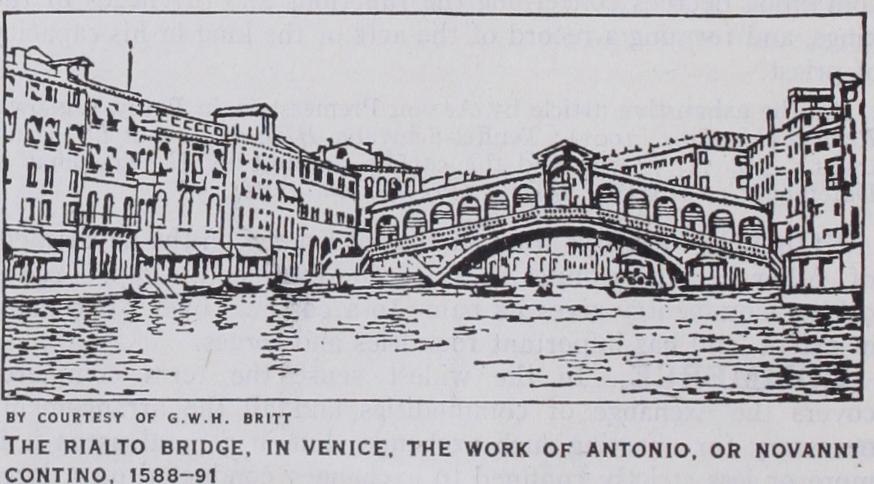
From the early part of the 14th century a fleet of galleys was des patched to the countries of the western Mediterranean, and it made its way by easy stages through the Strait of Gibraltar as far as the Low Countries. The voyage, which was usually annual, was publicly organized and controlled. The goods, however, were carried on the account of individual merchants to whom oppor tunity of securing space on the ships was offered by auction. Since Bruges was then the chief mart of north-west Europe most of the cargoes were directed there; but a ship might detach itself from the fleet to call at Southampton, Sandwich or London. By this means such commodities as pepper, cloves, indigo, ginger, etc., were carried to the 'Vest at a lower cost than that of the overland route. As a return cargo the galleys took wool, hides and metals which were worked up in Italy for export to the East. Florence, for instance, was the centre of a flourishing cloth industry organized on a capitalist basis, and Lucca had an important silk industry. As the Italian towns were purely commercial some kind of exchange of goods was necessary and consequently the expansion of trade promoted industrial activity. It was also facilitated by the im proved mechanism of commerce effected by the Italians in the methods of account-keeping and the organization of credit. Bank ers, particularly those of Florence, had connections throughout western Europe. The commercial activities of Venice were ri valled, though not equalled, by those of Genoa and Pisa. Genoa strove not unsuccessfully for a share in the Levantine trade and contended with Pisa for the trade of North Africa and Spain.
The fact that the Venetians found it worth while to make a direct sea voyage to the Low Countries shows that good markets for long-distance trade had grown up there by the i4th century. These had developed slowly from the 9th century onwards as new kingdoms had arisen out of the ruins of the Roman empire. Merchants began to enjoy some measure of protection. Charles the Great, for instance, assured Offa of Mercia in 796 that any of his subjects lawfully pursuing their business in his dominions would be safeguarded against oppres sion. The Northmen found their way by river routes from the Baltic to the Black sea and obtained supplies of oriental goods. Progress was slow at first. By the II th century, however, German towns had taken the initiative and the merchants of Cologne were particularly active. The towns of north Germany also entered into agreements with one another to co-operate in suppressing robbery on the roads and piracy at sea. Out of such understand ings the powerful Hanseatic League ultimately emerged. It was a confederation of towns, mostly though not exclusively in Ger many, formed to consult their common commercial interests. The League was no less than a great commercial State; it had its regular assemblies, its courts and its treasury, and it entered into treaty relations with foreign States. The main purpose was to gain concessions in its favour from the rulers of other coun tries. Such privileges it strictly confined to its members. In countries where long-distance commerce had not developed the League negotiated for factories or settlements which were at once residences and warehouses. They were concrete expressions of the treaty privileges gained by the League and the means of super vising the activities of its own members. There was a factory at Bergen from which the trade with Iceland could be carried on, and another at Novgorod where goods could be exchanged for Russian products. In London the League had its settlement called the Steelyard, and it long enjoyed more favourable terms than any other merchants in the payment of customs duties. Still more important was the position which it occupied in Bruges where the merchants of northern Europe and the Mediterranean came into direct contact. It was also the chief market for English wool and Flemish cloth. The Hanseatic merchants, therefore, were chiefly engaged in exchanging the products of the northern countries—furs, salt fish, flax, timber and tar—for wool, leather, cloth and the commodities in which the Italians specialized. They confined their attention to merchandise and did not undertake money-lending. Under the leadership of Lubeck and Hamburg the League established a great prestige which was of first impor tance in the commercial development of northern Europe.
The total vol ume of long-distance trade in the middle ages was comparatively small. With respect to the necessaries of life most areas were self sufficing. The goods which entered into international trade were still mainly articles of luxury for the wealthier classes. Oriental products reached western Europe chiefly through the agency of Venice and Genoa. They were paid for to an increasing extent by the export of high quality woollens. Cloth was the first European product which was carried long distances in considerable quan tities. It became worth while for special classes of merchants to devote all their attention to its sale. For the most part, however, merchants dealt in a variety of goods and a wholesale market in any commodity was exceptional. Particular value, indeed, was attached to the right of retail trading. Local merchant gilds tried to monopolize it by forcing outsiders to sell in bulk. The mem bers of the Hanseatic League were extremely jealous of the priv ilege of retailing where they had secured it. Obviously the retail market was more certain and profitable. The travelling merchant covered a range of articles, and even when he became resident and his business was carried on through agents, it retained its general nature.
Mediaeval commerce was restricted in many directions. Trans port remained expensive both by land and sea ; by land only small quantities could be carried by pack-horse or some such method and frequent tolls were exacted, and by sea it was customary to arrange common sailings for the sake of convoy and this meant that the relative cheapness of carriage had to be set against the slowness with which the capital invested was turned over. Local organizations of merchants often succeeded in imposing serious restraints on foreigners. The custom of hosting was common, usually requiring that aliens should have the period of their so journ in a country limited to 4o days and that they should stay with a native merchant to whom the details of their business should be revealed. Commerce also frequently suffered from regulations imposed in the fiscal interest of States. The chief goods on which customs were paid had to pass through pre scribed staple ports, and the situation and number of such staples were subject to constant change, usually for political reasons. The export of money was often forbidden because special importance was placed on the accumulation of the precious metals within the country. Sometimes alien merchants suffered from popular out cry against the nature of their trade, it being alleged that they were importing useless or harmful luxuries and exporting neces saries. The catalogue of discouragements, whether natural or artificial, seems formidable. It should be remembered, however, that local and Governmental restrictions were often relaxed. Reference has already been made to the privileges enjoyed by organizations of alien merchants such as the Hanseatic League. The fairs (see FAIR) also gave opportunity for temporary free dom of trade and were resorted to by merchants engaged in long distance commerce. Among the most notable fairs in western Europe were those of Champagne, which were held at Provins, Troyes and other centres, and extended over the greater part of the year. Merchants attending them were guaranteed safe jour neys and protection in their lawful enterprise. In the conduct of the fairs a common code of mercantile law was evolved to meet the problem of settling disputes between merchants of different countries without delay. The mechanism of trade was improved. Money-changing had to be arranged because of the great variety of coins which were current. From money-changing, money lending was an easy step. The inconvenience of paying debts at a distance by incurring the risk of sending money, when it was lawful to do so, or by despatching goods which the debtor was willing to accept, was removed by the growing use of the principle of the bill of exchange.
The con quests of the Ottoman Turks in the 15th century threatened to close the routes by which oriental goods had reached the Levant. Constantinople fell into their hands in 1453, and although Venice succeeded in her negotiations for the retention of her trading privileges for a time, the Christian powers could not but regard the Turkish advance into Serbia, Wallachia, Bosnia and Greece with apprehension. Venice herself was involved in a series of wars with the Turks in the 16th century and suffered heavily from the exhaustion of her resources and the loss of territory. Prolonged disturbance in the Mediterranean reacted adversely on the long-established and lucrative trade with the East. The question naturally arose whether the commodities could be ob tained by some other route. The pioneer work of Prince Henry of Portugal was rewarded by the rounding of the Cape of Good Hope by Bartholomew Diaz in 1486 and by Vasco da Gama's successful voyage from Lisbon to Calicut in 1498. Meanwhile Christopher Columbus, a Genoese sailor in the service of Castile, sought India by sailing west and discovered a "new world" lying across his path.
These two discoveries were destined to effect a revolution in commerce, but their consequences were not apparent for some time. Portugal and Spain claimed exclusive rights in the ex ploitation of the new routes. The English were not without hope that they would be able to find a northern passage to the East. This would enable them to avoid conflict with the Portuguese and Spaniards, and also to carry on an intermediate trade in woollens for which there was no demand in the tropics. The best-known athmpt to find a north-east passage is that of Chancellor and Willoughby in 1553. Chancellor succeeded in reaching Arch angel and on the basis of trading concessions made by the tsar of Russia an English joint-stock company—commonly called the Muscovy or Russia Company—was formed. It included in the area with which it proposed to trade Armenia, Media, Hyrcania, Persia and the Caspian sea; in other words, it intended to get into contact with the trade routes of central Asia. That this was possible was demonstrated by the celebrated traveller, Anthony Jenkinson, who in 1557-59 went from Archangel to Moscow, along the Volga to the Caspian sea and then found his way to Bolchara, where he saw great numbers of Indians and Chinese buying and selling. This would seem an impracticable route from England to the East, and yet the fact remains that the Russia Company made good profits from its "Persian Voyages" in the years 1566-8i. As to a north-west passage the persistent endeavours of the English to find one are illustrated by the careers of Martin Frobisher, John Davis, Henry Hudson and William Baffin. But the tendency of the Eastern trade to return to its old channels was still strong. An agreement was arrived at with the sultan of Turkey and an English company was formed in 1581 to carry on direct trade with the eastern Mediterranean. It was fully incorporated as the Governors and Company of Mer chants of the Levant in 1592. For some years the company did fairly well, particularly by importing currants, but towards the end of the century it met with difficulties.
Meanwhile Portugal and Spain had been endeavouring to profit from their discoveries. The Portu guese aimed at controlling for their own advantage the existing Indian trade-routes to Africa, the Red sea, the Persian gulf, the Cambay ports and the Spice islands. The centre of their power was Goa, but they had important settlements at Ormuz, Calicut and Cochin. In 158o the crowns of Portugal and Spain were united in the person of Philip II. This meant that the Portuguese possessions were at the mercy of the enemies of Spain. The position of the Spaniards in the New World had already been challenged by English sea-captains. John Hawkins had tried to gain a footing in the West Indies by supplying the Spaniards there with African negroes to do the field work for them. This breach of her monopoly was strongly resented. Spain had con centrated her main attention on the silver mines of Mexico and Peru. The treasure thus obtained by forced labour was expended in Europe in buying commodities from other countries and in the conduct of wars. It did not strengthen her commercial posi tion; in fact the yield of the plate fleet was often mortgaged to her creditors before it arrived. The one general result of her policy, indeed, was a fall in the purchasing power of money with all the social consequences of a price revolution. Francis Drake in his famous circumnavigation of the world in the years 1577-8o showed at how many points Spain could be attacked by an intrepid adventurer. He returned with a cargo of gold, silver, silk, pearls and precious stones. These were the spoils of a daring exploit and provided no foundation for trade. It was still to be sought in the East.
In the last decade of the i6th century the English and Dutch turned their attention to the Cape passage to India.. Sir James Lancaster in the expedition of i591-94 reached the Indian ocean but then met with a series of disasters. The Dutch voyage of 1595, commanded by Houtman, who had served on Portuguese ships in the East, succeeded in getting a valuable cargo of spices ' from Bantam. Encouraged by this example, and provoked to ac tion by the high prices the Dutch exacted for spices, the Levant merchants in London took steps to forrn a new company. A char ter was granted to the "Governor and Company of Merchants of London trading to the East Indies" on Dec. 31, 1600. For the first seven years the voyages of the company were directed to the Spice islands. The trade was lucrative, but it presented one serious difficulty—the ships could not take out commodities which the natives wanted. From its inception the company had been given the right to export silver, provided it did not exceed .£3o,000 in value in any one voyage; but this privilege exposed it to the charge that it was undermining the strength of the country. In the prevailing state of opinion the company could not but be sensi tive to this attack. When their factors at Bantam informed them that there was a good market for Indian calicoes there, they naturally explored the possibility of sending English goods to the Cambay ports, where they could be exchanged for calicoes, which were acceptable in exchange for spices in Java. So the company sought and ultimately obtained the right to establish a factory or trading-settlement at Surat. There they found that indigo could be bought at a price which yielded high profits in Europe, and it long remained one of the chief articles of direct trade be tween England and India. A footing was also gained in Persia where silk was obtained for export to Europe. The English com pany, in fact, gradually established itself on the mainland, the growing hostility of the Dutch driving it from the Spice islands. In the later years of the 17th century the English woollen indus try was complaining that the import of Indian textiles was ruin ing its trade; and later the use of certain Indian piece-goods was prohibited in Great Britain. They were imported and offered by auction for re-export and mostly shipped to West Africa. This example shows that the costs of carriage were so reduced by the development of the direct sea route to India that fabrics cheap enough to clothe negro slaves could enter into the trade.
English commerce had been largely in the hands of aliens, chiefly Italians and Germans, during the middle ages. But two groups of native merchants in the course of time won recognition as distinct companies—the Merchants of the Staple who exported wool and the Merchant Ad venturers who sought markets for English cloth. With the growth of the woollen industry the latter became the more important of the two. Their origins are obscure, but by the i6th century they enjoyed the monopoly in the export of cloth by English subjects to the Low Countries and Germany. They came into conflict with the merchants of the Hanseatic League, and in 1578 the Germans finally lost the favourable position they had so long held in England. The Merchant Adventurers themselves had their chief seat abroad at Antwerp, which in the i6th century had succeeded to the position previously occupied by Bruges; but the political disturbances in the Low Countries drove them to seek a centre in the north and they eventually settled in Hamburg. The Hanseatic League monopoly in the Baltic was further challenged in 1579 by the formation of the Eastland Company which secured conces sions in Elbing at the mouth of the Vistula. This activity in form ing trading companies—reference has already been made to the Russia Company, the Levant Company and the East India Com pany—might seem to indicate a policy of promoting English com merce. That was not necessarily the result. The companies were given exclusive rights as far as English subjects were concerned in the areas assigned to them and they were tempted to exploit this privilege for their own ends. There is good ground for con tending that the expansion of trade was due to the interlopers who defied the rights of the companies and tried to break their monopoly. At any rate the i7th century witnessed many attacks on the company system because it was alleged to restrict com merce; and the case against it seemed the stronger since Dutch competition was in so many instances successful in depriving the companies of trade in their special areas. The "endeavours of the industrious Dutch" are the constant theme of English economic writings in the i7th century.
The wealth of Holland rested primarily on the degree of organ ization she applied to the herring fishery, for it gave her ex perienced sailors and a commodity for which there was a great demand in the European markets. The fishing season was so ar ranged that a great fleet was kept constantly at sea and its wants supplied by other ships which brought in the herrings ready salted and packed in barrels. Situated at the mouth of great riverways, the Dutch were able to dispose of this fish on profitable terms. Amsterdam, it was said, was built on herring bones. Fishing led to an improvement in shipping and the building up of the proud position of being the chief maritime carrier in the world. Her towns were intimately connected by waterways and each special ized in some direction. Ships were built appropriate for the differ ent kinds of cargoes and their parts were standardized. With a high net tonnage, and managed by a comparatively small crew, specialized ships following a regular course in quick succession could easily offer freight rates with which other countries could not compete. Writing in i 665 Sir Josiah Child puts down a list of trades which the English had lost—the Russian, the Baltic, the Spanish, that of the Spice islands and the Far East, even that of Scotland and Ireland—all had fallen to the Dutch. They had, ac cording to him, the advantages of better education, better work manship, better commercial laws, better ship-designing, and above all a better banking system with a lower rate of interest. The English Navigation Act of 1651 was designed to damage the Dutch carrying trade by requiring that, as a general rule, goods should not be imported except in English ships or ships of the country where they originated. Contemporaries supposed that this policy did irreparable harm to the Dutch, but their opinion is not supported by the evidence. The Dutch carrying trade sur vived with little diminution for many years; its relative decline in the z 8th century was due to other causes.
"The ordinary means to increase our wealth and treasure," declared Thomas Mun in the middle of the z 7th century, "is by foreign trade, wherein we must ever observe this rule—to sell more to strangers yearly than we con sume of theirs in value." This meant that a government should see that the value of the commodities exported was greater than that of those imported ; the difference, it was supposed, would have to be paid in treasure, i.e., coin or bullion. The means adopted to secure a favourable balance of trade in this sense con stituted the mercantile system. The trade with foreign countries in general and each country in particular was examined to dis cover whether the general and particular balances were or were not favourable. If a balance was considered to be unfavourable, steps had to be taken to correct it. In France Louis XIV.'s minis ter, Colbert, set himself to promote French commerce on these principles ; he accordingly tried to restrict trade with England and Holland. English mercantilists, on the other hand, regarded trade with France as disadvantageous and it was subjected to the pro hibitive tariff of r 678 until Pitt initiated a more liberal policy in the commercial treaty of i 786. It was also found that the importa tion of naval stores—tar, pitch, resin and timber—from the Baltic meant that England had a permanently unfavourable balance of trade with Sweden and Russia ; consequently an attempt was made to stimulate a new source of supply by offering bounties on the production of these commodities in the American colonies. In fact colonization seemed to offer to the countries of western Europe a way of escape from the supposed disadvantages of un favourable balances of trade. The colonies might either produce the commodities which had otherwise to be imported from a for eign country, such as naval stores, or send to the mother country some staple goods, such as tobacco or sugar, which could be re exported to foreign countries and thus give it a firmer position in their markets. It was for this reason that the English Navigation Act of i 66o "enumerated" certain articles which had to be sent in the first instance to England, a list which included sugar, tobacco, indigo and ginger. The mother country was to be the entrepot for these goods. It followed that the highest value was put upon the colonies which produced them, i.e., the West Indies, Virginia and Maryland. The New England colonies were looked upon with suspicion because they produced commodities similar to those of the mother country. There is no doubt, of course, that England would have made high profits had she been able to monopolize the new staples which were now entering into long-distance trade. For a time she supplied the European markets with sugar, but in the r 8th century Dutch and French producers were able to under sell her. It was to prevent the New England colonies from trad ing with the foreign West Indies and thus assisting in their devel opment that the Molasses Act of t 7 33 was passed. For 3o years the act was almost a dead-letter, and then the declared intention of the mother country to enforce it contributed to the beginnings of revolutionary agitation in the colonies. The history of tobacco is different. It was overproduced in the British colonies and prices fell; but since so much credit had been advanced to the planters their position of heavy indebtedness was also an element in es trangement from the mother country. The aims of mercantilism had been defeated by the course of events. The revolt of the American colonies in i 7 76 made a serious breach in the system, and the publication of Adam Smith's Wealth of Nations in the same year supplied the classical refutation of its fallacies.
The fact that so much importance was attached to the trade in sugar and tobacco—and, it should be added, the East India Company's monopoly in tea—is an indica tion of the change which had come over long-distance trade. Commerce was now supplying the necessaries of the many rather than the luxuries of the few. Since these necessaries were only to be obtained in exchange for other goods, the increasing demand promoted industries in the trading countries. This was particu larly the case in Great Britain where commercial expansion led to an industrial revolution. A country which had attempted to use colonial staples in order to become "a nation of shopkeepers" found herself converted into "the workshop of the world." Her position as a great ocean carrier, the financial system which had been built up, the freedom of movement for persons and goods within her boundaries and the natural resources in coal and iron all contributed to this conversion. Perhaps one of the most signifi cant results was the change in the direction of the flow of textiles. Until the end of the r 8th century the trade with India had been looked upon with some disfavour because it involved considerable imports of calicoes and muslins and a comparatively small export of English woollens. The introduction of machinery in the Lan cashire cotton industry completely altered the position. Raw cot ton was now imported in large quantities from America and machine-made piece goods were sent to India where they were sold at such prices that the native products could not compete with them. The application of steam-power to transport enor mously enlarged the scope of commerce. Railways opened up the interior of the continents and so brought to the ports commodities which would not otherwise have entered into long-distance trade, or in many cases indeed would not have come into existence. The steamship reduced the length of voyages and construction in iron— and later in steel—greatly increased its carrying capacity; services were also more regular than in the old sailing days. When the Suez canal was opened in i 869 it provided a much shorter route to the East particularly suited to the steamship.
All these changes naturally reacted on commercial policy. Great Britain between 182o and /86o abandoned the restrictive system which had survived from the i 8th century. To sell her manufactures in the markets of the world she opened her ports to the raw materials and food stuffs which other countries could supply. She was also able to put her financial resources at the disposal of those who undertook the building of railways and other projects abroad and thereby helped to multiply the goods which entered into commerce. Railways and low ocean freights made it possible for wheat grown in the Mississippi valley to be sold in Great Britain at prices which drove British farmers to reduce arable cultivation. A rapidly growing population depended to an ever greater degree on the import of food from overseas.
In the later decades of the i 9th century the process of industrialization made rapid progress in other coun tries, particularly in the United States of America and Germany. They possessed deposits of coal and iron—the essential pre requisites in the first phase of industrialism—and became great manufacturing centres. A country cannot develop such resources on a large scale and remain independent of other countries; for the ideals of self-sufficiency and industrial development are incom patible. The reasons are obvious enough. An industrialized coun try is an urbanized country with a growing population; the indus tries require raw materials and wide markets for manufactured goods and the population needs food supplies which must be sought elsewhere. So there emerged a system which was an un easy combination of rivalry and interdependence. For while the industrial countries competed with one another in supplying non industrial countries with manufactured articles and in trying to gain access to the tropical products, such as rubber, which were beginning to assume importance, they also found the widest scope for the exchange of goods in the trade between themselves, because highly organized communities naturally offer the best mar kets for a great variety of commodities. Before the World War, for instance, Great Britain sold more to Germany than to any country except India, and she bought more from Germany than from any country except the United States.
These commercial ties seemed to some to preclude the possibil ity of war between the Great Powers. In this they proved to be wrong. Still war revealed the fact of the real interdependence of nations. It showed that great industrial communities cannot inflict damage on one another without suffering themselves in the process and indeed endangering the whole economic structure on the preservation of which the standard of life of their dense populations ultimately depends. A world economy must neces sarily mean that it is only a degree less disastrous to win a war than to lose it. The conquered can only be made to bear a pro portion of the war costs if the conquerors assist them to re establish their industries, which is merely to say that the only way to heal the disruption caused by war is to bind the nations together again. The fundamental fact in the modern world is the revolution in the means of transport and communication. Before the industrial age the movement of men and goods was difficult and therefore exceptional ; it has become easy and usual. And while modern inventions have greatly speeded up transport it has practically annihilated distance with respect to the sending of information. The sale of goods in large quantities can be effected at great distances. Where grading is possible they can be sold by description even before they have come into existence ; for speculators engage to deliver goods at a given price at a future date in the expectation that they will be able to buy at a lower price when the time comes to deliver. In these and other respects the mechanism of modern commerce tends to establish a world market in certain staple commodities.
The post-war period at first presented almost insuperable obstacles to the resumption of normal commer cial relations. Financial devices adopted in the course of the war produced a derangement of currencies which made international trade extremely difficult. Some nations, alarmed at the possibility that their markets might be flooded by goods from countries where the depreciation of the currency constituted a bounty on export, tried to safeguard themselves by means of restrictions on trade. Such regulations and the absence of commercial understandings gave a general instability to what trade was available. There was also the real poverty of the populations in the chief countries, which meant a falling off in purchasing power. The lack of a sur plus for capital investment in the undeveloped parts of the world reacted on the demand for manufactured goods and also on the supply of food and raw materials. But the instability of the ex changes and the fall in purchasing power were short period conse quences of war. The real question was whether in the long run normal trade relations would be resumed.
The war and the terms of the treaties which concluded it pro moted a movement which hampered foreign trade. During the war native industries had been stimulated and the plea for self sufficiency strengthened ; the countries which won recognition of their national aspirations, therefore, proceeded to erect tariff barriers along their frontiers. As a result of the peace treaties the number of independent customs administrations was nearly doubled. The prohibitions and restrictions imposed by these States together with the constant changes of tariff rates had serious consequences, particularly in central Europe. A return to a general policy of freer international commerce was recognized by the International Economic Conference, which met at Geneva in May 1927, to be a condition precedent to the restoration of prosperity. The advantages which accrue from the lowering of trade barriers hardly require to be demonstrated in view of the history of commerce. For if it proves anything it is that restrictive regulations have been harmful to those who have adopted them when they have not been entirely futile. But there is always the temptation to try to direct the course of events. The war cer tainly hastened inevitable changes. Eastern countries, for in stance, are supplying their own needs in machine-made textiles to an increasing extent. The exports of British cotton piece-goods to India declined 5 7 % between 1913 and 1923, a decline due in unequal proportions to a fall in consumption, increased local pro duction and more severe foreign competition. It is also clear that coal is no longer the only practical means of producing power and that this fact must embarrass the countries which have excess productive capacity. Changes such as these make the future un certain and often lead to the adoption of short-sighted policies.
A few simple principles stand. There is a mutual advantage in the exchange of commodities between different areas. Modern means of transport and communication make such exchange easy where no hindrances are imposed. To industrial communities such exchange is vital. A country in the position of Great Britain, for instance, can only secure food and raw materials if it can find markets for its manufactures. Should markets be lacking it will be impossible to maintain the present population with the standard of living to which it has become accustomed. The loss of some markets must be compensated for by the discovery of others and a falling off in the demand for the heavier commodities, such as coal, or the coarser goods, such as cheap cotton piece goods, must be met by the concentration on the more highly manu factured articles. Whether such compensations can be found will depend on many factors, chiefly on increased efficiency of pro duction. It was the practice of commerce that led to the industrial development of the Great Powers and it is hardly conceivable that its volume will be reduced, though its nature and direction will be changed in the course of the loth century.
See MACEDONIAN EMPIRE; ROME, History; GILDS; FAIR;
