
CONNECTICUT RIVER, a stream of the New England States, U.S.A. It rises in Connecticut lake in northern New Hampshire--several branches join in north-east Vermont, near the Canadian border, about 2,000ft. above the sea—flows south, forming the boundary between Vermont and New Hampshire, crosses Massachusetts and Connecticut, and empties into Long Island sound. Its course is about 345m. and its drainage basin ii,o85sq.miles. The principal tributary is the Farmington, which rises in the Berkshire hills, in Massachusetts, and joins the Con necticut above Hartford. From its head to the Massachusetts border the banks are wooded, the bed narrow, the valley slopes cut sharply in crystalline rocks, and the tributaries small and tor rential. In the 273m. of this upper portion of its course the aver age descent is 15 to 34ft. a mile. In Massachusetts and Con necticut the river flows through a basin of weaker triassic shales and sandstones, and the valley consequently broadens out, mak ing the finest agricultural region of large extent in New England.
Near Holyoke and at other points rugged hills of harder trap rock rise so high above the valley lowland that they are locally called mountains. The valley sides rise from the river channels by a series of steps or terraces noted for their perfection of form. They have been cut by the river in its work of removing the heavy deposits of gravel, sand, and clay that were laid down in this low land during the closing stages of the glacial period. In the course of this excavation of glacial deposits the river has here and there discovered buried spurs of rock over which the water now tumbles in rapids and falls. For example, um. above Hartford are the Enfield falls, where a descent of 31.8ft. in low water (17.6 in high est water) is made in 5.25 miles. At Middletown (Conn.), the river turns abruptly south-east, leaving the belt of triassic rocks and again entering the area of crystalline rocks which border the lowland. Therefore, from near Middletown to the sea the valley again narrows. The river valley is a great manufacturing region, especially where there is a good water-power derived from the stream, as at Wilder and Bellows Falls (Vt.), at Turner's Falls, and Holyoke (Mass), and at Windsor Locks, Connecticut. Sev eral huge power dams have been constructed for the purpose of developing commercial current.
From Hartford seaward the Connecticut is a tidal and navigable stream, with a i2ft. channel at low water. The Connecticut, like the Hudson, is a migration route for birds going from the south to nest in Canada.
Reports of Rivers and Harbors Committee (U.S. House of Rep. 67 Cong. 2nd sess. 1922) and E. M. Bacon, Con necticut River and the Valley of the Connecticut (1906).
A device to convert linear motion into circular motion, or vice versa, used in engines, pumps, com pressors and machines. The connecting-rod is coupled to the pis ton-rod through the crosshead in steam-engines, air-compressors, pumps and the large gas and Diesel engines, but in other internal combustion engines and in pneumatic and hydraulic engines it pivots directly in the piston. A crank and connecting-rod are employed to work slides in pressing, bending, stamping, f orging, punching, shearing, sawing, slotting and shaping machines. The crank and connecting-rod were patented in 178o by Pickard. This forced James Watt to devise the peculiar sun-and-planet motion for his beam-engines.
Various adjusting devices are fitted to connecting-rods to take up play in the brasses or steps as these wear down and cause knocking. In the majority of stationary engines the weight of a connecting-rod need not be considered as is necessary in the case of locomotives, motor cars and aero engines. It is, therefore, a solid circular or rectangular section. Fig. i shows a connecting rod for a Galloway gas-engine, of which the diameter near the forked end is 12 inches.
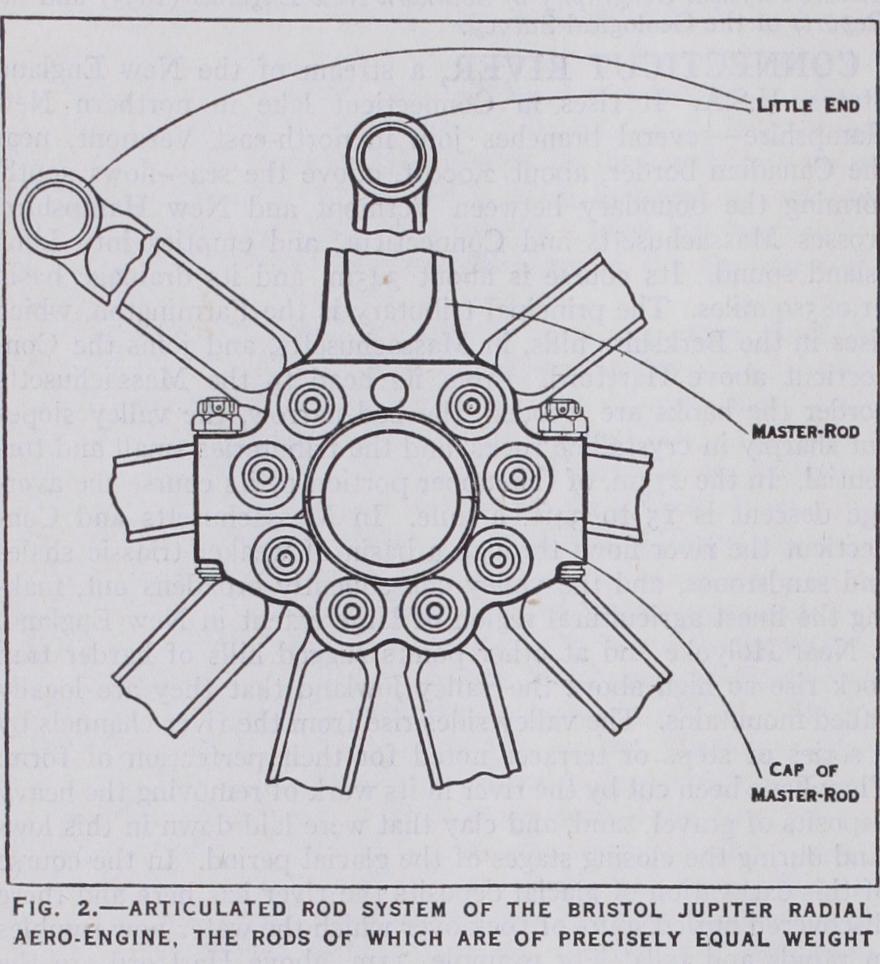
Locomotive connecting-rods are either of rectangular cross section or of girder or H-section, as are also those for car and aero engines. The articulated system, for V-engines and the radial engines, comprises a master-rod, and the other rods pivoted to its big end. This is seen in fig. 2, of a Bristol Jupiter radial outfit, with four articulated rods pivoted to the master rod, and four to its cap. Very light hollow pivot and gudgeon-pins are employed. All the rods are made of similar weights and the whole articulation is carefully hand polished so as to remove tool marks and scratches, which might possibly be the origin of fatigue cracks under the severe duties demanded.