
CONSOLE, in architecture, a corbel (q.v.) or built-in bracket (q.v.) whose height is greater than its projection. Decorative consoles were used by the Greeks and Romans of the classic period to support the projecting cornice over a door, as in the door of the Erectheum (q.v.) at Athens (completed 4o8 B.c.), and the temple of Vesta at Tivoli (early first century). The type of console decoration thus set, consisting of "S" scrolls on the sides, a moulded edge with, occasionally, an applied leaf, was widely used throughout the Renaissance styles (see RENAISSANCE ARCHI TECTURE), not only for door and window cornices, but also as a decoration under window sills and sometimes in cornices or other positions, such as the reversed consoles used as buttresses in the dome of S. Maria della Salute in Venice, begun 1631. It was a favourite form of the baroque period (see BAROQUE ARCHITEC TURE), which treated it with the utmost fantasy.
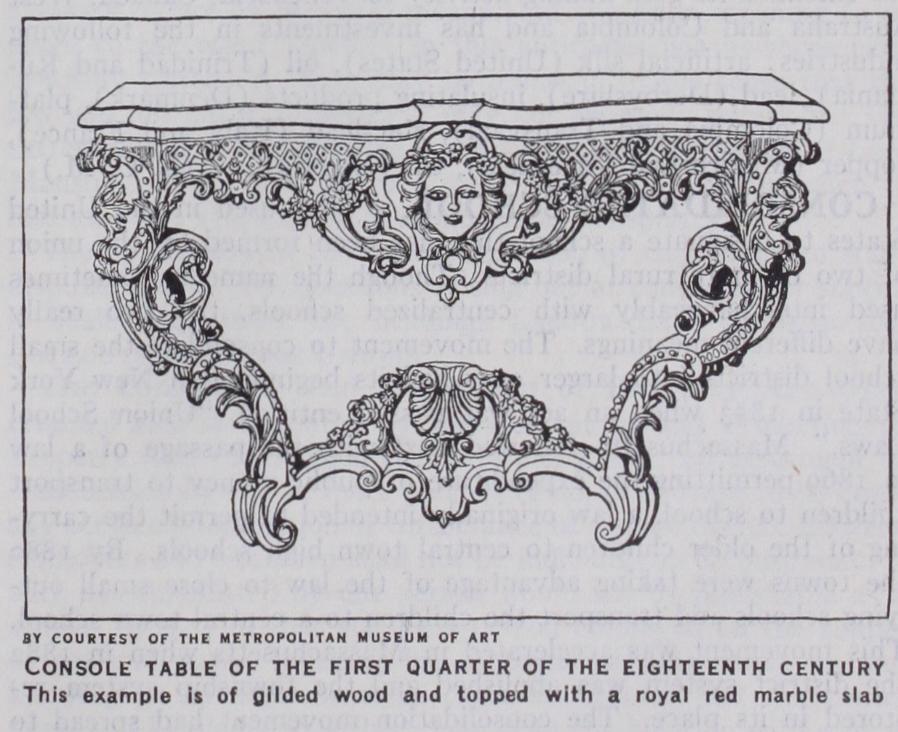
In furniture, the word console, or console table, is used to describe a type of table supported either upon brackets, like consoles, or by legs of similar form, and always designed to be placed against the wall. This type of table was particularly im portant in France from the time of Louis XIV. to the fall of Napoleon. In almost all cases French console tables are richly decorated with carved scrolls, shells, flowers, wreaths and even masks. During the Louis XVI. and empire periods the design is much more restrained. These console tables were frequently of bronze or brass, with marble tops, and when of wood usually gilded or painted, except under the empire, when they were of natural wood with brass mountings. A console mirror is a long narrow mirror designed to occupy the space above a console table.