
CONVOLVULACEAE, a botanical family belonging to the tube-flowered series of the group of Dicotyledons having joined petals. It contains about 5o genera with more than i,000 species, and is found in all parts of the world except the coldest, but is best developed in tropical Asia and tropical America. The most characteristic are twining plants with generally smooth heart shaped leaves and large showy white or purple flowers, as, for instance, the greater bindweed of English hedges, Calystegia sepium, and many species of the genus Ipomoea, the largest of the family including the "convolvulus major" of gardens, and morn ing glory. The creeping or trailing type is common, as in the English bindweed (Convolvulus arvensis), which has also a ten dency to climb, and Calystegia Soldanella, the sea-bindweed, the long creeping stem of which forms a sand-binder on temperate seashores; a widespread and efficient tropical sand-binder is Ipomoea Pes-Caprae. In hot dry districts such as Arabia and north-east tropical Africa, genera have been developed with a low, much-branched, dense, shrubby habit, with small hairy leaves and very small flowers. An exceptional type is represented by a native of Madagascar, which forms a large tree; the dodder (q.v.) is a genus (Cuscuta) of leafless parasites with slender thread-like twining stems. The flowers stand singly in the leaf-axils or form cymose inflorescences; they are sometimes crowded into small heads. The bracts are usually scale-like, but sometimes foliaceous, e.g. Caly stegia, where they are large and envelop the calyx. In North America, much the largest genera are Ipomoea (morning glory), Cuscuta (dodder, love vine) and Convolvulus (bindweed).
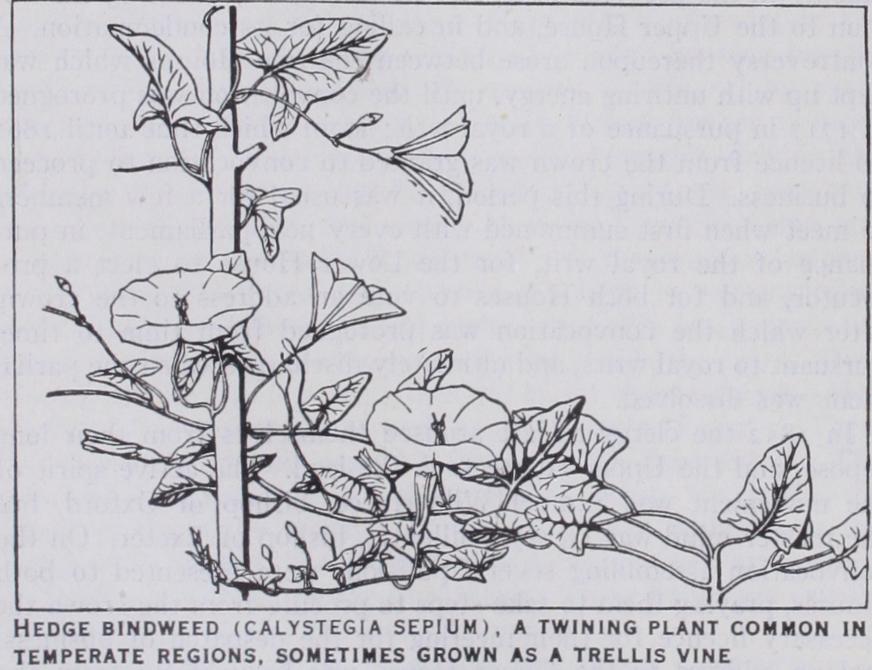
The parts of the flower are in fives in calyx, corolla and stamens with two carpels which unite to form a superior ovary. The se pals, generally free, show much variation in size, shape and cover ing, and afford characters for the distinction of genera. The co rolla is generally funnel-shaped, more rarely bell-shaped or tubular ; the outer face is often marked out in longitudinal areas, five well-defined areas tapering from base to apex, and marked with longitudinal striae corresponding to the middle of the petals and alternating with five non-striated weaker triangular areas. The slender filaments of the stamens vary widely, often in the same flower; the anthers are linear to ovate in shape, attached at the back to the filament and open lengthwise. The ovary is generally two-chambered, with two in verted ovules standing side by side at the inner angle of each chamber. The style is simple or branched, and the stigma linear, capitate or globose. The fruit is usually a capsule opening by valves; the seeds, where four are developed, are each shaped like the quadrant of a sphere; the seed-coat is smooth, warty or hairy; the embryo is large with generally broad cotyledons surrounded by a horny endosperm. Cuscuta has a thread-like spirally twisted embryo with no trace of cotyledons.
The large showy flowers are visited by insects for the honey secreted by a ring-like disk below the ovary; large-flowered species of Ipomoea with narrow tubes are adapted for the visits of birds.
The largest genus, 1 pomoea, has about 40o species distributed throughout the warmer parts of the earth. Convolvulus has about I5o species, mainly in temperate climates. Cuscuta contains nearly species in the warmer and temperate regions; two are British.
The tubers of Ipomoea Batatas are rich in starch and sugar, and, as the "sweet potato," form one of the most widely distributed foods in the warmer parts of the earth. Several species are used medicinally for the strong purging properties of the milky juice they contain; jalap is the product of the tubercles of I. Purga, a native of Mexico. The resinous cathartic scammony is obtained from the roots of Convolvulus Scammonia, native to Asia Minor. Species of Ipomoea (morning glory), Convolvulus and Calystegia are cultivated as ornamental plants. Calystegia lepium and Con volvulus arvensis (bindweed) are pests in fields and gardens and many of the dodders (Cuscuta) cause damage to crops.