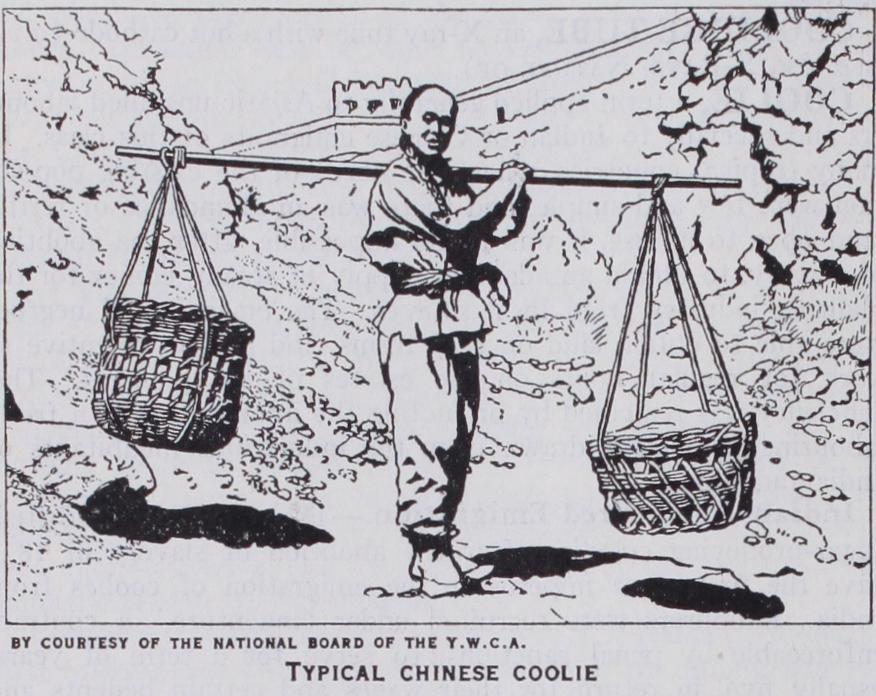
COOLIE, a term applied generally to Asiatic unskilled labour ers and specially to Indian or Chinese emigrants of this class. In many tropical countries, where the needs of the existing popula tion were few and simple, and there was an abundance of fertile land open to its use, it was found impossible, after the abolition of slavery, to obtain an adequate supply of steady labour for the planting industry from local sources. The emancipated negroes were able to obtain land on easy terms, and had no incentive to work for regular hours on the estates of the planters. The deficiency was remedied by promoting the immigration of a fresh labouring population drawn from the industrious inhabitants of India and China.
Indentured Emigration.—The needs of the British sugar-producing colonies after the abolition of slavery in 1834 gave the first great impetus to the emigration of coolies from India. Labourers were recruited under "indenture," a contract enforceable by penal sanctions, to serve for a term of years, usually five, in return for their wages and certain benefits and the cost of their passage. A considerable number of Indians had been introduced into Mauritius, and a few into British Guiana, by 1838 when the recruitment was stopped pending enquiry into abuses. In 1842 indentured emigration to Mauritius was re opened under proper safeguards; in 1844 it was allowed to Jamaica, Trinidad and British Guiana, in 186o to Natal and in 1885 to Fiji. Emigration to certain French colonies was regular ized by a convention of 1861, but was suspended about 189o, and not subsequently renewed. After 1872 emigration was allowed to Surinam under a convention with the Netherlands Govern ment. The system of indentured emigration to distant colonies was strictly regulated by Indian legislation, which was progres sively amended to remedy such abuses as came to light from time to time. The object was three—fold: first, to prevent kidnapping or any kind of coercion or fraud, and to ensure that the recruited labourers properly understood the terms of their contracts before they left India; secondly, to secure their well-being prior to em barkation and during the voyage; thirdly, to insist, as a condition of permitting emigration, on adequate provision being made in the colonies for the equitable treatment of the immigrants.
Colonial Governments made themselves responsible for recruit ment through their agents in India; these agents employed recruiters approved by the Indian Government's protector of
persons recruited were taken before the magistrates, who registered their engagements, and were then conveyed to Calcutta, Madras or Bombay and housed in depots, licensed by the protector, pending embarkation on vessels which were also licensed and required to be equipped in every respect with what was needed to ensure the safety and welfare of the passengers on their long voyage. On arrival in the colony the labourers were distributed among the estates on which they were to work. The employer was responsible for the welfare of his indentured labour force. Under the colonial laws he was bound to provide regular but not excessive work, at fair wages, and to house his labourers and their families. Rations at less than cost price were some times supplied. Medical care and inspection were provided by the employers and the Government. Special officials were ap pointed for the protection of immigrants. The labourer on his side was bound to give regular work, and penalties, of fine or imprisonment, were provided by law for offences such as refusal to work or desertion.
At the expiry of his contract the labourer was free either to re-indenture for a further period or to seek other employment or occupation; he frequently became a peasant proprietor; after a minimum period of residence in the colony he had the option of a free or assisted return passage to India, but many ex-in dentured coolies settled permanently in the colonies, where their descendants form a large and, for the most part, flourishing population. In 1926 the approximate Indian population, mostly of this origin, was 2 7 7,00o in Mauritius, i 2 5,00o in British Guiana, 126,00o in Trinidad, 17,00o in Jamaica, i30,00n in Natal and 68,000 in Fiji. In British East Africa Indian labourers were sup plied under Government auspices for the construction of the Uganda railway, which commenced in 1895 ; they were engaged on three-year contracts with the right of a return passage to India. At one time there were as many as 18,000 Indians thus employed ; but only a few of them remained permanently in the country, and the bulk of the present Indian population in Kenya has a different origin.
The Indian Government neither encouraged nor discouraged indentured emigration but confined itself to the neutral role of an honest broker between two parties to a commercial transaction, the colonial Government and planters on the one side and the Indian labourer on the other; the elaborate regulation of the system was no more than was necessary to avoid risk of the ignorance and weakness of the coolie class being imposed upon or exploited. In 1875 the late Lord Salisbury, as secretary of State for India, suggested that coolie emigration should be actively encouraged with a view to relieving congestion in India and promoting prosperous Indian settlements in the under-populated colonies. The Government of India, however, declined to change their policy, considering that any probable flow of emigration would be negligible in pro portion to the vast population of India, and that its promotion would cause misunderstanding and suspicion and would lay on themselves an embarrassing degree of responsibility for the prosperity of the emigrants and the quality of the labour supplied to the colonies. As time went on, the Government of India's atti tude was affected by two further considerations ; firstly, it was felt in India that her labour supply was not in excess of her growing industrial requirements ; secondly, the treatment of ex indentured Indians in Natal led to acute political difficulty after the colony obtained self-government, and encouragement of In dian settlement in other colonies might sow the seeds of similar trouble. Recruitment for Mauritius ceased in 1911 because the large Indian population rendered further immigration unnecessary. Meanwhile the grievances in Natal were one of several factors which were making the whole system unpopular in India; others were the penal clauses of the colonial labour laws in general, and evils resulting from the small number of women who emi grated; but above all it was felt that indenture attached a stigma of inferiority to the Indian race, and that the diffusion of coolies spread abroad a false estimation of India's cultural development by giving the impression that she was merely a reservoir of unskilled labour; the term "coolie," for example, had come to be mistakenly used in the West Indies as synonymous with "Indian," and in South Africa with "Hindu." In 191 o, Gokhale, in the Indian legislative council proposed that further indentured emi gration to Natal should be forbidden, and this was done in the following year; in 1912 he urged that all recruitment under inden ture should be abolished. During the war the system was sus pended and the Government of India proposed its final aboli tion; the British Government agreed, and the decision not to revive it was announced in 1917. The conventions with the Netherlands and France were formally terminated in 1919 and 1921. In the colonies outstanding indentures have come to an end either through cancellation, as in Fiji and British Guiana (192o) and Mauritius (1923), or through time expiry, save in a few cases of labourers who have entered into successive re-in dentures.
After the abolition of indentured recruitment the way was open for the consideration of other methods of attracting labour to the colonies with a view to eventual settlement of the labourers as colonists. Memories of the indentured system, however, made unpopular any scheme based solely on the labour requirements of distant countries. The Government of India's policy in regard to all forms of labour emigration has been embodied in the Indian Emigration act, 1922. No restrictions are placed on unassisted emigration, but the act applies to persons who receive financial assistance to leave India for the purpose of working for hire or engaging in agriculture; the assisted emigration of skilled workers may be permitted under adequate safeguards, but that of unskilled workers, includ ing agriculturists, is prohibited except to such countries and on such conditions as may be specified by the Government of India with the concurrence of the Indian legislature; any scheme of assisted emigration would be examined by these authorities in respect of the conditions of work and wages offered, medical and educational facilities, the cost of living, the terms of repatriation and the provisions of the labour laws in the country of emigra tion, as well as the political status of Indian immigrants and their opportunities for economic and social advancement. The act provides minutely for the protection of assisted emigrants against abuses in recruitment and hardships in transit, and for securing that a due proportion of women accompany their male relatives. Under the act emigration to Mauritius was again permitted for one year in 1923, but was then discontinued as enquiry showed that the Indian population in the colony had reached saturation point. An attractive scheme for the settlement of a small num ber of families as colonists in British Guiana was approved in 1926 but lapsed owing to the difficulty of financing it.
Indian Non-contract Labour in Ceylon and Malaya.— There is a large movement of Indian labour from the Madras Presidency to Ceylon and Malaya, especially for work on the tea and rubber estates. The estimated Indian estate population in Ceylon was over 700,00o in 1926. The total Indian population of Malaya was about 470,00o in 1921, of which more than half was on the estates, and is rapidly increasing, the estimate for 1926 being 66o,000. In Malaya prior to 1910 there was a certain number of indentured immigrants ; otherwise emigration to these neighbouring countries, which has taken place from an early date, has been a natural and largely a spontaneous process. Recruit ment is effected through kanganies (labour headmen), originally the senior members of emigrant families, who return home and persuade other relatives and friends to join them, financing the transaction with funds supplied by their employers. Recruitment for Ceylon was supervised by a labour commission set up by the planters in 1904; that for Malaya is financed by an Indian immi gration fund established in 1907, which is officially managed and is maintained by a levy on employers. But this emigration was not regulated by the Indian Government till 19 2 2 ; absence of long-term contracts, ease of communication with India and the patriarchal organization of the labour force made the system immune from the abuses to which emigration under indenture was liable, though it had defects of its own in Ceylon, such as the initial indebtedness of the coolie to his kangani, from which the former might never escape, and the consequent power possessed by the latter, in times of labour shortage, to barter the transfer of his gang from one estate to another in consideration of receiving advances which he pocketed himself.
This assisted emigration became subject to regulation by the act of 1922. It was temporarily allowed to continue, and in 1923 was definitely legalized under certain rules and conditions; the Governments of Ceylon and Malaya each appoint an emigration commissioner in India who is responsible for the organization of recruitment; the kanganies are licensed by the colonial authori ties; each recruit must be examined by his village headman, in the presence of the kangani, to ascertain that he understands the conditions attaching to his emigration and that his family agrees to his departure; engagements are limited to one month's duration; the Government of India has its agents in Ceylon and Malaya to assist and advise Indian residents; free repatriation is granted within one year of an immigrant's arrival when consid ered desirable by the agent; in the case of Ceylon it is provided that no payment made by a kangani to enable a coolie to liquidate his debts in India before emigrating shall be recoverable. Besides agreeing to these conditions the colonial Governments abolished penalties for labour offences and made a number of amendments in their labour laws, affecting Indians; a minimum age has been prescribed for the employment of children on estates, and machinery has been set up for fixing standard wages sufficient to maintain a labourer and his family comfortably, and provide a margin for savings for sickness and old age. Emigrants to Ma laya are accompanied on the voyage (of five to ten days' dura tion) by travelling inspectors appointed by the colonial authorities.
Assam.—In the Assam tea gardens there is a large immigrant population drawn from other parts of India to make up the deficiency of the local labour supply; in the year ending June, 1927, the number of new immigrants was over 45,000; recruit ment under careful official safeguards is carried on by sardars (labour headmen) who have themselves worked in the gardens; previously the labourers often entered into contracts which could be enforced by penal sanctions under the Assam Labour and Emigration act, or the Indian Workmen's Breach of Contract act ; but more recently the penal provisions of the former act have been withdrawn, and the latter was repealed in 1925.
Indentured emigration from China commenced about 1845. It was nominally prohibited before 1859, but owing to the weakness and corruption of the Chinese officials the prohibition was not effective; at the same time the refusal of legal recognition made it impossible to regu late recruitment and it was accompanied by all kinds of abuses. European firms employing Chinese recruiters were engaged in the traffic. Many coolies were actually kidnapped or decoyed; the ships were badly equipped and overcrowded, and many died on the voyage. Their principal destinations were Cuba and Peru; on arrival the contracts, which ran for seven or eight years, were sold by auction, and the coolies frequently found themselves in a position virtually little better than slavery, owing to the ab sence or non-enforcement of laws for their protection. So far as British ships were concerned, the traffic was checked by the Chinese Passengers act, 1855; under this the certificate of an emigration officer was required for all vessels clearing from Hong kong, or British vessels clearing from Chinese ports, which carried more than 20 passengers on a voyage of more than seven days, and the certificate was to be withheld unless the coolies un derstood the terms of their contracts, and the vessel satisfied minimum requirements as to space and provisions.
In 1859 the British Government obtained the co-operation of the Chinese authorities at Canton in establishing a legal and regulated system of emigration to the British West Indies on five-year contracts; the system was applied also to emigration to the territories of other powers. In the following year the Imperial Chinese Government by the Anglo-Chinese convention of 186o formally sanctioned contract emigration to British ter ritory under regulation. Similar conventions were concluded by other powers. Henceforward it became possible to control re cruitment. The system adopted in 1859 continued in force till 1866, when British, French and Chinese representatives signed a convention which provided for the grant of a free return passage to the coolies at the expiry of their five-year contracts. This con vention was not ratified by Great Britain and France, but the Chinese Government refused to continue countenancing emigra tion on other terms; the trade at Chinese ports was thus diverted to the Portuguese settlement of Macao, where its abuses had largely continued unchecked.
In Hongkong the law was strengthened in 1868, 187o and 1873, and contract emigration to places outside the British empire was prohibited. In 1874 Macao was closed to the traffic, and, after an enquiry into the treatment of the coolies in Cuba, the Chinese Government was more than ever averse to allowing it through the treaty ports. Throughout this period the Chinese emigrants to the British West Indies went chiefly to British Guiana; about 14,000 landed there between 1853 and 1879, and a few more in the course of the next generation, but the majority subsequently re-emigrated, and the Chinese population in, 1921 was only about 2,000. Indentured emigration to British territory was legalized afresh by the Anglo-Chinese convention of 1904 in order to enable Chinese to emigrate under three-year con tracts for unskilled work in the Transvaal gold mines (see TRANSVAAL). More recently Chinese contract labourers were introduced by the Germans into Western Samoa. In 192o the New Zealand Government adopted similar arrangements for the territory, but in 1923 they abolished the indenture system and replaced it by one of free labour.
From early times there has been a large spontaneous immigration of Chinese into Malaya. In the 9th century it was supplemented by assisted immigration or ganized on a "credit-ticket" system; passages were paid by Chi nese agents who recouped themselves from the immigrants or their prospective employers. From 1877 onwards this system was brought under strict regulation by the British Government with a view to preventing abuse and ensuring that immigration was voluntary; a protector of Chinese was appointed and regis tration of contracts was compulsory. In 1914 (1916 in the state of Kelantan) the system was abolished and immigrants could no longer be compelled to enter into any particular employment as security for repayment of passage money or any advance. The labour codes make special provision for the protection of Chinese. The law provides for the proper equipment of coolie ships and the comfortable accommodation of their passengers. Vessels carrying more than 20 immigrants must have a qualified medical practitioner on board. Specially appointed protectors examine the coolies on arrival, particularly in regard to the existence of any engagements to undertake labour or repay debts; their financial liability is limited to sums fixed by the protectors; immigrants under 16, or over 45, years of age, or physically unfit, and any who have been induced to travel by fraud or mis representation may be repatriated at the expense of their cred itors; any indebted immigrant who has obtained assistance by promising to enter into a labour contract may also be repatriated at his creditor's expense, or released from his obligation, at the discretion of the protector. Penalties for labour offences have been abolished, and, apart from the special protection of Chi nese, the laws in their general application provide amply for the well-being of labourers and their dependants on the estates, for housing, water supply, sanitation, medical treatment, hospital accommodation, maternity benefits, nurseries for infants and education of children. The popularity of work in Malaya is shown by the increase in the Chinese population of the Straits Settlements and Federated Malay States from 583,000 in I go to gg3,000 in 192i. The total Chinese population in the whole of Malaya was about 1,174,000 in 1921, of whom 257,000 were born in the country; it includes many independent agricultur ists, merchants and mine-owners, as well as labourers in the tin mines and on the estates.
of the Committee on Emigration from India Bibliography.-Report of the Committee on Emigration from India to the Crown Colonies and Protectorates (Cd. 5192, two) ; C. Clem enti, The Chinese in British Guiana (1915) ; P. C. Campbell, Chinese Coolie Emigration to Countries within the British Empire (1023); "Emigrant," "Indian Emigration," India of to-day, vol. v. (1024).
(J. C. W.)
