
COPENHAGEN, the capital of Denmark (Danish Kj¢ben havn), on the east coast of the island of Zealand (Sjaelland) at the southern end of the Sound, in 5 5 ° N., 1 2 ° 35' E. Pop. (193o) 617,069; including Frederiksborg and Gentofte, 771,168. The nucleus of the city is built on low-lying ground between the sea and a series of small freshwater lakes, known as St. Jor gens SO, Peblings S¢ and Sortedams So, a southern portion oc cupying the northern part of the island of Amager. An excellent harbour is furnished by the natural channel between the two islands; and communication from one division to the other is afforded by two bridges—the Langebro and the Knippelsbro,which replaced the wooden drawbridge built by Christian IV. in 162o. The fertile island of Amager produces vegetables for the capital; it was peopled by a Dutch colony planted in 1516, and many peculiarities of dress and language are retained. The older city, including both the Zealand and Amager portions, was formerly surrounded by ramparts and moats ; but boulevards and gardens now occupy the landward site of fortifications. Outside the lines of the original city (about 5 m. in circuit), there are extensive suburbs, especially on the Zealand side (Osterbro, N¢rrebro and Vesterbro or Ostersogade, etc.) and Frederiksborg and Amagerbro to the south of Christianshavn.
Copenhagen (i.e., Merchant's Harbour, originally simply Havn, Latinized as Hafnia), first mentioned in Io43, remained a mere fishing village until the 12th century, when Valdemar I. presented that part of the island to Axel Hvide, renowned in Danish history as Absalon (q.v.) bishop of Roskilde, and afterwards archbishop of Lund. In 1167 he erected a castle on the spot where the Christiansborg palace now stands, and the building was called after him Axel-huus. The settlement gradually became a great resort for merchants, and thus acquired the name of Kaupmannahofnor Kjobmannshavn corrupted to Kj¢benhavn. In 1186, Bishop Ab salon bestowed the castle and village, with the lands of Amager, on the see of Roskilde ; but the Danish kings became anxious to regain it, and in 1245 King Eric IV. drove out Bishop Niels Stigson. On the king's death (125o), however, Bishop Jacob Er landsen obtained the town, and, in 1 2 S4, gave to the burghers their first municipal privileges, confirmed by Pope Urban III. in 1286. Trade or craft gilds were expressly prohibited in the later charter of Bishop Johann Kvag (1294) ; and the distinctive character of the constitution of mediaeval Copenhagen consisted in the absence of the free gild system, and the right of any burgher to pursue a craft under licence from the Vogt (advocatus) of the overlord. Later on, though gilds were established they were strictly sub ordinate to the town authorities. Copenhagen was attacked by Lubeck in 1248, and by Prince Jaromir of Rugen in 1259. In i3o6 it repelled the Norwegians, but in 1362, and again in 1368, it was captured by the opponents of Valdemar Atterdag. In the following century a new enemy appeared in the Hanseatic league, which was jealous of its rivalry, but their invasion was frustrated by Queen Philippa. Various attempts were made to obtain the town from the see of Roskilde, as the most suitable for the royal residence; but it was not till 1443 that Copenhagen became the capital of the kingdom. From 1523 to 1524 it held out for Chris tian II. against Frederick I., who captured it at length and strengthened its defensive works ; and it was only after a year's siege that it yielded in 1536 to Christian III. From 1658 to 166o it resisted Charles Gustavus of Sweden, and was rewarded by various privileges for its defence. In 166o it gave its name to the treaty which concluded the Swedish war of Frederick III. In I 700 it was bombarded by the united fleets of England, Holland and Sweden. In 18oI the Danish fleet was destroyed in the roadstead by the English and in 1807 the city was bombarded by the British when the university buildings and its principal church were destroyed.
The area occupied by the inner city is known as Gammelsholm (old island). The main artery is the Gothersgade, running from Kongens Nytory to the western boulevards, and separating a district of rectangular blocks to the north from one of irregular, narrow streets to the south. The Kongens Nytorv, the focus of the life of the city and the centre of road communications, is an irregular open space at the head of a narrow arm of the harbour (Nyhavn). The Palace of Charlottenborg (1672) on the east side, takes its name from Charlotte, the wife of Christian V., and was granted by Frederick V. to the Academy of Arts, which holds its annual exhibition of paintings and sculpture in the adjacent Kunstudstilling (1883) . On the south is the Royal theatre. Other buildings in Kongens Nytory are the Foreign Office, several great commercial houses, the commercial bank and the Thotts Palais of c. 1685. The quays of the Nyhavn are lined with old gabled houses.
From the south end of Kongens Nytorv, a street called Holmens Kanal winds past the National Bank to the Holmens Kirke, or church for the royal navy, originally erected as an anchor-smithy by Frederick II., but consecrated by Christian IV., with a chapel containing the tombs of the great admirals Niels Juel and Peder Tordenskjold, the wood-carving of the 17th century. The street then crosses a bridge on to the Slottsholm, an island divided from the mainland by a narrow arm of the harbour, occupied mainly by the Christiansborg, originally built (1731-1745) by Christian VI. Twice destroyed by fire, in 1794 and 1884, the royal palace was rebuilt after 1903 for use on occasions of state. Since 1918 it has been occupied by parliament, the supreme court and the foreign office. The Thorvaldsen bronze statues which stood over the portal of the palace before the fire, and the palace chapel, adorned with works by Thorvaldsen and Bissen, were saved from the fire.
The exchange (BOrsen ), on the quay to the east, is an ornate gabled building erected in 1619-164o, surmounted by a remark able spire. To the south is the arsenal (T¢jhus) with a collection of ancient armour. The Thorvaldsen museum (1839-1848) has an open court, containing the artist's tomb. Most of the original works of the famous sculptor are housed here.
On the mainland, immediately west of the Slottsholm, is the Prinsens Palais, once the residence of Christian V. and Frederick VI. when crown princes, containing the national museum. This consists of six sections, the prehistoric collections, the Danish historical and Folk museums, the ethnographical and the numis matic collections and the collection of classical antiquities. It was founded in 1807 by Professor Nyerup, and extended between 1815 and 1885 by C. J. Thomsen and J. J. A. Worsaae. The pre historic Danish finds, in particular those of the Bronze Age, con stitute one of the most remarkable collections in existence. From this point the Raadhusgade leads north-west to the combined Nytorv-og-Gammeltorv, where is the old town hall (Raadhus, 1815), and continues as the Norregade, to the Vor Frue Kirke (Church of Our Lady), the cathedral church of Copenhagen. This church, on a 12th century site, was almost completely rebuilt after the bombardment of 1807. The facade is surmounted by a group of 16 figures, one of Thorvaldsen's masterpieces, representing John the Baptist preaching.
Immediately north of Vor Frue Kirke is the university, the only university in Denmark, founded by Christian I. in 1479, though its existing constitution dates from 1788. The building dates from 1836. There are over 4,00o students. In connection with the university are the observatory, the surgical academy in Bredgade, founded in 1786, and the botanic garden. The uni versity library, incorporated in 1867 with the Classen library, collected by the famous merchants of that name, contains about 430,000 volumes, besides some i8o,000 theses. Rask's famous Persian manuscripts and the Arnamagnaean collection of old Norse-Icelandic documents are housed here. It shares with the royal library the right of receiving a copy of every book published in Denmark. Adjacent is St. Peter's church, built in a quasi-Gothic style, with a spire 256 ft. high, and appropriated since 1585 as a parish church for the German residents in the city. A short dis tance along the Krystalgade is Trinity church. Its round tower (III ft.), considered to be unique in Europe, was formerly used as an observatory. It is ascended by a broad inclined spiral way, up which Peter the Great is said to have driven in a carriage and four. The HOibro-plads has an equestrian statue of Bishop Absa lon. The quarter north-east of Kongens Nytorv and Gothersgaden extending to the strong moated citadel (1662-63) which guards the harbour on the north-east, includes the palaces of Amalienborg, the castle and gardens of Rosenborg, etc. The Frederikskirke or Marble church was begun in the reign of Frederick V. (1749), but was left unfinished, until 1874, when it was purchased by a wealthy banker, M. Tietgen, who added the conspicuous dome. The four palaces, of uniform design, encircling the neighbouring Amalien borg-plads, became, on the destruction of Christiansborg in 1794, the residence of the king and court till 1848. One of the four is inhabited by the king, the second and third by the crown prince and other members of the royal family, while the fourth is occu pied by the coronation and state rooms.
South-west from the citadel extends a line of gardens on the site of former landward fortifications, skirted on the inner side by three wide boulevards, Ostervold, Norrevold and Vestervold Gade. The botanical gardens (1874) contains an observatory with a statue of Tycho Brahe. On the inner side of Ostervold Gade is Rosenborg Park, with the palace of Rosenborg (16o8-1617), an irregular building in Gothic style, with a high pointed roof, flanked by four unequal towers. It contains a museum, including fine collections of Venetian glass and oriental tapestry, the famous silver drinking-horn of Oldenburg (1474) and the crown jewels. Noteworthy among modern buildings is the Renaissance town hall (19oi) with a tower at the eastern angle. Here is also the museum of industrial art, and the Ny-Carlsberg Glyptotek, with its collec tion of sculpture, is on this boulevard, which skirts the Tivoli pleasure garden.
The western (residential) quarter contains the park of Fred eriksborg, with its palace erected under Frederick IV. (d. 173o) used as a military school. The park contains a zoological garden and is continued south in the Sondermarken. The quarter of Christianshavn skirts the harbour to the south, and lies within the fortifications. It contains the Vor Frelsers Kirke (Church of Our Saviour) dedicated in 1696, with a curious steeple 282 ft. high.
The railway along the coast northward passes the seaside resorts of Klampenborg (6 m.) and Skodsborg (1 o m.). Near Klampen borg is the Dyrehave (Deer park) or Skoven (the forest), a beautiful forest of beeches. The Zealand Northern railway passes Lyngby, on the lake of the same name, and Hillerod (21 m.), a considerable town close to the palace of Frederiksborg, erected in 1602-162o by Christian IV., embodying two towers of an earlier building, and partly occupying islands in a small lake. It was restored as a national historical museum after a fire in 1859. The palace church is an interesting medley of Gothic and Renais sance detail.
The city is the centre of several important learned societies including the Royal Danish Academy of Sciences and Letters, founded in '742, for the advancement of mathematics, astronomY, natural philosophy, etc., by the publication of scientific works, and by the endowment of research; and the Royal Antiquarian Society (1825) for diffusing a knowledge of Northern and Icelandic archaeology. The Academy of Arts was founded by Frederick V. in 1754. The Carlsberg foundation, established in 1876 by Cap tain J. C. Jacobsen, promotes research and publication and sup ports the Frederiksborg museum. Among educational institutions, other than the university, may be mentioned the veterinary and agricultural college, established in 1773 and adopted by the state in 1776. Technical instruction is provided by the technologicat institute (19o8), which had about 5,000 students in 1926. A high school of commerce was founded in Copenhagen in 1924.
Churches other than Lutheran include the Reformed church, founded in 1688, and rebuilt in 1731, the Catholic church of St. Ansgarius, consecrated in 1842, and the Jewish synagogue in Krystalgade, which dates from 1853. Of the monastic buildings of mediaeval Copenhagen traces are preserved in the present nomen clature of the streets. The Franciscan establishment gives its name to the Graabrodretorv or Grey Friars' market ; and St. Clara's Monastery, the largest of all, which was founded by Queen Chris tina, is still commemorated by the Klareboder or Clara buildings, near the present postoffice. The Duebrodre Kloster occupied the site of the hospital of the Holy Ghost.
Copenhagen is by far the most important commercial town in Denmark. Most of the foreign trade passes through the capital, while its transit trade is considerable. It is further the head quarters of nearly all the steamship and motorship owners of Denmark. The harbour is mainly comprised in the narrow strait between the outer Sound and its inlet the Kalvebod or Kallebo Strand. The trading capabilities were aided by the construction in 1894 of the Frihavn (free port) at the northern extremity of the town, well supplied with warehouses by the joint stock company under which it is worked. The area of the free port is 92 acres; of the customs port, 940 acres. Within the limits of the piers the harbour has total water area of 4,38o acres. The free port has contributed largely towards the position of Denmark as an em porium of Baltic trade. Ships numbering 15,3oo, totalling 5,000, 000 net register tonnage, arrived at Copenhagen in 1926. Den mark's neutrality in the war of 1914-18 brought about a great increase of trade and general prosperity. Since 1917, however, unemployment has been serious in the capital. Copenhagen is not an industrial town; the manufactures carried on are those typical of a large town. Special mention should be made, however, of metal working (ship and machine construction) and of the Royal Copenhagen Porcelain Manufactory, which employs about i,000 hands and is celebrated for models of Thorvaldsen's works in biscuit china. Several industrial plants have been established within the area of the free port for the purpose of working up imported materials duty free.
See O. Nielsen, KObenhavns Historie og Beskrivelse (Copenhagen, 1877-1892); C. Bruun and P. Munch, KObenhavn, Skrildring of dets Historie, etc. (ibid. 1887-19o1) ; Bering-Liisberg, KObenhavn i gamle Dage (ibid. 1898, seq.). (X.) The Battle of Copenhagen.—The sending of a British Fleet to the Baltic Sea in 18oi was the outcome of the formation of an Armed Neutrality, consisting of Russia, Prussia, Denmark and Sweden, backed by France, to resist the British claim to right of search. The fleet included eighteen ships of the line, and was commanded by Sir Hyde Parker who was fortunate enough to have Nelson as his Second-in-Command. The naval forces at the disposal of the Neutrality Powers were, on paper, consider able, but they were scattered in various ports, and no apparent effort was made to concentrate them. Indeed, many of the Russian ships were frozen in at Reval.
The British force was at the entrance to the Sound on March 2ist. Here they heard that Denmark refused to come to any agreement and was putting Copenhagen into a state of defence. Nelson was in favour of immediately tackling Russia, which he rightly regarded as leader of the Armed Neutrality, but Parker declined to do this until Copenhagen had been reduced; neither would he approach that city by way of the Great Belt which would have enabled them to attack it from the South and also have cut off Denmark from Russian help. After long delay the fleet entered the Sound where they were at once engaged by the guns of Kron borg Castle. The Danish shot, however, fell short and the Swedes made no effort to second their attempts. Thus the British passed through successfully and in the afternoon of March 3oth brought up under the lee of Hven Island, whence they began reconnoitring the approaches to Copenhagen.
Copenhagen lies on the islands of Zealand and Amag; the channel between them forms the harbour which was protected by the guns of the citadel, of the Trekroner forts situated on islands at the harbour mouth, and by several large ships placed at the entrance. The remainder of the Danish ships, eighteen in number and of various types, were anchored along the sea-front of Amag Island, in a line stretching south from the Trekroner forts. They were on the edge of the shoals in front of the island and thus their position could not be turned, and it appeared to the Danes that any enemy attacking from the North—the situation of the British Fleet—must pass the Trekroner to reach the line of battle. Parker thought likewise, but Nelson's unerring eye had already discovered the weakness in the Danish position. East of Amag lies the Island of Saltholm ; between them are two navigable passages, bisected by a shoal—the Middle Ground. Along the westernmost edge of the Western Passage—the King's Deep—lay the Danish Fleet. On the other side of the Middle Ground lay the other passage—the Outer Deep. Nelson saw that, could he find that passage, he would be able to round the Middle Ground and approach the Danish force from the South, unhampered by the Trekroner. He offered to make the attempt with half the fleet. Parker, accepting, gave him ten sail of the line, two fifties and all the smaller vessels.
Throughout the night of March 3 i st–April i st soundings were taken, and in the morning of April r st the whole fleet proceeded to the Northern end of the Middle Ground and from there Nelson's squadron successfully navigated the Outer Deep. During the night the wind, to Nelson's delight, changed to South and in the morning the signal was made to weather the shoal into the King's Deep. Nelson had ordered that his leading ship should anchor opposite the fifth Danish vessel and that each successive ship, passing on the disengaged side of those already at grips, should take her place ahead. The leading Danish vessels he hoped to destroy by the continuous fire of the English as they passed in succession. The "Agamemnon" failed to weather the shoal, and the "Bellona" and "Russell" went ashore in the King's Deep. This seriously depleted Nelson's force and compelled him to engage the Trekroner with only the light craft. The remainder were soon engaged in a stubbornly-contested action. At one o'clock Parker signalled to Nelson to withdraw, but the latter, putting his telescope to his blind eye, declined to obey. Anyhow with drawal by the way they had come was impossible and by the Trekroner risky. An hour later the Danish fire slackened and Nelson tried to take possession of such Danish vessels as had struck, but the Danes, contrary to the usage of war, fired upon him as he did so. They agreed, however, to an armistice. Nelson collected his prizes and withdrew.
All but three of the Danish ships had been taken or sunk.
Denmark eventually agreed to abandon the Neutrality for four teen weeks, but the death of the Czar before Nelson reached Rus sia, and a consequent change in Russian policy, brought about its complete collapse.
See R. Southey, Life of Nelson, edited by G. A. R. Callender (r gs s ) (Bibl.). (G. A. R. C.; J. G. B.) COPEPODA, one of the sub classes of the Crustacea (q.v.), the members of for the most part of microscopic size, are abundant in the sea and in fresh waters. They form one of the most important constituents of the plankton and it would be difficult to find a sample taken with the tow-net in any part of the world which would not contain some representatives of the group. The bottom-living species, which have been less studied, are not so numerous as individuals but probably much more numerous as species than the pelagic forms. A large number are parasitic on other aquatic animals of all classes and these exhibit a wide range of modifications in structure and life-history.
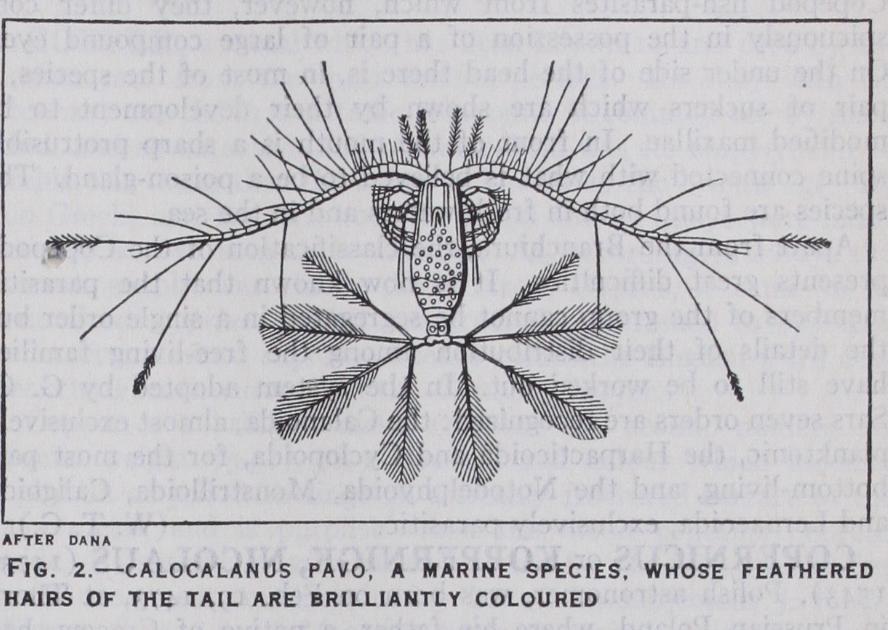
The typical free-swimming Copepoda have usually a some what pear-shaped body, divided into somites and narrowing behind to end in a "caudal fork." There is no distinct carapace, although one or two of the body-somites are coalesced with the head. There are four or five pairs of two-branched, oar-like, swimming feet. The unbranched antennules are generally large and many jointed, the antennae smaller, sometimes two-branched, and both are used in swimming. The mandibles are often of very primi tive structure, the biramous palp retaining the form, and to some extent the function of a two-branched swimming foot. The un paired or "nauplius" eye is usually present but the paired eyes are not developed in the typical Copepoda. The eggs are usually carried by the female, cemented together in a pair of masses attached to the genital openings. The young are hatched, as a rule, in the nauplius stage and attain the adult form by the suc cessive addition of somites and appendages without any very sudden change. The antennules, antennae and mandibles may re tain in the adult, more nearly than they do in any other Crus tacea, the form they have in the nauplius stage.
Theparasitic habit has been ac quired in the evolution of many unrelated families of Copepoda and the modifications of structure and of life-history to which it has led are correspondingly diversi fied. In some parasites the power of swimming has been retained and the general form does not differ greatly from that of free living species, the mouth-parts only becoming modified for suck ing the juices of the host. In many other cases the male re mains free-swimming and little modified while the adult female has a vermiform or distorted body and loses most of the ap pendages. In others again the minute and degenerate male is attached, like a secondary para site, to the body of the much larger female. In all cases, prob ably, the earliest stages are free swimming while the adults may be sedentary parasites. In some, however, the life-history is more complicated. In the Monstrillidae, the adults, after a temporary parasitic phase, regain their appendages and again become free swimming. In the Lernaeidae there are in the female two para sitic phases passed on two different species of fishes, with a temporary free-swimming phase intervening.
Many of the parasitic Copepoda are much larger than any of the free-living species. The largest are species of Pennella which are parasitic on whales, and sometimes exceed a foot in length.
A small group of Crustacea parasitic on fish, the Branchiura or carp lice, are usually classed with the Copepoda although it is doubtful whether they have any close affinity with them. They have a broad, flat, oval body, somewhat resembling that of some Copepod fish-parasites from which, however, they differ con spicuously in the possession of a pair of large compound eyes. On the under side of the head there is, in most of the species, a pair of suckers which are shown by their development to be modified maxillae. In front of the mouth is a sharp protrusible spine connected with what is believed to be a poison-gland. The species are found both in fresh waters and in the sea.
Apart from the Branchiura, the classification of the Cop*poda presents great difficulties. It is now known that the parasitic members of the group cannot be segregated in a single order but the details of their distribution among the free-living families have still to be worked out. In the system adopted by G. 0. Sars seven orders are recognized : the Calanoida, almost exclusively planktonic, the Harpacticoida and Cyclopoida, for the most part bottom-living, and the Notodelphyoida, Monstrilloida, Caligoida and Lernaeoida, exclusively parasitic. (W. T. C.)