
COR ANGLAIS, or ENGLISH HORN, a wood-wind double reed instrument of the oboe family, of which it is the tenor. It is not a horn, but bears the same relation to the oboe as the basset horn does to the clarinet. The cor anglais differs slightly in construction from the oboe ; the conical bore of the wooden tube is wider and slightly longer, and there is a large globular bell and a curved metal crook to which the double reed mouthpiece is attached. The fingering and method of producing the sound are, however, so similar in both instruments that the player of the one can, in a short time, master the other. The quality of the cor anglais is penetrating like that of the oboe, but mellower and more melancholy. The cor anglais is the alto Pommer (q.v.) or haute-contre de hautbois (see OBOE), gradually developed, im proved, and provided with key-work.
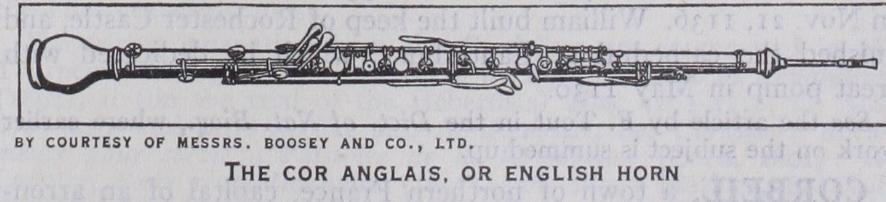
The origin of the name of the instrument is a matter of con jecture. Two theories exist—one that cor anglais is a corruption of cor angle, a name given on account of the angular bend of the early specimens. The other is that when the instrument was given a bend in order to facilitate its handling, the name was adopted to mark its resemblance to a kind of hunting-horn said to be in use in England at the time. But this suggestion does not seem to be a happy one in default of record of any kind of horn of the sort implied.