
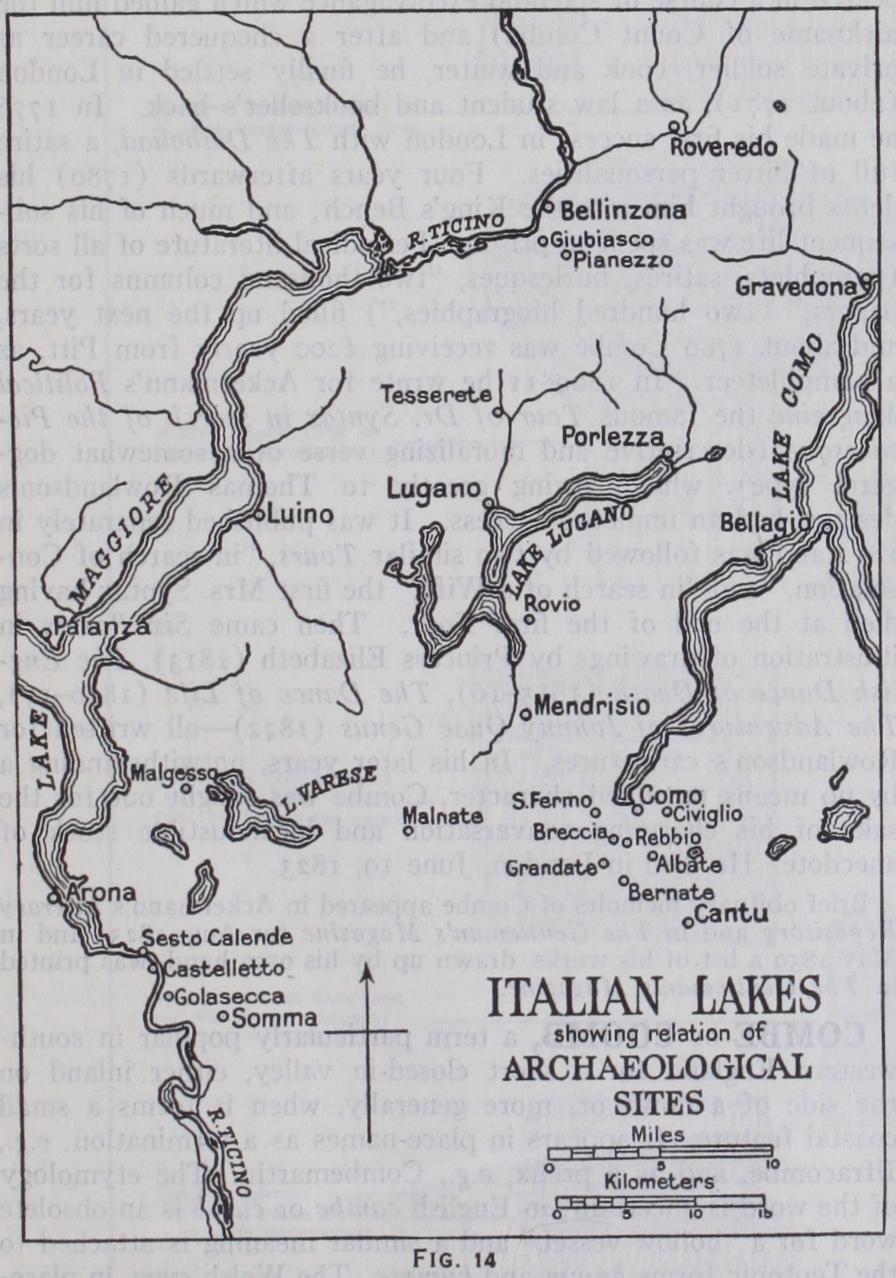
COMACINES, THE, may be defined as the people who lived in the Iron Age all round the lake of Como, and on the adjoining lakes of Lugano and Varese. They are close relatives of the Golasecca tribes near Lago Maggiore but show some points of difference from them (see GOLASECCA). The records for the Como region begin much earlier than for the Somma plateau on the Ticino. At Malgesso near Varese, and at Albate, Moncucco, San Fermo and Villa Nessi, four sites clustered at the south end of the Lago di Como, have been found objects which, though few, yet demonstrate that there were settlements here at the very opening of the Iron Age, made by a branch of those cremating peoples who came over the Venetian Alps in successive waves between 1200 and l000 B.C., and who must be judged on this evidence to have found their way into Lombardy as early as into any other region. Their march westwards was probably by way of the Val di Sole and the Valtellina. They buried, like the Villa novans and all the other cremating invaders, in pottery jars, which contained the ashes of the deceased and a few small objects or personal ornaments. Weapons and larger objects might be placed adjoining the jar, which was often enclosed in a shelter of rough slabs as shown in the annexed figure. The archaeology of the Iron Age in the region of Como and Varese falls into three well defined periods. From the 12th century to about 75o B.C. is the Early period, contemporary with the two Benacci stages of Bolo gna. The Middle period is the correlative of the Arnoaldi period of Bologna, equivalent to the Golasecca civilization of 75o to Soo B.C. ; and the Late period runs from Soo B.C. down to the Ga,ulish invasions of the 4th century. A fair amount of material repre sentative of all this time has been discovered and chronicled by local archaeologists, whose records have been published for the last 5o years in the Rivista archeologica della provincia di Como. So far as the objects have been collected in any one place they may be seen in the municipal museum of the town of Como.
In the Early period, represented by the cemeteries of Mon cucco, Villa Nessi and San Fermo, very archaic fibulae have been found which can hardly be later than the 12th century B.C., of types familiar in other parts of Italy at Pianello, Timmari and Bismantova. A certain number of the Comacines had thus ar rived at their new homes simultaneously with the establishment of the earliest Villanovans in Etruria and Latium. The ossuary employed for burial was, however, not the Villanovan urn but a pottery situla or spherical olla, as seen in Nos. 3-5 of the plate. All the pottery of this stage is of the rough hand-made style seen in these examples, often incised with bands and chevrons formed by rows of dots. Apart from pottery, the most important objects of the Early period are the weapons, particularly the bronze swords. All belong to types which must have been imported from north of the Alps. There was one instance of the antennae handled sword, well known as a transalpine product, which occurs on a number of different sites in north Italy as well as in Etruria. More remarkable than this, however, are the examples figured as Nos. 1 and 2 in the plate, which are not familiar else where in Italy. No. 2, a famous sword from Bernate near Como, is a definitely Hungarian model, which may be matched by one lately found at Sondrio in the Valtellina and another from Serra valle near the Ticino. Another foreign type is No. 1, from Mon cucco, closely resembling a sword found at Colico on the northern edge of the Lago di Como.
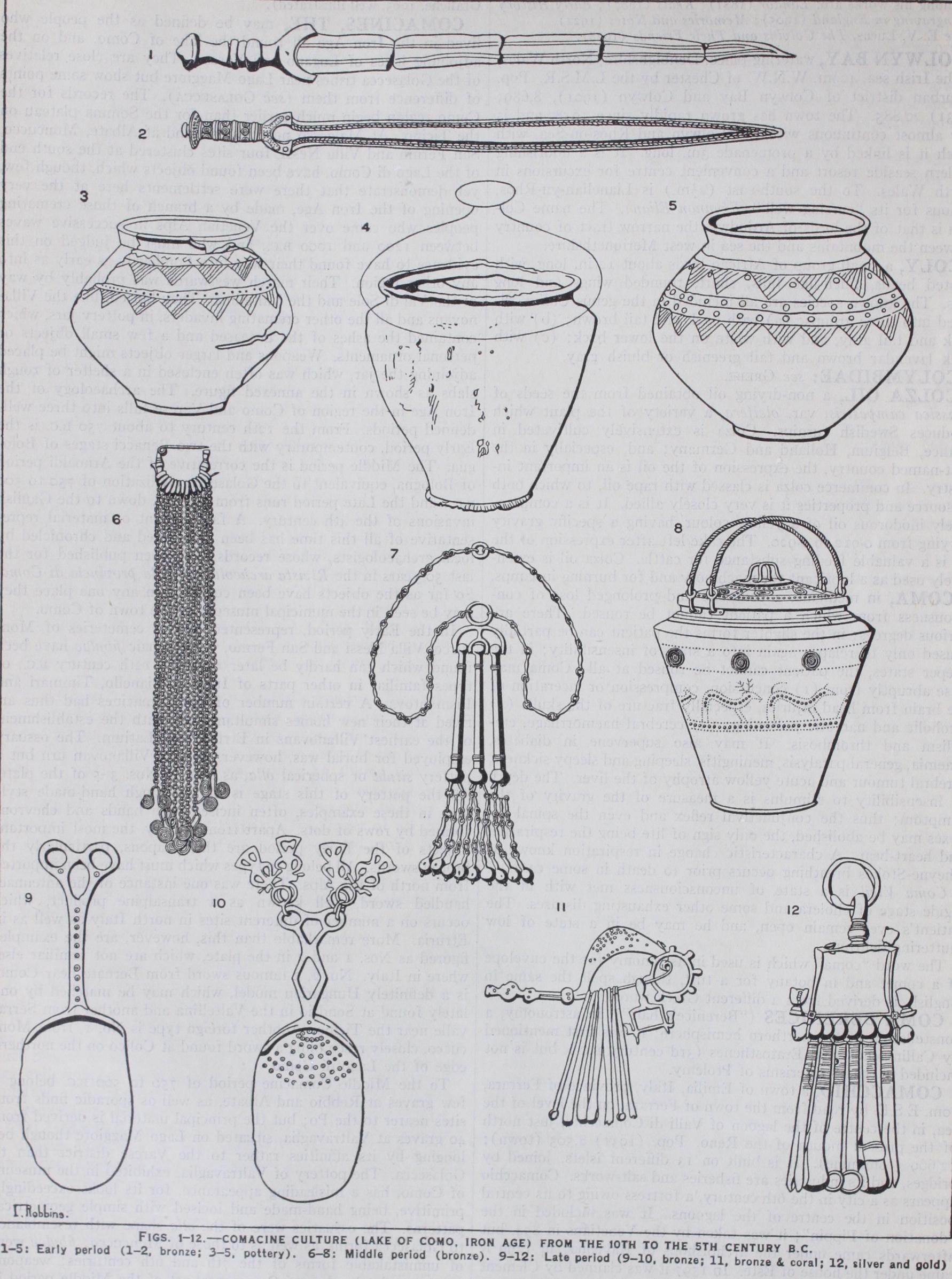
The Late Comacine period is considerably influenced by the Etruscans, whose products began to penetrate into the Lake region about soo B.c., before which time they were quite unknown there.
Bronze palettes such as those shown in Nos. 9 and o of the Plate are an Etruscan invention; they were used f or shifting the ashes and placing the incense on the sacrificial fire. A gaudy set of manicuring implements on a chatelaine of massive silver picked out with gold (No. 12) is of late Etruscan origin, and a complete series of Etruscan objects was found at Rondineto. Many of the fibulae, however, are dif ferent from the Etruscan and the Bolognese, belonging to types peculiarly characteristic of the Lake region, many of which are found also in the Italian-speaking Swiss canton of Ticino. No. it is a good example of a very popular form.
Closely connected with the Comacine civilization is that of the Canton Ticino as seen in a group of cemeteries clustering about Bellinzona. The burial-rite is inhumation, which has led some authors to regard these people as Ligurian colonists from the west ern plain of the Po. They exploited their geographical position at the opening of the principal pass then in use, which was not the St. Gotthard but the Val di Mesocco, to become the porters and carriers of a transport service between northern Italy and the head-waters of the Rhine. Through their mediation Etruscan, Greek, Bolognese and Venetian products found their way to Switzerland, western Germany, France, Belgium and even Eng land. Being of a peaceful disposition, these Ligurians possessed no weapons, but they were well provided with ornaments and other objects showing a high standard of luxury. Many of these were obtained from their clients on either side of the Alps, but a cer tain number were produced locally. In particular the Ticinese developed a primitive but independent style of metal-work, shown at its best in their bronze girdles. These barbaric objects contrast curiously with the sophisticated bronze vessels of Campanian workmanship found in the same graves. The Bellinzona cemeteries begin about 600 B.C. and continue down to the Roman empire. It is to be observed that the Early La Tene (q.v.) period 5oo to 3oo B.C. is free of all Gaulish influence, but the middle La Tene which succeeds this is entirely Gaulish in character.
D. Randall-MacIver, The Iron Age in Italy, gives the few original authorities. (D. R.-M.)