
CYNOSCEPHALAE, BATTLE OF (197 B.e.). Once the Hannibalic War (see PUNIC WARS) was concluded Roman ex pansion began. Expansion eastwards soon brought the Republic into contact with the fragments of the Alexandrian Empire, and between the years 200 and 197 B.C. the Second Macedonian War took place culminating in the decisive victory of Quinctius Flamininus, the Roman Consul, over Philip, King of Macedon, at Cynoscephalae in Thessaly. Both armies numbered about 26,000 men, the Macedonian being organized in a phalanx of two divisions of 8,000 men each, about 7,000 light troops and 2,000 horse. Flamininus had the same number of heavy foot, but was consider ably the stronger in cavalry as the Aetolian horsemen had joined him ; he also possessed a force of war elephants.
When the king arrived at Larissa he learnt that Flamininus was approaching Pherae, and immediately pushed forward to that place. Finding the ground there "thickly wooded and full of walls and gardens and consequently unsuited to the movements of his phalanx" he fell back to Scotussa, a corn-growing district which offered him not only moderately level ground but ample supplies and forage. Learning of his withdrawal, Flamininus followed him, and quite unknown to each other both armies encamped on the opposite sides of a low range of hills called from their appearance Cynoscephalae, or "the Dogs'-heads." The next day both generals sent out reconnoitring parties to occupy the ridge ; a dense fog cov ered the ground; in it the two forces of light infantry met unex pectedly, and the Romans being the weaker were driven back, then being reinforced they advanced, were once again heavily attacked by the Macedonians who would have cut them up had not they been held back by the Aetolian cavalry.
Flamininus now, the fog having cleared, drew out his legions. Ordering his right wing to remain where it was with the elephants in front of it, he advanced at the head of the left wing covered on its left by light troops, to support his advanced guard. Philip was a sound but weak general. At first he had no intention of entangling his columns in the hilly ground, but finally was per suaded by his subordinates to advance. Placing himself at the head of the right division of the phalanx he was soon compelled to form it into a heavy column in order to cross the broken ground. Meanwhile Nicanor who was in command of the left division of the phalanx was instructed to follow the right division as soon as possible. This over-haste to support the Macedonian advanced guard resulted in Philip's army being beaten in detail.
On approaching Flamininus, Philip threw out his light infantry on his right flank and sounded the charge. The sarissas (pikes) were lowered, and the Roman left wing driven down the hill. Flamininus, seeing that it was not possible to prevent his men falling back, and perceiving that the Macedonian wings were separated, Nicanor being still a considerable distance in rear, gal loped over to his right wing and ordered it to advance against the Macedonian left, which caught in column of march was thrown into confusion by the elephants, and at once broke and fled, being pursued by the Roman right wing. One of the tribunes, a man of quick tactical insight, seeing that the Roman left was hard pressed, broke away from the pursuit and wheeling round some 20 maniples moved rapidly towards the Macedonian right wing, and charged it in rear. The nature of the phalanx being such that it was most difficult for the men to face round singly and defend themselves, confusion at once resulted. Under cover of this con fusion the Roman left wing reformed its ranks and attacked the Macedonians in front. This dual attack in rear and front proved decisive. Philip left the field with a small party of men, his right wing was cut to pieces, his losses being 8,000 killed and S,000 prisoners ; the Romans lost 700.
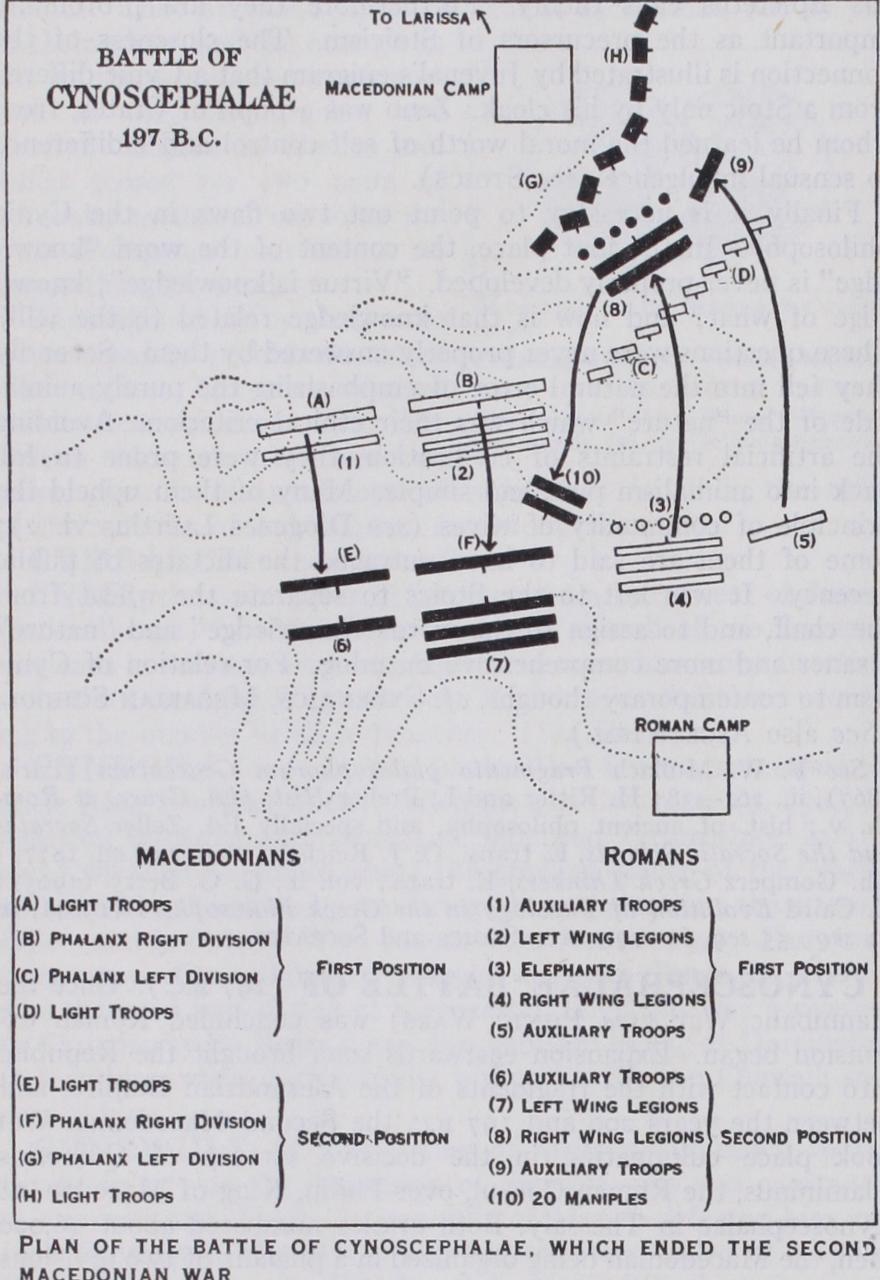
Tactically the battle of Cynoscephalae is an interesting one. Both armies attacked and were attacked in detail. In the actual charge the sarissa proved once again all-powerful, but the legionary organization being the more flexible enabled a clear-sighted sub ordinate quickly to break off a small party of men and manoeuvre towards the decisive point—the rear of the victorious Macedonian right. See also ROME: History.
BIBLIOGRAPHY.-Polybius xviii. ; Livy xxxiii. ; T. Mommsen, History Bibliography.-Polybius xviii. ; Livy xxxiii. ; T. Mommsen, History of Rome, Book iii., viii.; T A. Dodge, Great Captains, Hannibal H. chap. xlv. ; H. G. Liddell, History of Rome, ii., xxxix. ; Kromayer Veith, Schlachten--Atlas Zur Antiken Kriegsgeschichte, part ii.